Bharatpur, September 23
Kalpana Bote lives in a small thatched house on the edge of Chitwan National Park. Forest surrounds her home, and her family’s life remains closely connected to it. But the same forest that sustains them has also become a source of fear and pain.
Inside her house, children still cry as Kalpana goes about her daily chores. She has no one to help her. Her greatest pain is the memory of her mother-in-law, Umadevi Bote. The memory becomes even more painful when the children cry.
In 2022, Umadevi was attacked by a tiger while she had gone near the forest to collect grass and fiddlehead ferns. She died at the scene. The family received Rs 1 million in relief within 20 days. The money helped ease the immediate financial burden, but it could not bring Umadevi back or end the family’s dependence on the forest.
Kalpana’s family still needs to enter the forest for grass, firewood, fiddlehead ferns and other forest products.
Her story is shared by many families living around Chitwan National Park and its buffer zone.
Conservation success, growing challenge
The number of tigers in and around Chitwan National Park has reached 145. According to the National Tiger Survey 2025, Nepal has 429 tigers, an increase of 74 in four years.
The growth in tiger numbers represents a major achievement in conservation. But alongside that success, human-tiger conflict has emerged as a growing challenge. Ten people were killed in tiger attacks across Nepal in the last fiscal year.
Tigers are increasingly being seen not only inside national parks and buffer zones but also near and inside settlements, increasing fear among locals.
A recent incident in Meghauli, Bharatpur-28, illustrates the risk. On August 9, 65-year-old Mangle Bote was attacked by a tiger in the Rapti Hariyali and Bethari Buffer Zone Community Forest. He had gone for a morning walk at around 8 am and disappeared after the attack. His body was found at 4:20 pm following a search by the national park, Nepal Army, police and residents.
A few days later, a tiger attacked 60-year-old Thakur Adhikari in Dipat settlement of Rapti Municipality-1. Adhikari was injured in the thigh. The same tiger also attacked a cow tied in the shed of resident Dilakumari Tamang.
Since the beginning of the current fiscal year, tigers have entered settlements and attacked people and domestic animals in Chitwan. One person was killed and another injured in August alone.
When the forest is both livelihood and risk
The risk of human-tiger conflict is not the same for all communities. Those directly dependent on national parks and buffer zones face greater exposure.
For poorer families, the forest is not simply a source of employment but a means of meeting daily needs. Collecting grass, firewood, fiddlehead ferns and other forest products requires them to enter the forest, turning their dependence into a potential risk.
Wildlife expert Baburam Lamichhane says not all tigers pose a threat to settlements. Some old, injured or physically weak tigers that struggle to hunt in the forest may move towards settlements in search of easier prey, including domestic animals, and can also attack people.
He says the number of problem tigers is small compared with the total tiger population. However, failure to identify and manage them in time can increase losses of human lives and livestock and fuel resentment towards tiger conservation.
Chitwan National Park has recently captured some tigers that entered settlements and posed risks. On June 23, an incapacitated tiger that had entered Lakshmaniya village in Madi Municipality-1 and killed livestock was captured.
A study conducted in Chitwan identified 22 problem tigers between 2007 and 2016. Of them, 13 had killed people, six had repeatedly killed livestock and three were considered a risk to human safety.
Research covering human-tiger conflict in Chitwan National Park and its buffer zone from 2007 to 2014 also found that conflict was influenced not only by tiger behaviour but also by human entry into forests, dependence on forests, the location of settlements and forests, and the time and place of encounters.
Seven holding cages and a new proposal
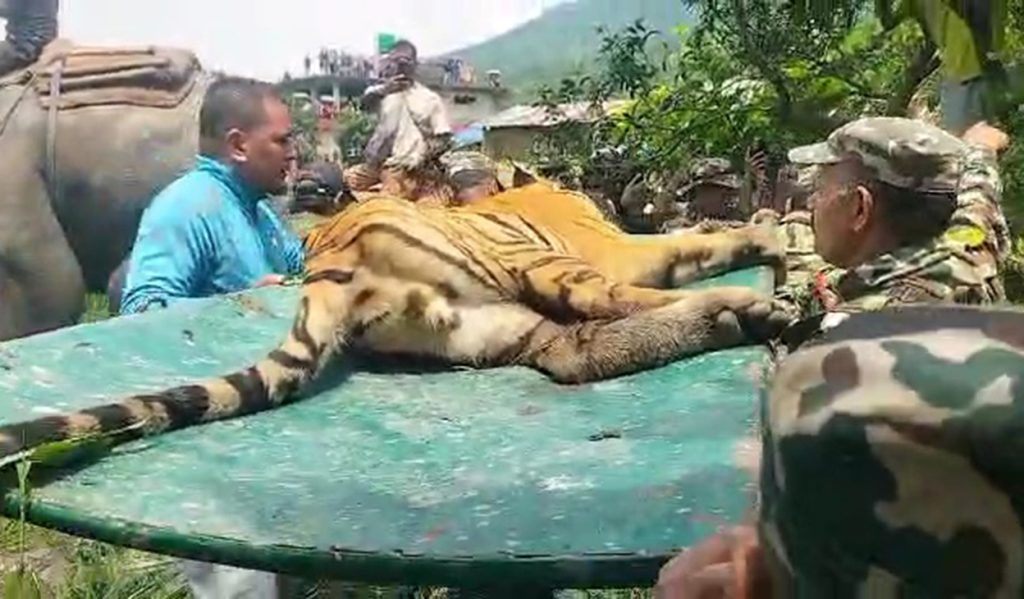
Chitwan National Park has seven holding cages in different areas for tigers that enter settlements or become problematic. But with tiger numbers and activity increasing, these facilities are considered insufficient.
According to park information officer Abinash Thapa Magar, weak, injured or old tigers, as well as tigresses raising cubs, may sometimes leave the forest in search of food and security.
The park is now considering a “tiger sanctuary” concept for problem tigers, with the aim of keeping them in a managed setting that provides as natural a habitat as possible.
Thapa Magar says the plan would combine natural habitat management with conservation of tiger prey species. The park is also preparing to increase funding for programmes ranging from improving holding cages to managing prey species.
For communities such as Kalpana’s, however, the challenge goes beyond compensation after an attack. Their dependence on the forest remains unchanged.
According to data from the National Trust for Nature Conservation, 10 people were killed by tiger attacks across Nepal in the fiscal year 2025/26—four in Banke, three in Parsa, two in Bardiya and one in Chitwan. Over the past eight years, 85 people have died in tiger attacks.
The growing tiger population marks a conservation success, but for families living alongside forests, that success also depends on whether both tigers and the people whose lives are tied to the forest can remain safe.