Kathmandu, November 1
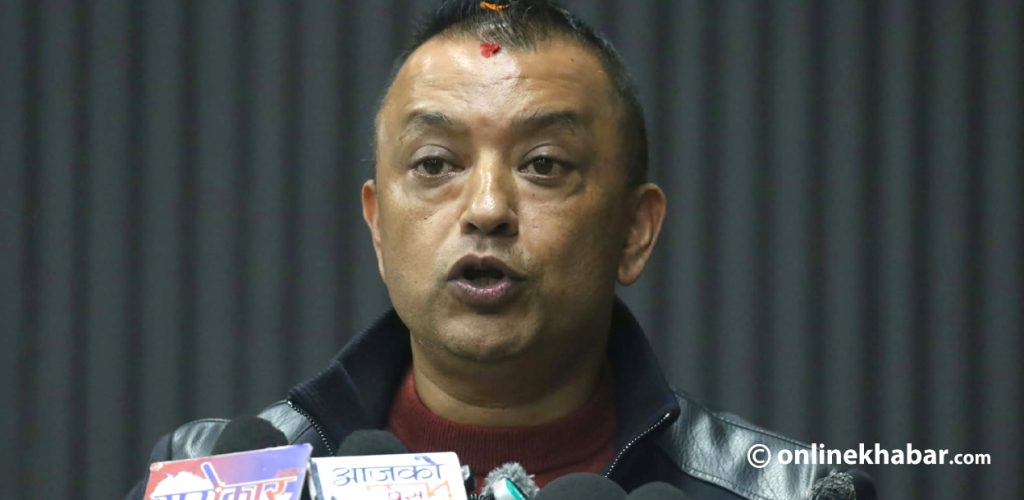
Nepali Congress president Gagan Thapa has raised concerns over what he described as the government’s increasingly arbitrary use of state power, accusing a small group of people in government of behaving as though they themselves were the state and their wishes amounted to law.
Speaking at a press conference at the party’s central office on Sunday, Thapa questioned the government’s recent actions, including police raids on media houses, the arrest of journalists and reports of further arrests being planned. He said the issue could not be considered resolved simply because some people had been arrested and subsequently released.
“Some of our colleagues were arrested and released, but this matter does not end there. It has not ended,” Thapa said. “The questions it raises are about how the government understands its authority and how it understands freedom of expression.”
He said recent police actions had raised serious questions about how the government exercises its power. Thapa suggested that police personnel had acted on instructions from those in authority and that media reports may have been used to identify people for arrest.
“The police went to the media on the orders of those above them,” he said. “In some places, colleagues may have looked at newspaper reports and been told to pick them up.”
Thapa also suggested that another issue may have been brought into public discussion to divert attention after criticism of the arrests began.
Describing the broader pattern as a matter of concern, he said a small group appeared to be treating itself as the state and exercising power without restraint.
“Some small group of people have started saying, ‘We are the state’,” he said. “There is arbitrary use of power. Those in government have begun to act as though their wishes are the law. This tendency has gone too far.”
Thapa said the Rastriya Swatantra Party (RSP), the ruling party, had issued a statement acknowledging that the incidents were wrong. However, he argued that a statement alone was not enough and that the government must be held accountable for its actions.
He recalled a previous incident on Ashar 29, 2083, when a vehicle was parked at the entrance of a media organisation. The RSP had issued a statement at the time, he said, but questioned whether any action had been taken against those responsible.
“The RSP issued a statement when the government did something. And that was it. There had been an instruction at the time. Was any action taken?” he asked.
“We do not want a statement from the RSP. We want results,” he said.
Thapa also called on the ruling party to take responsibility for the government’s actions, both good and bad. He said the RSP should not distance itself from controversial government decisions while claiming credit for its achievements.
Referring to the RSP’s criticism of previous governments led by the Nepali Congress, Thapa said the party had consistently argued that a ruling party must take responsibility for the actions of its government.
“When something went wrong under a Nepali Congress-led government, we would speak up. The RSP’s position then was that it was a Nepali Congress government, and because the government had done it, criticism from us was not enough — we had to take responsibility because we belonged to that party,” he said.
“Does that principle apply to you as well? Does it apply to the Nepali Congress and UML but not to the RSP?” he asked.
Thapa questioned whether the RSP expected the prime minister to answer for the government’s shortcomings while the party claimed credit for its successes.
“If the government does something good, the RSP takes the credit. If questions are raised about something the government does, is that then the prime minister’s responsibility alone?” he said. “The prime minister must answer for the government’s bad decisions, while the entire RSP takes credit for the good ones? Should the RSP not also take responsibility?”
He urged the ruling party to raise the issue through its parliamentary party and take it up directly with the prime minister, rather than limiting its response to public statements.
Thapa also questioned whether investigations into corruption scandals and other controversies would be conducted impartially under the current government. While saying the Nepali Congress would support investigations into all cases, he warned against what he described as selective investigations and the leaking of information to gauge public reaction.
“Scandals and controversies have come to light. Let all of them be investigated. We will support that. But our question is whether the investigations will be impartial,” he said. “There is selectivity. An investigation is under way, something is leaked, and then the public reaction is watched. How can that be impartial?”
He said the government must demonstrate that investigations were being conducted fairly and consistently, rather than allowing public pressure or political considerations to determine which cases received attention.
Thapa said the opposition would continue to question the government’s conduct in Parliament and called on the RSP to ensure that the concerns were conveyed to the prime minister through its parliamentary leadership.