Kathmandu, October 4
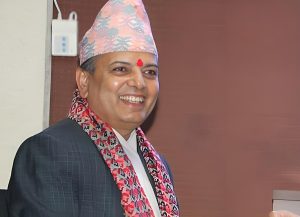
Standing before a large gathering at Khulamanch, Nepali Congress President Gagan Kumar Thapa used the historic public space to make a broader argument about the state of democracy in Nepal.
His message was that the country needs more places where people can question those in power, disagree openly and be heard.
Addressing the inaugural session of the Nepali Congress’ 15th General Convention on Sunday, Thapa said the decision to hold the convention at Khulamanch was not simply about choosing a venue. For him, the space represented the kind of openness he believes is missing from Nepal’s political life.
“Khulamanch does not mean that differences disappear. It is a place where differences can be brought together on a common platform,” he said.
Thapa recalled the political history associated with Khulamanch, noting that leaders including BP Koirala, Ganesh Man Singh and Girija Prasad Koirala had addressed people from the same space.
“Khulamanch has opened after 10 years. It is not merely a ground in Kathmandu,” he said. “Big political parties were built here, and smaller ones also emerged from here.”
But Thapa’s focus was less on the history of the venue and more on what he said Nepal needs now.
He argued that the country needs “open forums” not only in public spaces but also inside Parliament, political parties, communities and even on social media.
His first target was Parliament.
Thapa questioned the absence of Prime Minister Balendra Shah, saying Parliament could not truly be considered open if the prime minister was not present to face lawmakers and listen to their questions.
“Parliament is not open. Parliament is closed,” he said.
For Thapa, the issue was not simply the prime minister’s physical presence. He linked it to the dignity of Parliament and the relationship between the executive, lawmakers and the people.
He said the prime minister should be present for both the lawmakers who supported him and those who did not, as well as for the dignity of the parliamentary system and the people.
Thapa then extended the argument beyond Parliament.
He said political parties also needed spaces where members could question their leaders without fear of losing their membership.
“There should be an open forum within the party too. Party membership should not be cancelled simply because someone questions a leader,” he said.
He argued that the right to disagree, criticise and question leadership should become part of the internal culture of political parties.
For Thapa, this was not separate from the larger question of democracy.
“Democracy cannot be sought only outside. Political parties themselves must also have democratic structures and practices,” he said.
He also warned against treating Nepal’s current problems lightly.
Thapa said the country’s difficulties could not be solved simply by assuming that a new person in power would make everything disappear.
“Our problems cannot be taken lightly — nor can they be solved as if someone has arrived today and will make everything disappear with a magic wand,” he said.
He also pointed to the influence of international developments on Nepal, asking whether the country could remain insulated from global conflicts.
“Isn’t Nepal affected by the Russia-Ukraine war? Can Nepal remain unaffected by what is happening in the Middle East?” he asked.
Thapa said the challenges facing Nepal therefore needed to be understood in a wider context, rather than treated as problems that could be solved through quick political fixes.
He said the country needed open spaces from the hills to the Tarai, from physical public spaces to digital platforms, where citizens could raise questions and leaders could respond.
That, he suggested, was the larger message behind bringing the Congress convention back to Khulamanch after a decade.
The convention, he said, should not be treated merely as an event to choose party leaders. It should also be an opportunity for the party to reflect on what kind of political culture it wants to build.
“Parliament is closed, parties are closed, and that is why the country needs open forums,” Thapa said.