
Kathmandu, November 27
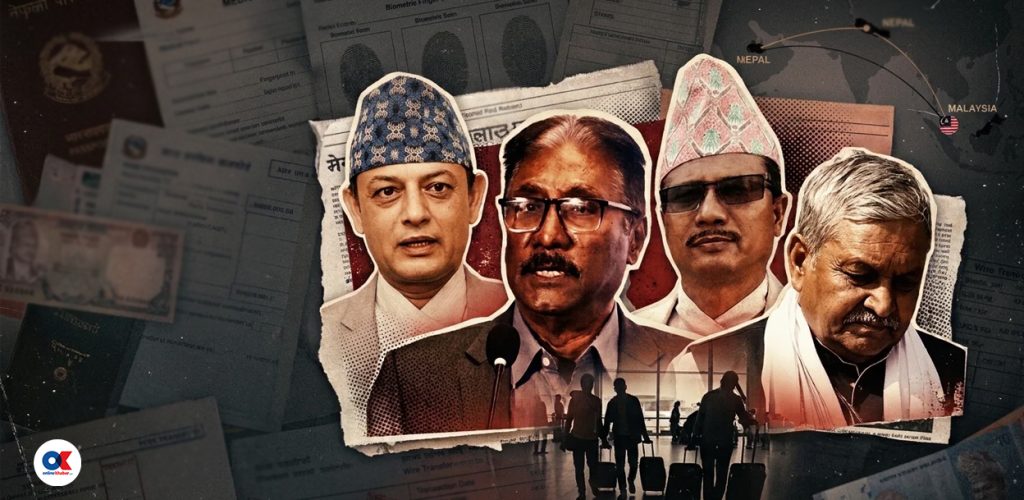
More than 750,000 Nepali workers heading to Malaysia were charged an unauthorised fee for medical examinations over four years, with approximately Rs 1.69 billion transferred to a Malaysian company, according to findings from an investigation into an alleged syndicate involving medical institutions, government officials and former labour ministers.
The money was collected from workers for a biomedical screening service that, under the Nepal-Malaysia labour agreement, was supposed to be paid for by Malaysian employers. Investigators say the fee was collected systematically through a network of 36 medical institutions in Kathmandu and transferred abroad through 17 transactions.
Former labour ministers Rameshwar Raya Yadav and Sher Bahadur Kunwar, who are currently in Central Investigation Bureau (CIB) custody, are among those accused of authorising the transfers. Investigators also say the money was transferred during the tenures of ministers DP Aryal and Sharat Singh Bhandari.
According to government records, Rs 1,69,02,24,026.76 in foreign currency was transferred to the Malaysian company Bestinet Sdn Bhd between February 2020 and May 2024, involving 750,988 workers. The transfers were made 17 times through Telegraphic Transfers (TT), following 16 applications, with recommendations from the Labour Ministry and approvals from Nepal Rastra Bank.
The investigation suggests that this was not an isolated case of overcharging but a system of financial exploitation sustained for years, despite provisions in the bilateral labour agreement requiring Malaysian employers to bear the costs.
The agreement between Nepal and Malaysia, signed on October 29, 2018, clearly stipulates that employers must cover workers’ recruitment-related costs, including medical examinations. If workers pay such expenses in Nepal, they are entitled to reimbursement with their first month’s salary.
Yet, instead of reimbursing workers, money was collected from them and transferred to Malaysia.
According to the CIB, officials from the Malaysian Embassy in Kathmandu, labour ministry secretaries and officials, ministers and Nepal Rastra Bank personnel may have been involved in facilitating the transfers. Investigators also suspect misuse of diplomatic privileges.
Those arrested are being investigated under the Fraud and Criminal Offences Act, 2013, and the Organised Crime Prevention Act, 2013. No court has yet convicted any of the accused.
The agreement placed the cost on employers
The labour agreement signed between Nepal and Malaysia on October 29, 2018, during the tenure of then-labour minister Gokarna Bista, established a zero-cost recruitment arrangement for Nepali workers.
Clause 7(g) of Appendix B of the agreement states that Malaysian employers must bear the cost of medical examinations conducted in Nepal. If workers pay for the examinations themselves, the employers are required to reimburse the amount along with the first month’s salary.
The first Joint Working Group (JWG) meeting held on the same day also approved an estimated recruitment-cost table under Annex 5. The table listed 100 Malaysian ringgit for the biomedical system and 260 ringgit for medical examinations under the employer’s column, while the worker’s column was left blank.
A public notice issued by the Malaysian Embassy on March 7, 2022, also stated that the cost of the Biomedical Screening System (BMS) was the responsibility of employers.
However, workers were reportedly charged Rs 6,500 for medical examinations and an additional 100 ringgit, equivalent to Rs 3,164 at the time, for the biomedical service. The additional fee consisted of Rs 2,800 in service charges and Rs 364 in VAT.
Workers had little choice but to pay, as they were required to undergo examinations at the medical institutions included in the designated network.
The monitoring team found no documentary evidence that Malaysian employers had paid the biomedical fee or that workers had received reimbursements through their first month’s salary.
How the 36-institution syndicate was established
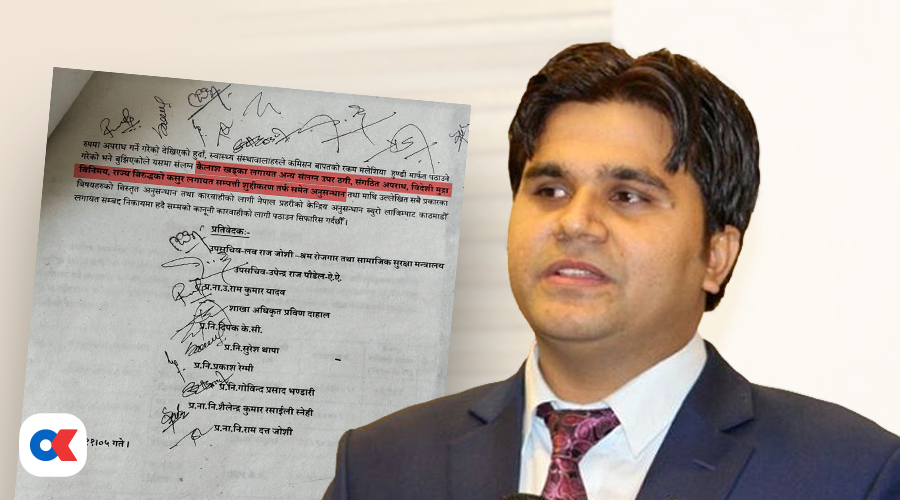
Investigators have identified Ramechhap native Kailash Khadka as a central figure in the alleged network.
Before 2013, workers heading to Malaysia could undergo medical examinations at any of the 205 government-approved medical institutions. The government had not designated a fixed network for medical examinations for Malaysia-bound workers.
Khadka, who entered the business in 2013, allegedly used his position in the Nepal Health Business Association to establish a biometric screening arrangement with Bestinet, a Malaysian company.
On June 20, 2013, Khadka reportedly signed an understanding with Bestinet’s chief executive on operating a biometric system. According to a government monitoring report, Pravin Tiwari was the association’s president and Khadka its senior vice-president at the time.
Sources familiar with the matter say Khadka travelled to Malaysia himself to arrange the agreement with Bestinet.
The arrangement gained momentum after Tek Bahadur Gurung became labour minister on January 22, 2014.
Following a report from the International Relations and Labour Committee of the Legislature-Parliament, the Labour Ministry decided on July 6, 2015, to introduce biometric screening for workers heading to Malaysia. The ministry secretary prepared the decision the following day, and it was approved at the state ministerial level on July 7.
On July 9, the ministry wrote to the same association, granting permission for biometric examinations for a maximum of six months, with a condition that the arrangement could be cancelled if it went against workers’ interests.
The arrangement, initially authorised for a limited period and under the promise of facilitating free services, continued for years, while fees were allegedly collected from workers.
Bestinet sought applications from medical institutions to operate biometric screening, and 39 institutions were initially selected. Khadka allegedly collected commissions from the institutions and removed three that did not pay the requested amounts, reducing the network to 36.
Malaysia also maintained that the same 36 institutions had been operating since 2015.
On May 16, 2018, then-labour minister Gokarna Bista directed authorities to take action against those collecting unauthorised fees and wrote to the Home Ministry.
The letter was forwarded through Nepal Police Headquarters to the Kathmandu District Police Office, which arrested around 40 people, including Ram Shrestha. Khadka, however, remained at large.
Those arrested were later acquitted by the court, reportedly on the grounds that the six-month authorisation had not been revoked and the syndicate arrangement was not considered fraud. The ruling became controversial, and the judge involved was subsequently brought before the Judicial Council.
Bista, insisting that Malaysia-bound workers should not be sent until the financial burden imposed on them was removed, suspended recruitment to Malaysia on the same day.
Recruitment remained suspended for nearly two years before resuming following a bilateral agreement. However, workers continued to go through the same screening arrangements.
MacroTech and the Malaysian Embassy’s fee letter
Despite the zero-cost recruitment agreement, the alleged network continued operating. According to the CIB, Khadka brought Mukund Bhattarai and Shaligram Chhetri into the arrangement and established MacroTech Pvt Ltd on February 18, 2019.
The company, registered under number 208897/075/076, is based in Nabil Galli, Maharajgunj. On April 1, 2019, MacroTech signed an agreement with Bestinet to provide Business Process and IT Help Desk services under the Biomedical Module of the Foreign Workers Centralised Management System (FWCMS), presenting itself as Bestinet’s Nepali partner.
Documents submitted to the government reportedly bear Khadka’s signature as the company’s chairman.
The fee collection arrangement was further formalised through a letter from the Malaysian Embassy. On June 17, 2019, then acting ambassador Ahmad Fadil Ismail wrote to MacroTech director Mukund Bhattarai, rather than the Nepal government, setting the BMS fee at Rs 3,164 with immediate effect and directing its implementation at 37 medical institutions.
The fee, fixed in Nepali currency and including Nepal’s VAT, became the basis for the collection system, according to investigators.
Investigators suspect the letter was prepared at the embassy’s initiative to facilitate the medical screening, collection of fees and transfer of money abroad.
During the second Joint Working Group meeting held on September 10–11, 2019, Malaysia insisted that the 36 institutions operating since 2015 were sufficient and should continue providing services, effectively limiting competition.
The monitoring team found that workers had to wait for extended periods at hotels because of the restricted network of medical institutions.
The institutions reportedly issued VAT bills in MacroTech’s name without authorisation, collected Rs 3,164 from each worker and deposited the money into MacroTech’s Sunrise Bank account.
According to Mukund Bhattarai, MacroTech retained 10 ringgit from the 100 ringgit collected per worker and transferred the remaining 90 ringgit to Bestinet.
How the money was transferred abroad
Foreign currency transfers from Nepal require approval from Nepal Rastra Bank, which generally authorises transactions after the concerned ministry recommends that the funds are legitimate.
In this case, investigators say the same process was repeated for each transfer.
MacroTech submitted applications for the payments, including at least one application filed by Khadka himself. The Malaysian Embassy then wrote to Nepal Rastra Bank, providing the number of workers who had undergone examinations and requesting facilitation of payments.
The Labour Ministry recommended the transfers through ministerial decisions, after which the Foreign Exchange Management Department of Nepal Rastra Bank approved them.
The money was then transferred through TT from Laxmi Sunrise Bank account number 0020584772070001 to Bestinet’s account number 5684-7260-1892 at Malayan Banking Berhad in Malaysia.
According to the CIB, 16 applications were submitted to Nepal Rastra Bank, resulting in 17 transfers to Malaysia. Nepal Rastra Bank, in its response to the CIB, confirmed the transfers and said they covered medical examinations for 750,988 workers.
The transfers were recorded under the heading “Charge for Business Process and IT Help Desk/Tech Support: Biomedical Module (FWCMS).”
An investigation officer said Nepal Rastra Bank approved the transfers without adequately verifying the documents submitted to justify the transactions.
The CIB’s preliminary investigation also suggests that letters issued by the Malaysian Embassy may have exceeded diplomatic norms and that foreign currency was transferred through misleading information provided to government agencies. The bureau says the authenticity of some of the embassy letters is yet to be established.
A monitoring report prepared in 2025 also questioned the legal basis for a foreign embassy setting fees in Nepal and requesting the central bank to facilitate payments to a private company.
If all 750,988 workers had paid the full Rs 3,164 fee, the total collection would have amounted to approximately Rs 2.376 billion. Of that, around Rs 1.69 billion was transferred to Malaysia, equivalent to approximately Rs 2,250 per worker, or the 90 ringgit transferred after deductions.
Investigators suspect the remaining amount may have been retained as MacroTech’s commission and used to cover taxes and VAT.
Transfers during four ministers’ tenures
According to CIB spokesperson SSP Anupamshamsher Rana, the transfers of money collected unlawfully from workers began in 2019, during the tenure of then-labour minister Rameshwar Raya Yadav.
An investigation officer said the first ministerial approval for transferring the money to Malaysia was issued on February 15, 2020. Subsequent ministry recommendations reportedly referred back to this decision.
During Yadav’s tenure, four transfers were made. On February 27, 2020, £693,000 was transferred, followed by £248,000 on March 24, £245,946 on June 1 and $213,658 on July 27.
The final transfer was linked to a letter from the Malaysian Embassy dated June 16, 2020, which reported that 11,828 workers had undergone examinations between February 13 and 29.
No transfers to Malaysia were recorded during the tenures of ministers Gaurishankar Chaudhary, Bimal Prasad Srivastava and Krishna Kumar Shrestha, a period during which recruitment declined amid the Covid-19 pandemic.
Meanwhile, on May 20, 2022, MacroTech director and shareholder Mukund Bhattarai submitted an application to the finance minister, seeking to freeze funds collected from medical examinations.
Bhattarai said around Rs 189.84 million collected from approximately 60,000 medical examinations had been deposited in Sunrise, Gairidhara, Mega, Kalanki and NCC banks. He said medical examinations continued despite a lack of new demand from Malaysia and alleged that his business partner Khadka was preparing to transfer the money abroad without his consent.
The funds were not frozen, and transfers resumed three months later.
During Sher Bahadur Kunwar’s tenure as labour minister, five transfers were made. On August 30, 2022, $135,375 was transferred, followed by $666,936 on September 27, $735,803 on November 10, £780,989 on December 2 and £1.749 million on December 26.
The final transfer was made on the last day of Kunwar’s tenure as labour minister, the same day the Deuba-led government was replaced by one led by Pushpa Kamal Dahal.
An investigation officer said the transfer was rushed through on the final day because the incoming minister might have discovered the arrangement and stopped the money from being sent abroad.
According to the CIB, both Yadav and Kunwar issued ministerial decisions on two occasions each to authorise transfers.
After Kunwar, DP Aryal became labour minister on January 17, 2023. Just two days later, on January 19, $900,257 was transferred to Malaysia. The letter reportedly cited Kunwar’s earlier ministerial decision as the basis for the transfer. Aryal remained in office for only 22 days.
During Sharat Singh Bhandari’s tenure, five more transfers were made, according to the CIB. On February 27, 2023, $1.701 million was transferred, followed by $1.501 million on April 24, $788,084 on July 18, $552,215 on October 18 and $484,544 on January 23, 2024.
CIB officials say Bhandari did not issue separate decisions for each transfer but continued sending money based on the decisions made by previous ministers.
Aryal, who returned to the labour ministry for a second term from March 7 to July 15, 2024, oversaw two further transfers.
On May 7, 2024, $654,390 was transferred, followed by $36,599 on May 22.
The final transfer was linked to examinations conducted for 2,239 workers in April 2024. MacroTech’s application calculated the payment at 90 ringgit per worker, totalling 201,510 ringgit, with 15 percent deducted in taxes, leaving 171,283.50 ringgit.
The embassy wrote to Nepal Rastra Bank on the same day, confirming the number of workers and informing it that Malaysia had stopped recruiting workers from May 2024.
CIB officials say all three transfers during Aryal’s tenure were made based on decisions issued by previous labour ministers.
Khadka linked to four medical institutions
The monitoring team has compiled a list of all 36 medical institutions, including the names and phone numbers of their operators.
Khadka is listed as the operator of four institutions — Anmol Medical Centre and Prashanti Health Care in Sinamangal, Dynasty Medical Centre in Chabahil and Himalayan Diagnostic Clinic in Koteshwar. All four institutions reportedly share the same contact number.
The four institutions conducted a combined 136,316 X-ray examinations, according to the monitoring team’s records. Anmol conducted 56,984, Prashanti 45,089, Dynasty 18,543 and Himalayan 15,700. Their combined figure accounts for approximately 15 percent of the nearly 910,000 X-ray examinations recorded across 34 institutions listed in the report.
The monitoring report has also raised questions about Khadka’s financial growth.
On June 24, 2016, Kailash Development Bank warned Wellcare Hospital and Research Centre, whose authorised representative was Khadka, that it would be blacklisted unless it repaid an outstanding loan of Rs 454,852.80 within five days.
The report now identifies Khadka as operating at least four institutions and accumulating property in various locations. It has recommended investigating assets held in the names of his relatives as well.
The report also states that Khadka, Dhan Bahadur Giri and Rabindra KC operate the Malaysian Visa Centre at the building housing Crystal Diagnostic Centre in Sinamangal.
While the Malaysian Embassy charges Rs 700 for visa services, complaints have been lodged that the centre charged workers Rs 7,700.
Bestinet also reportedly sold medical institutions fingerprint scanners, computers, webcams and FWCMS software for a total of $8,000, comprising $5,000 for the system, a refundable deposit of $2,000 and a service fee of $1,000. The report says the deposit has not been returned.
Irregularities beyond the biomedical fee

The Labour Ministry’s monitoring report found that workers were allegedly overcharged at multiple stages of the medical examination process, beyond the biomedical fee.
Although the prescribed medical examination fee was Rs 6,500, institutions were found to be charging Rs 9,500. Recruitment agencies reportedly sent workers directly for medical examinations without adequately explaining the process, sometimes arranging repeated examinations for the same worker while issuing only one bill.
Recruitment agencies were also found to be charging workers up to Rs 10,000 under the guise of service fees, despite the government’s free visa and free ticket policy.
The report found that some medical institutions issued reports without conducting all the prescribed tests, while others reportedly issued medical reports without conducting any examination at all. In some cases, reports were issued in the names of workers who had not even visited the institutions.
Institutions were also accused of reporting fewer examinations than they had actually conducted to evade taxes.
The monitoring team found that many institutions lacked the required personnel and proper records, including attendance registers for doctors, ECG, X-ray and laboratory records, and quality-control documents. Several institutions had not regularly submitted reports to the Department of Foreign Employment and the Labour Ministry, while some had conducted examinations without the required pre-approval or lot numbers.
The report listed 24 types of irregularities.
It also cited individual complaints. Sachin Chaudhary, a 22-year-old from Kapilvastu, filed a complaint with video evidence alleging that New SOS HR Manpower and Amitabh Buddha Medical Centre had overcharged him.
Similarly, Aniruddha Prasad Barai of Kapilvastu complained that South Asian Medical Centre in Dhumbarahi had issued an incorrect fit report, resulting in his return from Malaysia after being declared unfit there. He also alleged that the institution threatened him when he sought compensation.
Missing files and arrests

Following a growing number of complaints, the Labour Ministry formed a monitoring team on February 6, led by joint secretary Lovraj Joshi and including police officers.
The team inspected all 36 institutions and submitted its report on February 17. It recommended that the CIB investigate Khadka and others for suspected organised crime, fraud, foreign exchange offences and money laundering, alleging that commissions had been transferred to Malaysia through hundi transactions.
In August 2026, the CIB sought details of the foreign currency transfers from Nepal Rastra Bank.
As the CIB began investigating former ministers and other officials, the files related to the ministerial decisions authorising the transfers were reportedly found missing from the Labour Ministry.
“Decisions made by two ministers to send the money to Malaysia have not been found. There is suspicion that government documents may have been destroyed to conceal the crime,” an investigation officer said.
Two former labour ministers, Rameshwar Raya Yadav and Sher Bahadur Kunwar, are among 11 people currently in custody.
Former chief secretary and then-labour secretary Ek Narayan Aryal was arrested in India and brought to Kathmandu on Thursday. Former labour secretary Binod KC, former heads of the Employment Management Division Umesh Dhungana and Rajiv Pokhrel, and former legal officer Nirmala Gurung are also in custody.
The CIB had earlier arrested four individuals — Kailash Khadka, 42, of Kagashwari Manohara Municipality-1; Rabindra KC, 40, of Changunarayan Municipality-9; Pravin Tiwari, 42, of Gorkha Municipality-3; and Rampukar Tiwari, 45, of Malangwa Municipality-4.
The monitoring report identifies Rabindra KC as the operator of A Quality Health Care Diagnostic Centre and co-operator of the Malaysian Visa Centre. Rampukar Tiwari is identified as the operator of Amitabh Buddha Medical Centre.
All those arrested are being investigated under the Fraud and Organised Crime Prevention Act, 2013. No court has yet convicted any of the accused.