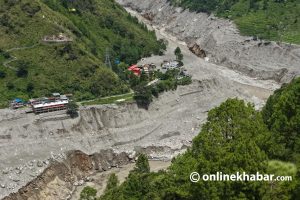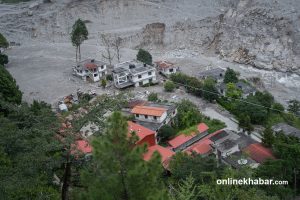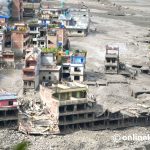


Nine-year-old Prabha (name changed) is a third-grader from Uttargaya Rural Municipality-5 in Rasuwa.
Before August 26, her days were ordinary. She went to school, played with her siblings and spent time with her family.
Her father worked at a nearby hydropower project. Her mother was a farmer. At home were her brother and sister. Then the flood came.
Since that day, Prabha has been unable to contact any of them. She is now alone.
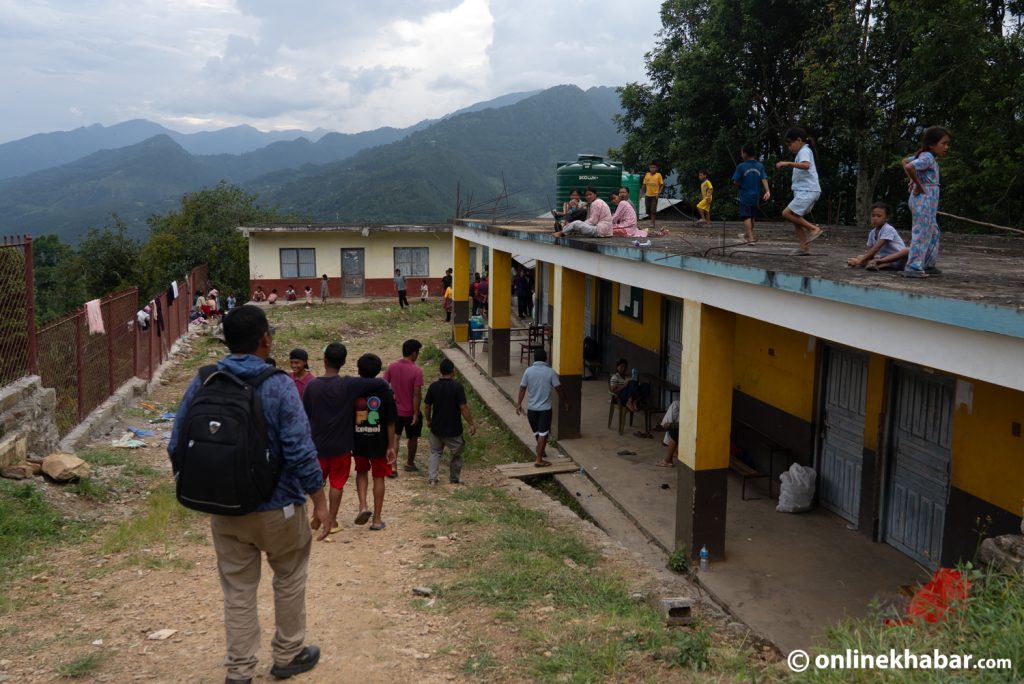
Ten-year-old Ganga (name changed), a fourth-grader from Pairebeshi, Rasuwa, knows something of what that uncertainty feels like. She had been on her way to school when the flood struck. When her teacher heard that floodwaters were coming, she took Ganga to higher ground.
Ganga survived, but she does not know whether her family did.
Her father, who worked at a hydropower project, has been out of contact since the flood. Her mother is unreachable. Her grandfather and grandmother are unaccounted for. So are her maternal uncle and brother.
“My grandfather, grandmother, mom, aunt, and brother were all at home,” Ganga says, crying. “Where could they be now?”
For children like Prabha and Ganga, surviving the flood was only the beginning of their ordeal. More than a week after the disaster, authorities still do not have an official figure for the number of children who have been separated from their parents or remain unable to contact them.
As of September 3, Madhav Lamichhane, principal of Nilkanta Secondary School in Uttargaya Rural Municipality-5, said 74 school students from his rural municipality had already lost their parents. Many students had also lost their shelter. But the wider picture remains unclear.
The respective districts are still working to compile data on children who have remained out of contact with their parents, according to Nepal Police spokesperson Deputy Inspector General (DIG) Abi Narayan Kafle.
“It could take some more time to get the exact figure of children who haven’t been able to contact their parents,” Kafle says.
The police, he adds, are currently occupied with relief, recovery, security, rescue, investigation and transportation.
A UNICEF report published on August 31 offers another indication of the scale. It estimates that at least 107 children may have been separated from their parents or caregivers.
The report estimates that another 22,100 children require urgent child protection support, including mental health and psychosocial support, family tracing and reunification, case management and referral services.
The numbers point to a problem that goes beyond finding missing family members.
When children are suddenly left without parents, caregivers, shelter or the protection of familiar adults, they can become vulnerable to trafficking, exploitation, abuse and child marriage.
Tilotam Poudel, president of the Children as Zone of Peace National Campaign (CZOP), says identifying these children must therefore be the government’s first priority.
“Nepal Child Rights Council should actively coordinate with the local level, prepare data, and take the necessary steps for their protection,” he says.
Poudel says Rasuwa’s history of human trafficking makes the situation particularly concerning.
“In times of crisis, particularly when children lack shelter and parental support, traffickers can easily take advantage and lure them,” he says.
CZOP, a child rights organisation, has also urged that children affected by the disaster receive priority attention, with safety, health, nutrition, protection and education treated as special priorities.
“During times like this, children can be at risk, including being vulnerable to trafficking and exploitation,” the organisation says, adding that child-friendly psychosocial counselling and support are essential to help children deal with fear, stress, anxiety and mental trauma.
For child protection workers, the concern is not simply what is happening to children today, but what could happen in the weeks ahead.
Narbada Soraili Magar, Protection Head at Anahat Nepal, an organisation working to prevent human trafficking, says previous disasters have shown how quickly children separated from their parents can become vulnerable.
“During the earthquake and Covid-19 pandemic, children who had lost their parents were found being transported from one place to another,” she says.
At the time, essential vehicles carrying vegetables, water and dairy products were allowed to travel, and children were found being transferred through such vehicles.
Magar fears similar risks could emerge as the immediate fear of the Rasuwa disaster begins to fade.
The presence of social activists in affected areas may decrease, while transportation is expected to resume. That combination, she says, could make it easier for vulnerable children to move without adequate monitoring.
Kathmandu could be a particularly important destination, she says, as many children may have relatives in the capital. Such movements have been seen after previous disasters.
Magar wants authorities to strengthen monitoring at checkpoints in Kathmandu.
“If there are any children, the authorities should ask who they are travelling with, what their destination is, and whether they have someone to receive them there,” she says.
“Children whose travel arrangements cannot be verified should be intercepted and handed over to their closest relatives, organisations, holding centres, or other trusted individuals.”
Nepal has seen the consequences of inadequate protection after disasters before.
Following the 2015 earthquake, children who had lost their parents became vulnerable to trafficking. In May 2015, authorities in India rescued more than 20 children from a human trafficking network targeting families who had lost their livelihoods in the earthquake.
UNICEF reported that at least 245 children were intercepted from being trafficked and unnecessarily or illegally placed in children’s care homes in the nearly two months after the first earthquake hit Nepal.
According to Children and Women in Social Service and Human Rights (CWISH), 104 children lost their parents in the 2015 earthquake.
The Anti-Human Trafficking Bureau (AHTB) of Nepal Police has continued to record child victims of trafficking. It recorded 163 trafficking cases in fiscal year 2022/23, with 81 children among the victims. In 2023/24, there were 170 cases involving 76 child victims. In 2024/25, 151 cases were recorded, with 80 children among the victims. In 2025/26, 214 cases were recorded, involving 85 child victims.
Magar says the lessons from previous disasters should prompt authorities to act before children begin moving out of affected areas.
She urges local governments in Kathmandu not to overlook children simply because they come from another municipality and calls for greater monitoring of vehicles entering the capital.
But trafficking is not the only danger.
Child protection experts also warn of the risks of child marriage, exploitation and abuse.
Anju Bhattarai, Urban Protection Coordinator at World Vision International Nepal, says the children affected by the floods are facing a major crisis.
“The current situation is a huge crisis for these affected children. If we cannot address this crisis immediately, it will have a long-term effect,” she says.
The challenge is made harder because the disaster has also affected the institutions expected to protect children.
Bhattarai says the child protection support system has become weak because local-level authorities themselves have been affected. At the same time, she says federal and provincial child protection systems have been significantly active.
The National Child Rights Council (NCRC) is conducting protection assessments.
For Bhattarai, protection also means giving children somewhere safe to be children.
She calls for child-friendly spaces where affected children can play and share their experiences, and says child protection should be mainstreamed throughout the disaster response.
She also stresses the importance of protecting children’s privacy.
“No photo, video, or anything that would reveal the identity of the affected children should be made public,” she says. “Before anyone takes their photo or video, they should obtain consent from the concerned people.”
Authorities say they are aware of the risks.
Rajan Limbu, Superintendent of Police and spokesperson of the AHTB, says police know that children who have lost or remained out of contact with their parents are particularly vulnerable to trafficking.
“Any family member or organisation taking care of children who are not in contact with their parents must inform the concerned authority whenever there is any kind of movement,” he says to Onlinekhabar.
“Since this is a critical time, and we are aware of the potential risk, we have been preparing ourselves accordingly,” Limbu adds.
The NCRC says it has also taken steps to mitigate the risk.
It has formed a committee to assess the condition of children and asked local governments to screen children to determine how many are with their parents and how many are not.
The council says the process of identifying and safely handing over children must be formal.
“We have strictly instructed the concerned authorities to hand over the children only after completing all the official procedures,” says Durga Prasad Chalise, member secretary of the NCRC. “The children should be handed over only through official channels.”
For Prabha and Ganga, however, the most immediate question remains unanswered.
They survived the flood.
They are still waiting to know what happened to the families they left behind.
Considering the privacy and safety of the children, their names have been changed.