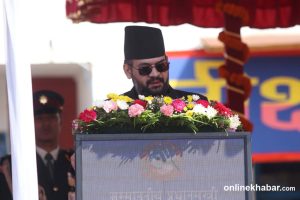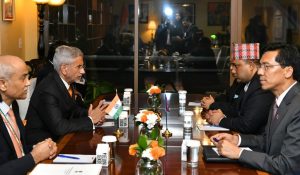

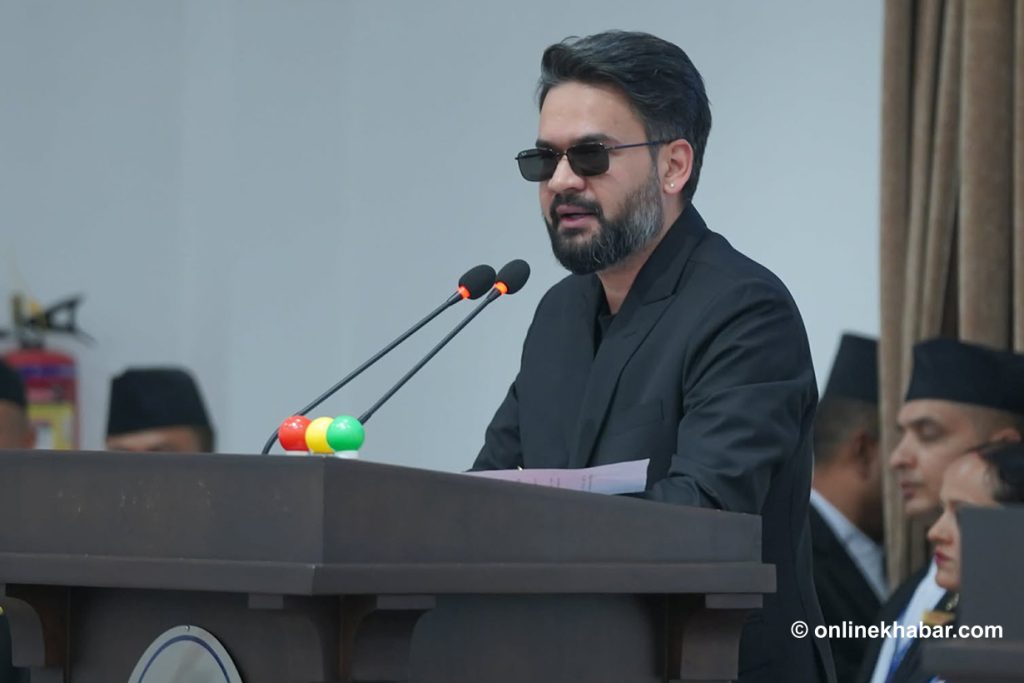
Nepal’s Prime Minister Balendra Shah (Balen) is set to speak at the 81st United Nations General Assembly (UNGA) on September 24, in the aftermath of the Bhotekoshi floods.
If Balen steps down from the UNGA podium having simply asked for aid, Nepal will remain what Nepal has always been: a tragic headline.
I propose the following national stance in Balen’s speech at the 81st UNGA.
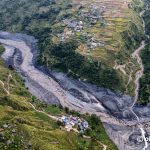
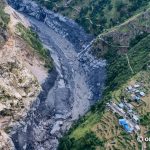
“Your Excellencies, my country Nepal experienced a mountain bedrock collapse followed by a ‘Himalayan Tsunami’ that claimed over 1,451 lives, with another 5,745 still missing, including approximately 600 foreigners from 35 countries. We did not cause the mountain bedrock to collapse, yet we are facing disproportionate consequences.
I am not here today to present a bill for our collective dead, and I am not here to ask for your pity. For far too long, vulnerable nations have been patient in dealing with transnational polycrises.
There is an ecological crisis underway in the Himalayas. The delicate Himalayan ecosystem is interconnected with livelihoods in both lower riparian and upper riparian regions, including the global economy.
I am here to tell you that Nepal is retiring the quiet and passive posture of waiting for action.
Nepalis have a long history of persevering in the face of extreme adversity. We come from the roof of the world, Sagarmatha (Mt. Everest), the land of the fierce Gurkhas, and the land of the Sherpa guides hauling mountaineers through death zones.
Starting today, Nepal is putting forward our mountains not as a hazard zone or merely a tourist attraction fading away from the ecological disaster currently underway. To the UN member states and global funds: we want to tell you that we do not want to pour temporary concrete that washes away with the next monsoon.
Today, we begin to take on a more challenging task. We call upon all UN member states to deal with the global ecological crisis at hand to ground our hopes for a greener and sustainable future.
To this end, Nepal is here to negotiate a global partnership for structural resilience against the crisis we collectively face.
We are opening a Special Himalayan Economic Zone that will feature a world-class disaster tech university along with an international legal and financial corridor. The goal will be to develop novel intellectual property in disaster tech, including alpine drone logistics, early-warning systems, and predictive terrain modelling to strengthen disaster response mechanisms.
The government of Nepal invites the UN member states and all global funds to co-endow and co-create the International University of Disaster Risk Reduction, Prevention, and Management (IUDRRPM), headquartered in the Himalayas in the Special Himalayan Economic Zone dedicated to disaster-resilient technology, public administration, environmental governance, and environmental diplomacy.
We will offer the world’s researchers frontline data and invite you to bring capital, research prowess and collaborative spirit to join us in taking definitive long-term measures for structural resilience against disaster scenarios.
Our promise is disaster technology designed in Nepal, manufactured and scaled in India & China, our neighbours with whom we share the common ecological and cultural heritage of the Himalayas.
We want to develop green, affordable and sustainable technology to export to every climate-vulnerable country on Earth, along with the most advanced search, rescue, and relief operations capacity. Nepal wants climate-vulnerable countries to be positioned to thrive rather than barely survive in the face of the crisis.
As a non-aligned state between two Asian giants, we want to offer a neutral institutional home for an International Court of Arbitration for Environmental Disputes, International Carbon Clearing-house/Exchange, and an International Innovation Hub for Sustainability.
Let us end the era of waiting for climate justice.
I call upon all UN member states to begin the era of building the tools necessary to deliver climate justice.
The Himalayas are calling, and this time for a different kind of adventure. The partnership to deliver climate justice is open, and the choice is yours to join us.”
The Prime Minister Balendra Shah can either deliver a conventional diplomatic eulogy. Or he can redefine Nepal’s identity and posture at the global stage.
Why? Strategic autonomy without structural capacity is a pipe dream. Nepal needs to retire the posture of passive “resilience” without structural capacity.
Thus, Balen must not read from the default diplomatic playbook at the UN General Assembly. The traditional plan to point to melting glaciers, showcase the dead and the debris, and present the bill for loss and damage as reparations fundamentally relies on the moral conscience of the very actors who have been strategically inactive in solving the root causes of the global polycrisis facing planet Earth, leaving vulnerable countries to borrow their way out of economic losses.
Nepal must proactively pivot to become a coalition-based structural power for the changes that it wants in the future. The sample speech above reimagines a new global identity of Nepal suited to this purpose.
The old international identity
Nepal is the land of tall mountains with extensive gorges. Historically, Gurkhas are renowned for their bravery and participation in various wars, fighting in the security forces of the UK, Hong Kong, India, and Singapore. Currently, Nepali soldiers are among the top contributors to UN peacekeeping forces. And the Sherpas of Nepal, or mountain guides, are experts at scaling the peaks of the world.
Economically, Nepal is in poverty (others call it poor). Nepal cannot provide employment or higher education to its young people in their own country, so the Nepalis migrate. The state institutions are in perpetual disarray, forever under construction, just like the infrastructure. Back-to-back natural and political crises every decade or so haven’t helped the state, but they have tested the identity of Nepalis as resilient people.
In brief, Nepal’s perceived international identity can be categorized into the following: the first is the territorial identity as the people of the mountains and second as the brave ones capable of being deployed in the most treacherous of conditions to fight, to labor and to do really the impossible.
Vision 2050 AD: Who are the Nepali people?
Imagine a historian in 2050 AD looking back at how Nepal responded to the 2026 crisis with developed structural capacity.
Nepali people are the most technologically advanced disaster experts in the world. They save lives the fastest when deployed in crises. They can reach the most treacherous of places with courage. And they apply themselves most thoughtfully. They are the humanitarian spirit and brain of the world, enabled by cutting-edge science, research, engineering and robust public policy.
Nepalis simultaneously manage search, rescue and relief operations in the most efficient manner. They are swift in saving people, getting food, shelter and medicine where it is needed the quickest and in ensuring minimum risks for the most vulnerable. They are experts not just in disaster technology but also in administration, management and risk reduction.
Essentially, Nepalis rejuvenated their state identity by honouring and building on their ecological and socio-cultural heritage.”
There has never been a more pressing moment to redefine Nepal’s identity and posture on the global stage. As the outgoing Secretary-General António Guterres said, one alternative to a networked multipolar world is a world with fragmentation and transactionalism rife with shrinking cooperation, rising tensions and deepening mistrust. This is a world Nepal cannot afford.
Can PM Balendra Shah rally the global community to break the ritual of vulnerable nations describing suffering and waiting until structural powers decide on a course of action?
PM Balendra Shah’s speech needs to deliver a powerful vision in New York, and his government needs to operationalise it in the coming decades.