
New York, September 25
As evening fell outside the United Nations headquarters on the banks of the East River along 42nd Street, the cold wind grew sharper.
Inside, however, the General Assembly Hall was the scene of heated debate, with heads of government and heads of state from around the world making their cases before the global community.
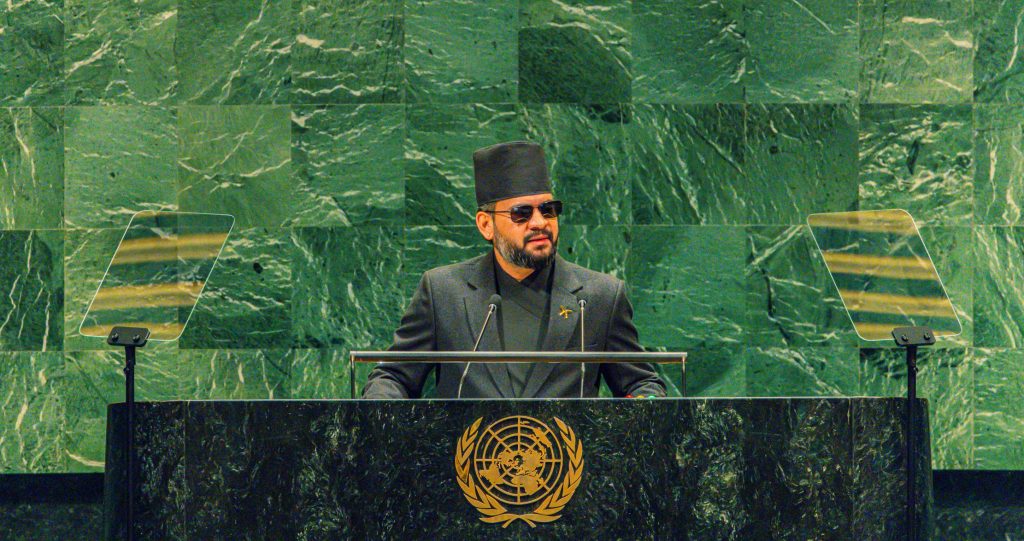
On Thursday afternoon, as Prime Minister Balen Shah travelled from the Hyatt Hotel at Grand Central to the UN headquarters to deliver his address, Nepalis gathered along the route chanting slogans in his support.
By the time evening set in, the number of participants inside the main chamber of the General Assembly Hall had begun to thin. But the Nepalis waiting in the balcony for Shah were still there.
For those attending in person and those following the prime minister’s address through various platforms, there was one common expectation — that Nepal, having just suffered the devastating impact of a Himalayan climate disaster, would make its voice heard on climate justice before the international community.
Onlinekhabar had reported the previous day that Shah was expected to raise the issue of the suffering faced by people in smaller countries due to climate disasters and wars imposed by powerful nations.
That is precisely what unfolded during Thursday’s special session of the General Assembly.
The applause and occasional cheers heard as Shah spoke suggested that many of those watching felt the prime minister had addressed the concerns they had come to hear.
Around 130 heads of state, heads of government and foreign ministers are scheduled to address the 81st session of the UN General Assembly. Among the heads of government and heads of state participating, Shah is the youngest by age.
He made a point of acknowledging that himself.
“I am the youngest head of government to address this Assembly this year. But I am not here to tell that story,” Shah said.
Shah’s participation in this year’s General Assembly was decided relatively late.
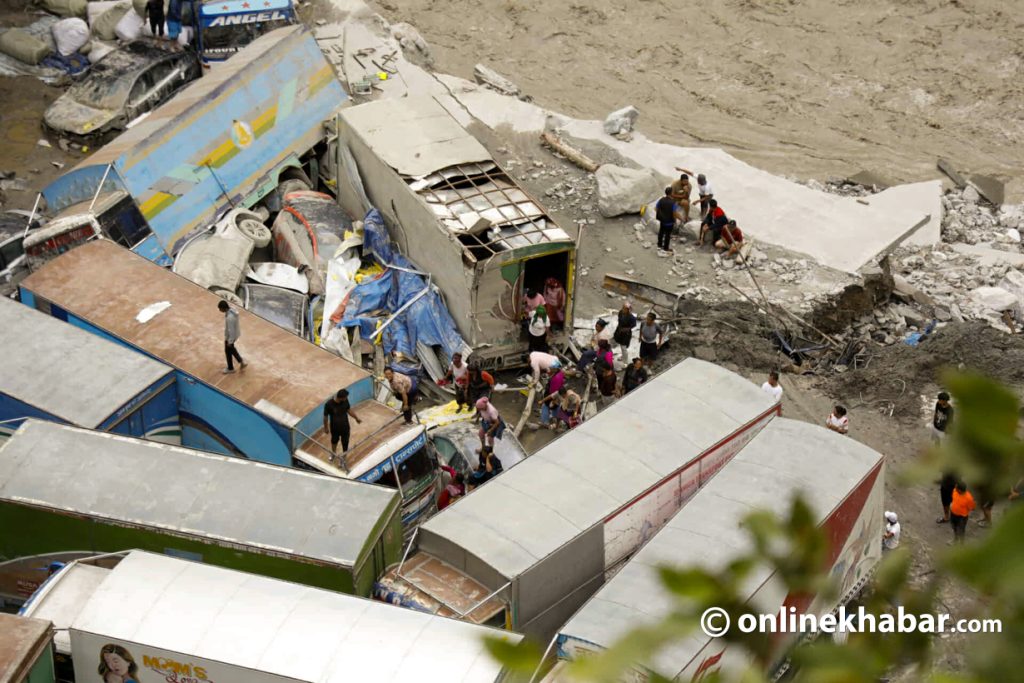
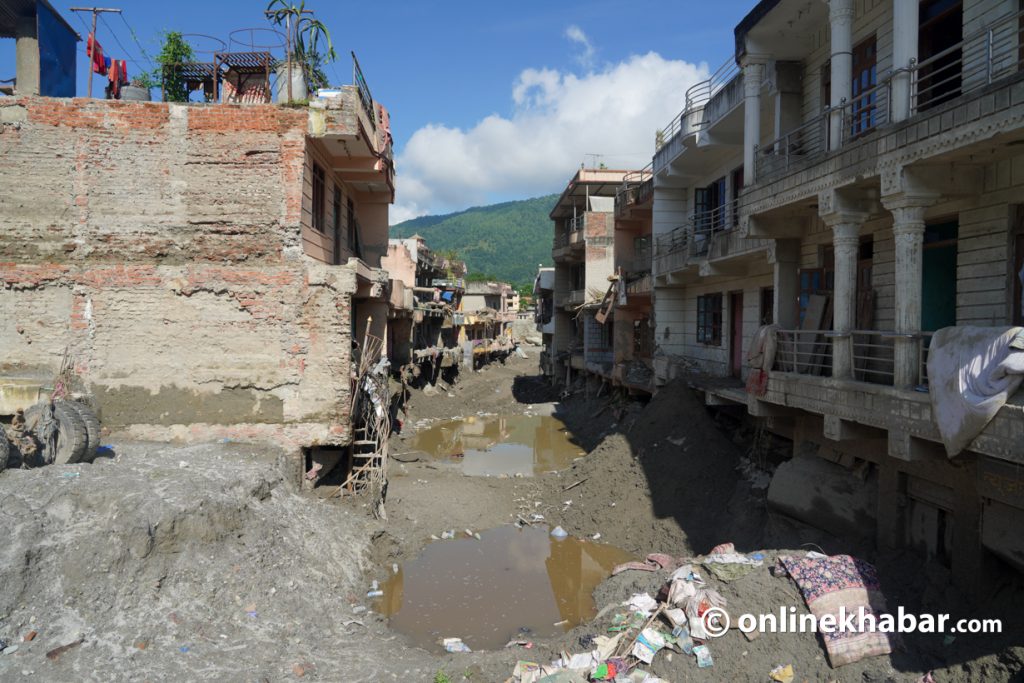
He travelled to New York after the devastating Bhotekoshi flood killed thousands of people and destroyed property worth trillions of rupees, with the aim of drawing greater international attention to Nepal’s situation.
At the UN, Shah spoke about what he presented as two distinct tragedies facing Nepal.
The first was a disaster caused by a climate that Nepal did little to heat. The second was the consequences of wars that Nepal itself did not wage.
He connected the two through a narrative that focused on the unequal burden borne by countries and communities with limited responsibility for the problems affecting them.
“A country that wants to pay [for climate change compensation] should be allowed to pay, and a world that can deliver weapons anywhere within 72 hours cannot leave farmers helpless simply to live a normal life,” Shah said.
He spoke emotionally about the devastation caused by the Bhote Koshi flood.
“I want to speak about those families who are waiting for their loved ones who will never return home, who are searching for their people beneath mud, rocks and water, whose bodies may never be found,” he said at the beginning of his address.
During the opening session of the General Assembly, UN Secretary-General António Guterres had recalled that nearly three years ago, while standing in the Everest region, he had warned that the roof of the world was collapsing, but that his warning had not received sufficient attention.
Shah echoed that message.
“We heard that warning in Nepal. Our communities heard it. Scientists around the world heard it. They kept repeating it with evidence. But we, the political leadership of the world, ignored it,” he said.
At times, Shah’s voice sounded slightly subdued. But his descriptions of the injustices Nepal has faced because of climate change did not lose their force.
While speaking out for Nepal, Shah did not portray another country as a criminal or single out any particular nation for blame.
Instead, he thanked those who had openly supported Nepal in its time of suffering.
Climate justice discussions often involve assigning responsibility to wealthy countries and large corporations. Shah took a different approach, calling instead for countries around the world to build a common campaign against climate change and to take seriously the warnings emerging from the Himalayas.
Nepal, he said, would require resources equivalent to 10 percent of its gross domestic product for physical reconstruction.
He called for the kind of solidarity and support Nepal received during the reconstruction following the 2015 earthquake.
“A poor country like Nepal, despite contributing negligibly to climate change, is being forced to take on significant debt to compensate for the damage,” Shah said.
“We are not here to blame any country or continent. We are not here to turn climate change into another geopolitical battleground. We are here to call on everyone to recommit to their responsibility and solidarity.”
Shah argued that “climate justice” should not remain merely a beautiful phrase in UN documents.
He particularly warned that the commitments made by the international community to mitigate climate change have not been fulfilled.
He also proposed the establishment of a Himalayan Climate Resilience Mechanism in the Hindu Kush Himalayan region, with Nepal, China and India taking the lead.
Shah then highlighted Nepal’s progress towards becoming a carbon-neutral country.
He pointed to the expansion of forest cover, hydropower as a source of clean energy and the increasing use of electric vehicles as areas where Nepal has made progress.
During his address, Shah also asked the United Nations to pay particular attention to six words beginning with the letter “R.”
“Relief.” “Rehabilitation.” “Reconstruction.” “Responsibility.” “Reparation.” “Resilience.”
The first three, he argued, are needed immediately after a disaster, while the remaining three are necessary for a lasting solution.
Several world leaders who spoke before Shah also referred to the climate devastation in Nepal.
UN Secretary-General Guterres spoke about it, as did General Assembly President Annalena Baerbock and Irish Prime Minister Micheál Martin, who spoke immediately before Shah.
Earlier, activists gathered outside the UN headquarters had also raised slogans demanding that Nepal receive climate justice immediately.
Not loans, but grants
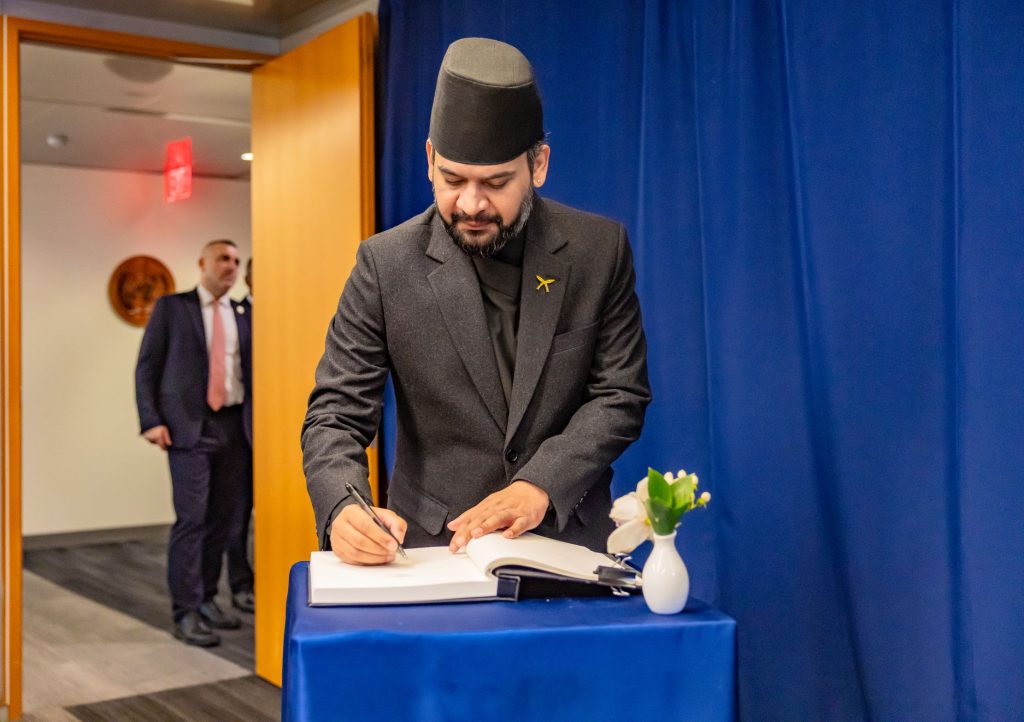
Shah said large loans or fragmented grants would not be enough to rebuild after climate-related losses and damage.
“We need sufficient grant-based support from the international community,” he said.
He argued, however, that existing mechanisms, including the Loss and Damage Fund, the Global Environment Facility and other relevant financial mechanisms, remain inadequate and that additional resources must be mobilised.
He also called for the process of accessing climate finance to be simplified.
The poor bear the cost when powerful nations go to war
Shah also turned his attention to the consequences of wars involving powerful nations, arguing that poor people once again bear the costs when the world shifts from peace to conflict.
“When poor farmers in Nepal tried to sow seeds in their fields this monsoon, they could not get fertiliser on time. When we tried to pave highways, we could not get bitumen. When families wanted to cook their evening meal, there was no cooking fuel,” he said.
He questioned the global supply chain in which weapons can cross borders and reach battlefields on time while fertiliser and food face obstacles.
“We have created a world where it is easy to supply the things needed for war but extremely difficult to supply food,” Shah said. “This is not Nepal’s misfortune alone.”
Shah concluded with a call for changes to the existing global order.
“Let us reform the current world order in which the weak are the most powerless,” he said.
Guterres’ affection for Nepal
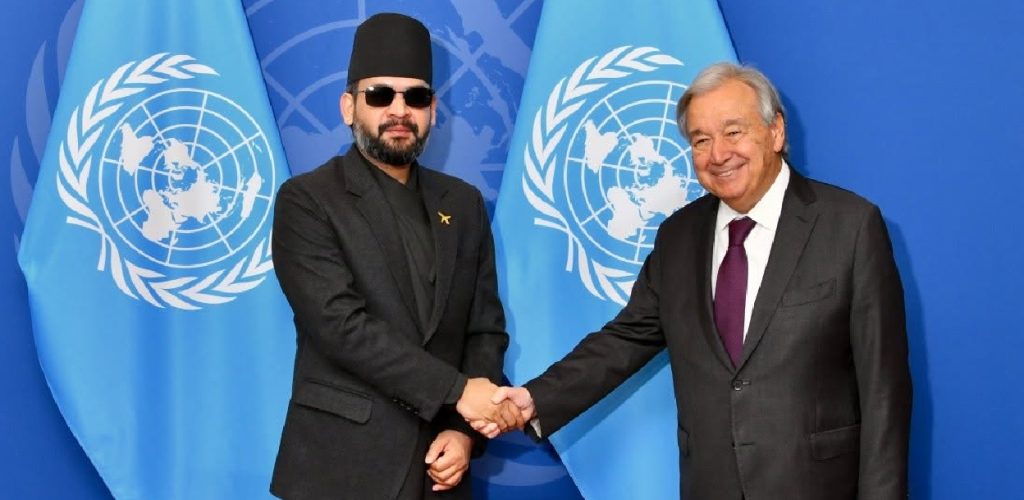
As UN Secretary-General António Guterres approaches the end of his tenure, he has continued to express strong affection for Nepal.
He displayed the same sentiment during his meeting with Prime Minister Balen Shah on Thursday evening.
Guterres told Shah that the United Nations stood with Nepal on climate issues. He also recalled visiting Nepal as a tourist in 1978 and said he would continue supporting Nepal even after retiring from his position at the United Nations.