Kathmandu
Scientists have uncovered new clues about the mystery surrounding the small, red celestial objects known as ‘Little Red Dots’, discovered with the help of the James Webb Space Telescope. First observed in 2022, the nature of these objects has been the subject of extensive study.
An international team of researchers has published a new study on the subject in The Astrophysical Journal. According to the study, these red dots are not a distinct type of galaxy. Instead, they may represent a temporary stage in the evolution of a black hole.
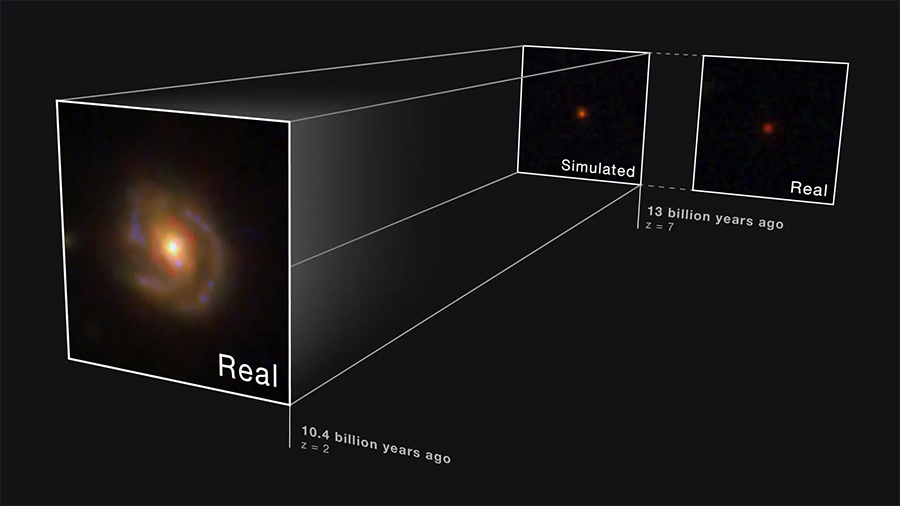
To study the phenomenon, scientists examined a nearby spiral galaxy named ‘Saguarо’. At the centre of this galaxy is a small, red object that closely resembles the ‘Little Red Dots’ observed in the early universe.
Researchers conducted a detailed analysis by combining data from the Hubble and James Webb space telescopes. Because the galaxies are extremely distant, their surrounding structures appear blurred, while only their bright central regions are clearly visible, making the objects appear isolated.
Observations with the Chandra X-ray Observatory confirmed the presence of an active black hole at the centre. The black hole emits only a small amount of X-ray radiation. The study is expected to contribute significantly to scientists’ understanding of black hole evolution. Researchers said they will continue searching for and studying similar galaxies.