
Every major change in filmmaking begins with a period of uncertainty. Digital cameras were once treated as inferior to film. Editing software made physical cutting rooms unnecessary. Smartphones placed capable cameras in millions of pockets. Each shift created the same fear: that technology would make existing skills, equipment and even people irrelevant. Artificial intelligence has brought that fear back, only louder.
Today, AI can generate images from a sentence, create video from a prompt, remove unwanted objects from a frame, imitate voices, translate dialogue and build a rough storyboard before a camera has been switched on. Tasks that once took days can sometimes be completed in hours. For a country like Nepal, where filmmakers regularly work with limited budgets, small crews and tight deadlines, this creates a genuine opportunity. It also raises difficult questions about work, ownership and truth.
AI is already part of the production process
The public conversation often imagines AI as a machine that receives a prompt and produces an entire film. That possibility receives attention because it is dramatic, but it is not how most working filmmakers currently experience the technology. AI is entering production through smaller, less visible tasks.
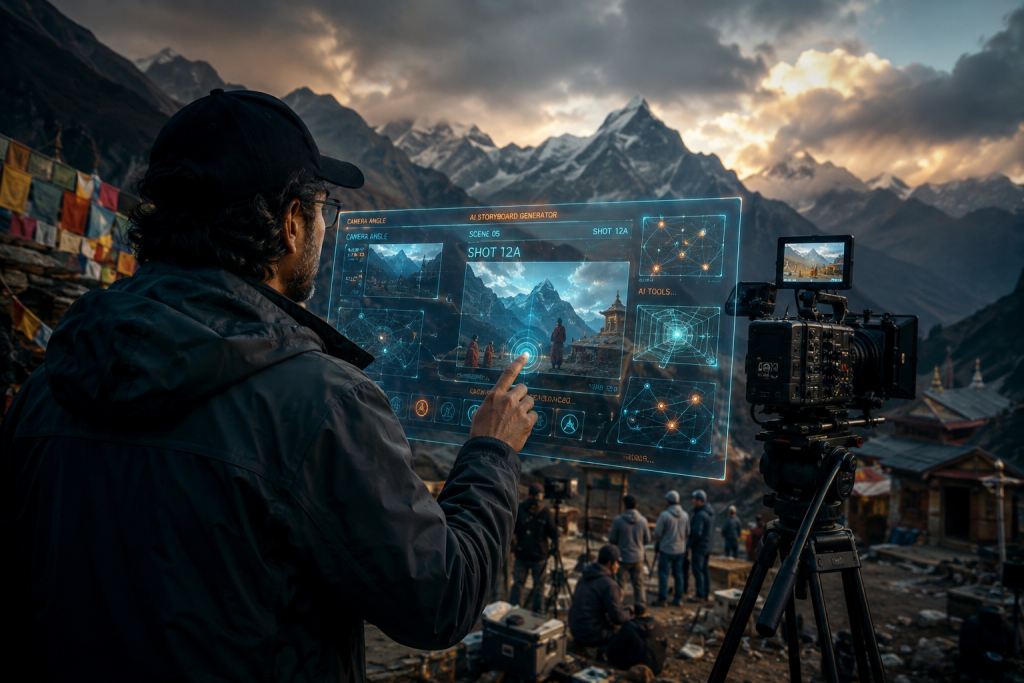
During pre-production, it can help organise research, produce early visual references, create draft storyboards, and break scripts down into locations, characters, and props. In post-production, it can assist with transcription, subtitles, footage organisation, noise reduction, object removal and the creation of multiple versions of the same video. McKinsey has identified applications across development, production and post-production, including pre-visualisation, editing, audio synchronisation, tagging, subtitling and dubbing.
Production companies are also experimenting with leading AI video generators such as Higgsfield, Runway, Kling and Seedance, as well as tools such as Google Veo, Adobe Firefly and OpenAI’s Sora. Depending on the platform, these systems can turn text or reference images into short clips, test camera movement and visual styles, extend or alter footage, and help build concept films or pre-visualisations before a full shoot. For a production company, their most practical value may be less about generating a finished film and more about communicating an idea quickly, testing creative directions and identifying what still needs to be achieved by a real crew on location.
Used responsibly, these tools can reduce repetitive work and give filmmakers more time to focus on decisions that require judgment. That distinction matters. AI can produce options, but a filmmaker still has to know which option serves the story.
What AI could mean for Nepal?
Filmmaking in Nepal is often an exercise in adaptation. A location becomes unavailable. The weather changes. Equipment cannot reach the place where it is needed. A small crew performs several roles. The ambition of a project is frequently larger than its available budget. AI cannot remove these realities, but it can help teams prepare for them.
A director can test the visual direction of a scene before committing resources to it. A production team can compare approaches to a location or sequence. An editor can search hours of footage more efficiently. A small organisation can subtitle a documentary for international viewers without beginning from zero. For independent filmmakers, students and emerging creators, this may lower some barriers to entry.
This is especially relevant outside the Kathmandu Valley, where access to specialised production resources can be limited. AI-assisted tools could allow more creators to experiment, learn and participate. But cheaper production does not automatically produce better films. Making images easier to generate may increase the quantity of content while making original thinking even more valuable.
The camera was never the storyteller
The availability of technology has never been the same as the ability to tell a story. A camera does not decide where to stand during an intimate moment. Editing software does not understand why silence may be more powerful than music. An image generator does not carry lived memories of a place, language, ritual or relationship. Those decisions come from observation and experience.
Through my work as a producer, director, photographer and editor, I have seen projects with modest resources create a lasting impact because they understood their subject. I have also seen technically polished productions fail to connect because they had no clear emotional centre.
AI may help us produce a shot. It cannot decide whether that shot belongs in the story. If we use AI only to imitate visual trends from somewhere else, we may create work that appears sophisticated but says very little about us. Nepal does not need cheaper copies of international advertising or cinema. It needs tools that help Nepali creators express ideas rooted in their own experiences.
The risks cannot be an afterthought
Many generative systems are trained using enormous collections of existing creative work. A filmmaker may generate an image in seconds, but the visual language behind it may come from photographers, illustrators and designers who were neither consulted nor compensated. Synthetic voices and faces create another problem. If a person’s likeness can be reproduced without meaningful consent, the damage affects dignity, identity and public trust.
Employment is also a legitimate concern. Production companies may be tempted to use AI simply to reduce the number of people they hire. Editors, assistants, designers and junior crew members do not only complete tasks; they learn through them. If every entry-level responsibility is automated, where will the next generation gain experience? Nepal’s creative sector needs an honest discussion about consent, copyright, disclosure and fair credit before harmful practices become normal.
A responsible approach
AI should be treated as a production tool, not an invisible replacement for human contribution.
Filmmakers should obtain permission before recreating a face or voice; never present synthetic documentary material as a real event; check output for cultural and factual errors; disclose meaningful generative use to clients; protect confidential footage; and credit the people responsible for final creative decisions.
These principles will evolve with technology. The goal is not to reject experimentation. It is to ensure that experimentation does not come at the cost of trust.
The future still needs filmmakers
AI will change jobs inside filmmaking. Some tasks will become faster, some roles will evolve and new specialisations will appear. The filmmakers who remain valuable will not simply be those who know the latest software. They will be the ones who can ask better questions, recognise truthful moments, guide collaborators and understand the people whose stories they tell.
For Nepal, AI could make ambitious visual storytelling more accessible. It could help smaller teams plan carefully, reach international audiences and make limited resources travel further. But its greatest value will not come from generating more content.
It will come from giving filmmakers more space to think. Technology may change how an image is produced. The responsibility for deciding what that image means still belongs to us.