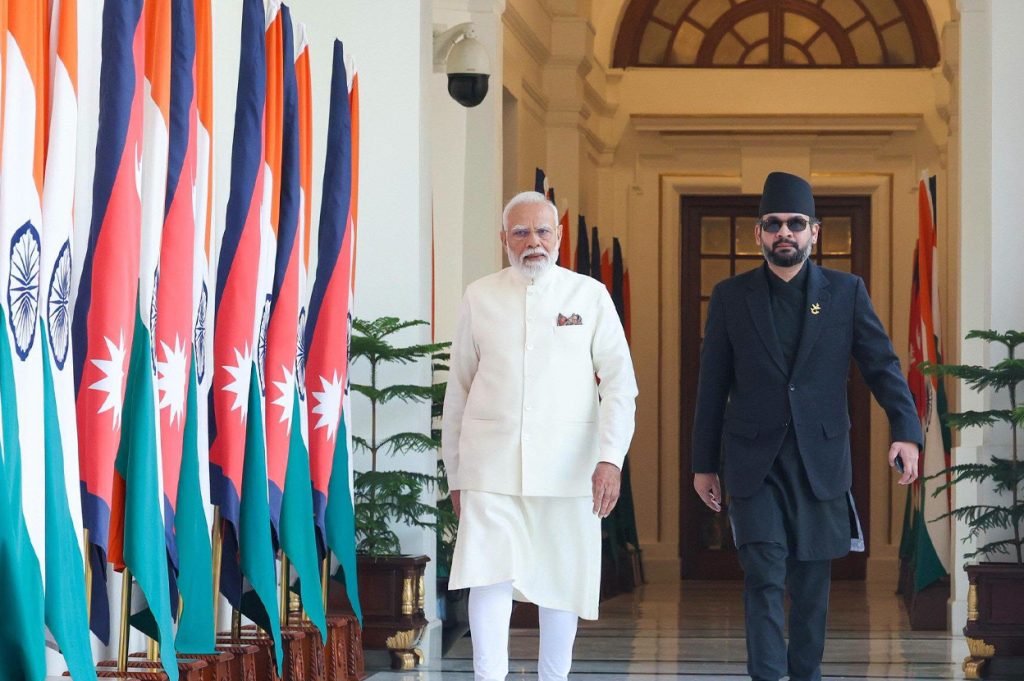
During Prime Minister Balen Shah’s visit to India, India announced a development cooperation package worth Rs 240 billion for post-flood reconstruction and long-term development. The package includes Rs 56 billion in grants for reconstruction and new infrastructure, and a concessional line of credit worth Rs 184 billion, denominated in Indian rupees, for energy projects.
According to India’s foreign secretary, this is the largest financial assistance package India has ever extended to Nepal. Alongside it, eight memorandums of understanding were signed, and a joint vision document titled “Viksit Bharat and Samunnat Nepal” (Developed India and Prosperous Nepal) was issued. These decisions are more than figures on paper. They represent the first concrete outcomes of a young leadership’s effort to approach Nepal-India relations from a new perspective.
The relationship between Nepal and India was not built on diplomatic convenience. It has been woven together through rivers, temples, pilgrimages, markets and families stretching from the Himalayas to the Tarai. A century ago, devotees from Janakpur travelled to Ayodhya, scholars from Kashi came to Pashupati, and farmers from Gorakhpur knew the markets of Birgunj. Political speeches have sometimes made this relationship sound strained and, at other times, fragile. But at its core, it has never broken. The real question today is not whether the relationship will survive, but whether it will remain weighed down by disputes or be built on a foundation of shared opportunities. Prime Minister Shah’s new approach appears to have chosen the latter path.
Shared interests in development
The value of India’s reconstruction support goes beyond the amount involved. Floods, landslides and earthquakes are recurring challenges for Nepal, and this year’s floods in the Himalayan region have once again underscored the vulnerability of the country. Nepal’s rivers flow towards India, meaning that safer infrastructure in the hills also contributes to the safety of the Tarai and the Gangetic plains. The joint vision document includes real-time, two-way sharing of hydrometeorological data, glacial lake monitoring, institutionalised early-warning systems and joint disaster-relief exercises. Such cooperation in disaster management is a shared security interest for both countries.
The eight understandings point in the same direction. Cooperation in forensic science, police training and training for administrative officials can strengthen institutional capacity. Satellite communication opens up the possibility of extending information services to remote villages. Cooperation in sustainable urban development, health and medicine, animal husbandry and fisheries directly relates to people’s living standards. None of this compromises either country’s sovereignty. On the contrary, it can pave the way for greater self-reliance by strengthening domestic capacity.
The potential for cooperation is greatest in the energy sector. Nepal has considerable hydropower potential, while India has a growing demand for clean energy. The two countries have agreed in principle to work towards Nepal exporting 10,000 MW of electricity to India, although current exports remain limited to around 1,200 MW. The Rs 184 billion concessional credit, denominated in Indian rupees and extended under a new arrangement, is expected to be directed mainly towards energy projects and transmission infrastructure. During the visit, the foundation stone of the 669 MW Lower Arun Hydroelectric Project was laid. The two sides also agreed to move forward with the Pancheshwar Multipurpose Project, along with the Saptakoshi and Sunkoshi multipurpose projects. These projects have been stalled for a long time, making it imperative that the latest agreements translate into action.
Tourism and religious ties

The most vibrant aspect of Nepal-India relations is religious and cultural travel. Every year, millions of Indians visit Pashupatinath, Muktinath, the Janaki Temple and Lumbini. Thousands of Nepali pilgrims travel to Kedarnath, Badrinath, Varanasi, Gaya and Haridwar. This movement sustains livelihoods, from temple priests and hoteliers to guides, drivers and handicraft traders.
The Ramayana and Buddhist tourism circuits are prime examples of this connection. The bond between Janakpur and Ayodhya is rooted in the story of Sita and Ram. Lumbini, Kapilvastu, Bodh Gaya and Sarnath are linked to the life and teachings of Gautama Buddha. The understanding on Ayurveda and traditional medicine has also opened new avenues for health tourism. When Nepal’s expertise in Himalayan herbs, yoga and meditation meets India’s experience in Ayurveda, both countries stand to benefit. A visitor who returns home after worshipping at a Nepali temple can become an ambassador for Nepal in their own community. The trust built at the grassroots level helps sustain the relationship even during difficult moments in diplomatic engagement.
Connecting pilgrimage tourism
One of the most talked-about outcomes of this visit is the progress made on the air route linked to Gautam Buddha International Airport in Bhairahawa. According to Point 8 of the joint statement, both sides agreed to make the existing one-way B345 Kathmandu-Bhairahawa-Lucknow route bidirectional. Nepal had been seeking additional entry routes through Indian airspace for more than a decade. Several previous prime ministers had raised the issue without securing concrete results. The airport, located near Lumbini, the birthplace of Buddha, has not received the number of flights anticipated since it began operations. With the route now set to operate in both directions, access for flights arriving from the Indian side is expected to become easier, potentially unlocking the airport’s commercial potential.
It must be acknowledged, however, that this is not a complete solution. The joint statement notes that the modalities of the route will be finalised through technical consultations, while other civil aviation proposals remain under discussion. Nepal’s demand for an additional high-altitude entry point in the Mahendranagar area in the west has yet to be resolved. Even so, the first formal agreement on an issue that had remained stuck for decades is a significant achievement in itself. The path towards connecting Lumbini and Buddhist tourism with the rest of the world could begin here.
During the visit, the two prime ministers also virtually flagged off the Saryu-Kamala Express train service connecting Ayodhya and Janakpur Dham. The weekly service linking two sacred cities associated with the Ramayana is expected to further strengthen religious tourism. The foundation stone of a new integrated check post at Banbasa was laid, while both sides expressed satisfaction with progress on the integrated check posts at Bhairahawa, Sunauli and Dodhara-Chandani. By air, rail and road, efforts to facilitate the movement of travellers and goods are bringing the relationship closer to practical realities.
An agenda wider than the MoUs
The eight memorandums represent immediate agreements. The “Viksit Bharat and Samunnat Nepal” joint vision, by contrast, sets out a long-term roadmap spanning ten areas, including economic cooperation, physical and digital connectivity, energy and water resources, governance, technology, education, sports, culture and tourism, health and agriculture.
In education, the two sides have agreed to establish an offshore campus of an Indian Institute of Technology in Nepal. The document also covers a start-up incubator and innovation hub, artificial intelligence, including a large language model for the Nepali language, digital parks, data centres and space cooperation. An agro-industrial park will be established in Chitwan with Indian grant assistance to add value to Nepali agricultural produce. In sports, India will support the establishment of a national cricket coaching academy and the development of cricket infrastructure. The foundation stone of an oil storage terminal in Jhapa was also laid.
The shared heritage of culture and nature
Language, festivals, marriage ties and food have deepened the relationship between the two countries beyond what any official document can capture. Dashain, Tihar, Chhath, Holi and Buddha Jayanti are celebrated across borders. The history of Nepali Gorkha soldiers and the contributions of Nepali-speaking communities in India are shared assets of both countries. Rather than turning culture into a subject of dispute, it is wiser to preserve and promote it as shared heritage.
Nature, too, binds the two countries together. The Koshi, Gandaki, Karnali and Mahakali rivers flow from Nepal into India. Chitwan and Valmiki, Koshi Tappu and the sanctuaries of Bihar are parts of the same ecological system. When Himalayan snow melts, it affects the Tarai and the Gangetic plains, while pollution originating in India also affects Nepal’s air quality. To confront climate change, both countries must share knowledge, technology and resources. As Prime Minister Shah said during his visit to India, the pristine rivers flowing from the Himalayas into the Ganga remind both countries of their shared future.
Trust must show in action

One thing must be made clear. Cooperation does not mean giving up one’s own interests. Keeping national interests at the centre while seeking solutions through dialogue is what mature diplomacy looks like. The Balen government has chosen this path. The joint statement directs the foreign secretaries of both countries to work on outstanding boundary issues and states that the legal framework, including the 1950 Treaty of Peace and Friendship, will be reviewed by mutual consent. This, too, points towards a way forward through dialogue without ignoring existing disputes. Disputes should be brought to the negotiating table, not inflamed from podiums or turned into walls that obstruct other avenues of cooperation.
To translate this approach into action, the government has three responsibilities. First, it must make the implementation of the understandings and reconstruction support transparent, with clear timelines. The two prime ministers have agreed to activate a high-level monitoring group led by Nepal’s foreign secretary and India’s ambassador to Nepal, which will meet at least once every six months. Making this mechanism effective will be the first test. Citizens must see tangible changes in their lives, not merely photographs of the visit.
Second, the government must ensure that grant and loan funds are spent transparently and that progress is regularly reported to Parliament and the public.
Third, it must balance cooperation with India against Nepal’s relations with other neighbours and friendly countries, while preserving the dignity and independence of its foreign policy.
This is also an opportunity for India. When India treats Nepal not merely as a neighbour but as an equal partner, the benefits will be long-lasting. Nepal’s stability, prosperity and security are in India’s interest, too. At a time when a young leadership is seeking to carry the relationship forward with renewed energy, India’s supportive and respectful approach will help strengthen trust on both sides.
The prime minister’s visit to India marks a new chapter in Nepal-India relations. It has demonstrated that the two countries can move forward not by opposing each other but by working together. They share interests across a range of fields, including development, energy, tourism, religion, culture and the environment. The Rs 240 billion package, the eight understandings, the agreement on the Bhairahawa air route and the Saryu-Kamala Express are the first indications of that shared commitment.
The real test now is implementation. Announcements and signatures are easy; delivering results is harder. If Prime Minister Shah’s government can turn these commitments into tangible outcomes, the visit will be remembered not merely for the agreements signed but for the improvements it brings to people’s lives. The strongest foundation of Nepal-India relations is the trust of their people, and that trust can carry both countries forward on the path to prosperity.