

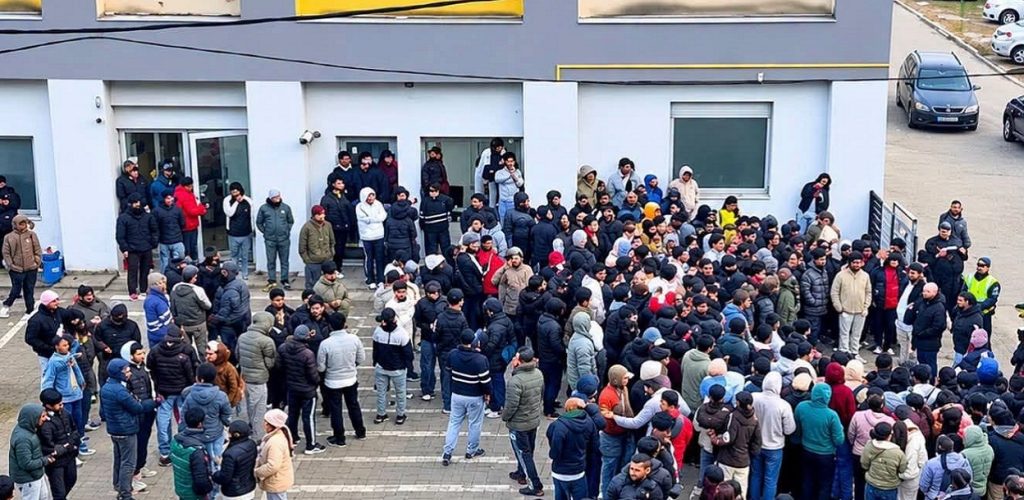
Nepali workers who spent hundreds of thousands of rupees to reach Romania for work have launched a protest, saying they have not received work or wages.
About 600 Nepali workers employed at Bisar Logistic SRL in Romania began the protest on Saturday. They say they have not received the work, salary and benefits promised in their contracts.
The workers have gathered outside the company and are chanting “We want justice.” They say each of them paid between Rs 1 million and Rs 1.2 million to go to Romania for work.
Despite paying so much to reach Europe, they say they are not getting regular work. They are struggling to repay their loans and cover daily expenses.
One worker said they barely get two or three days of work a month. For the rest of the month, they are made to sit idle.
“I came after paying Rs 1.2 million, but they give us duty for only two or three days a month and keep us on leave for the other 27 or 28 days,” the worker said to Onlinekhabar. “We came because we were told there was work at Bisar. After arriving, we got neither the work nor the salary we were promised.”
Another major grievance is the gap between the pay stated in the contract and what the workers actually receive. The contract signed in Nepal before departure states a monthly basic salary of 2,699 Romanian lei. The workers say the company has not paid them accordingly. Their frustration grew after the company began deducting money for accommodation.
Surendra Gautam, a former president of the Non-Resident Nepali Association in Romania and a current member of its International Coordination Council, says the company has not stopped paying wages altogether, as the workers claim.
According to him, Bisar Logistic SRL employs between 600 and 700 workers, including about 400 Nepalis. He said the company has reduced working hours because Romania’s economic activity has slowed, taxes have risen and work has fallen with the onset of winter.
“The company used to provide accommodation free of charge. Now it has started deducting some money for housing, so the salary workers take home has fallen,” Gautam said. “A housing deduction of 300 to 400 lei means they get Rs 9,000 to 10,000 less each month, and that is why they have started protesting.”
He said take-home pay has fallen because housing, electricity and other costs are deducted from wages after tax. He added that the company has not stopped paying salaries.
Gautam said that as a large company, it must submit salary details to the government tax office and keep payment records. For that reason, he said, it cannot simply refuse to pay wages.
Even so, the claims of the two sides differ over the actual work, wages and benefits workers receive. The workers are demanding the work and pay promised in their contracts, while Gautam attributes the problem mainly to the recent economic slowdown and lack of work.
Problems for Nepali workers in Romania are growing
According to Gautam, the number of Nepali workers in Romania has risen significantly in recent years. He estimates that 75,000 to 80,000 Nepalis now live there, though government records show only about 50,000 to 55,000.
The flow of Nepalis to Romania has grown along with the appeal of jobs in Europe. But he says workers face more trouble after arriving, because jobs are hard to find, promised benefits do not materialise, and loans weigh on them.
“Agents and manpower companies send people saying the opportunities are good, but the situation is different once they arrive,” Gautam said. “Someone who spends Rs 1 million to come here and earns 600 euros a month will struggle to repay the loan and cover expenses.”
He said companies that employ Nepali workers in Romania often expect them to work longer hours than local workers. Foreign workers also have to complete paperwork and take on other job-related responsibilities, which puts them at greater risk.
Gautam also demanded that Nepal set up an official consulate or embassy in Romania to help resolve workers’ problems. Romania’s diplomatic matters are currently handled through the Nepali embassy in Germany. He complained that even contacting that embassy rarely brings effective help.
“There are many Nepalis here, but when problems arise, there is no official body to contact,” he said. “When someone dies, we even have to raise donations to send the body to Nepal. Nepalis who come abroad to work should get support from the state when they face problems.”
He said that as the number of Nepali workers in Romania has grown, so have cases of death, disappearance, suicide and other problems. He urged the Nepal government to take an interest in providing timely facilitation and support in such cases.
The Nepali community and various organisations in Romania have also appealed to stakeholders to address the demands of the protesting workers. They have asked the concerned bodies to investigate the workers’ problems impartially and ensure their rights.
The affected workers have demanded immediate diplomatic action from the Ministry of Labour, Employment and Social Security and the Ministry of Foreign Affairs. They have also asked the Nepali embassy in Germany to contact the company and the affected workers directly, learn the real situation and take steps to resolve the problem.
Nepalis often borrow hundreds of thousands of rupees to work abroad, only to find on arrival that the work and pay promised in their contracts are not there. The latest incident in Romania has again exposed the gap between the commitments made by manpower companies, the contracts signed with employers, and the benefits workers actually receive in destination countries.
The Nepali embassy in Berlin has said it has no information about the Nepalis’ protest or their problems.