
Kathmandu, November 20
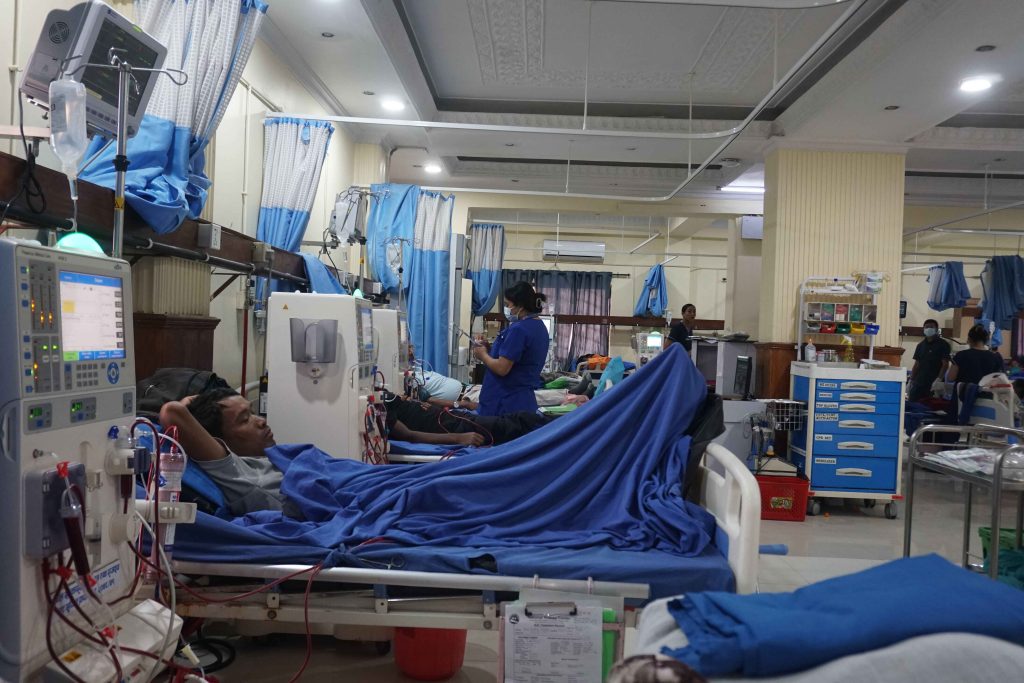
More than 400 kidney patients have been struggling to continue their treatment due to a shortage of fluid required for peritoneal dialysis (PD), a home-based treatment that uses a catheter inserted into the abdomen.
The shortage has disrupted treatment for patients who rely on PD to sustain their lives, with the fluid supplied by a single company in Nepal reportedly failing to reach patients regularly for the past three months.
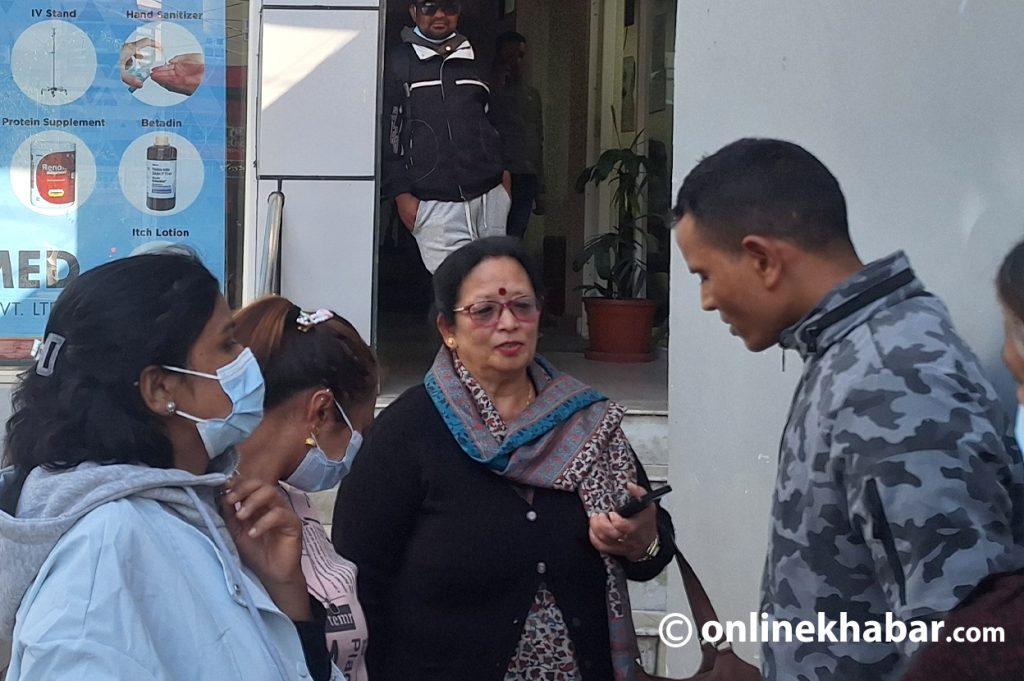
On Thursday, more than 20 kidney patients gathered at the fluid distribution centre in Kalimati, Kathmandu, to collect supplies.
Among them was 45-year-old Kiran Thapa, whose body has swollen due to missed dialysis sessions. She struggles to breathe and speak.
Thapa, who lives in Sanepa, has been living with kidney disease for the past 12 years. She initially underwent haemodialysis at hospitals but switched to peritoneal dialysis after her fistula deteriorated and doctors struggled to find suitable veins for access.
PD allowed her to receive treatment at home instead of making frequent hospital visits. The procedure involves introducing a specially prepared fluid into the abdomen through a catheter to remove waste and excess fluid from the body. However, the shortage of the fluid has made her treatment increasingly difficult.
Thapa said her legs have swollen and she has been experiencing breathing difficulties.
“My legs are swollen. When I lie down at night, the fluid seems to reach my mouth. I find it difficult to breathe and even speak,” she said.
Thapa requires four dialysis sessions a day but said she had gone without treatment for two to three days because she could not obtain enough fluid.
“It has been three months since I started facing difficulties getting the fluid regularly. I have been making daily trips and managing with one or two bags,” she said, tearfully.
She said returning to haemodialysis was no longer a viable option, as doctors could no longer find suitable veins in her arms to create another fistula.
“I no longer have the possibility of getting another fistula. What am I supposed to do if I cannot get the fluid? I came here today to understand the problem,” she said.
Thapa is not alone. More than 400 patients undergoing peritoneal dialysis are facing similar difficulties.
Akbir Tamang, 35, from Dakshinkali Municipality, is another patient who depends on PD. He said he missed two consecutive days of dialysis last week because of the shortage.
After missing his regular sessions, his body began swelling, he experienced breathing difficulties and his blood pressure rose. His condition deteriorated to the point that he was left severely debilitated at home.
“I felt like I was going to die,” he recalled of that night. “Around 8 or 9 pm, I called the office that supplies the fluid. They finally provided me with two bags, and only then could I resume dialysis.”
Tamang, who was diagnosed with kidney disease three years ago, undergoes dialysis three times a day, at 6 am, 2 pm and 10 pm. Each session involves introducing a special fluid through a catheter into his abdomen to remove waste from his body.
He requires around 15 cartons of dialysis fluid a month but said he has recently been able to obtain only two to three cartons. He has been forced to borrow supplies from friends, who are also struggling to secure enough.
“We need to undergo dialysis three times a day. But when there is no fluid, some of us have to reduce it to twice a day, while others can manage only once,” he said. “We try to borrow from friends, but they are struggling too. Who can we rely on now?”
The uncertainty over when supplies will arrive, how much will be available and whether patients will be able to undergo their next dialysis session has also taken a toll on their mental well-being, he said.
Many patients have no easy alternative to peritoneal dialysis. Some cannot physically undergo haemodialysis, while others face difficulties with the procedures required to establish vascular access. For them, the shortage of PD fluid threatens not just continuity of treatment but their ability to survive.
Company promises to resolve shortage within 15 days
As nearly 400 kidney patients struggle with the shortage, Mitra Company, the sole importer of the fluid required for PD in Nepal, has said it expects to resolve the problem within 15 days.
The company has attributed the disruption to road blockages, festivals and delays in imports.
Mitra Company chairman Madhu Chitrakar said supply disruptions had occurred in recent months but that the company was working to restore regular deliveries.
“Several months ago, road problems delayed the supply. The floods in Rasuwa disrupted our entire supply chain. On top of that, Dashain, Tihar and Chhath meant trucks could not leave India. As a result, supplies were interrupted,” he said.
Chitrakar said the company was working to ease the shortage and that a vehicle carrying dialysis fluid had already departed Delhi, India.
The absence of an alternative supplier in Nepal has further exacerbated the situation, leaving patients vulnerable whenever deliveries are disrupted.
“There is no alternative supplier in Nepal. A few months ago, when another company’s product was discontinued, nearly 100 patients came to us, further increasing the pressure,” he said.
According to Chitrakar, the company supplies PD fluid to Nepal Medical College, Patan Hospital, Bir Hospital and Tribhuvan University Teaching Hospital in Kathmandu, as well as Western Regional Hospital and Manipal Teaching Hospital in Pokhara.
Hospitals send the company details of patients requiring dialysis. The Health Insurance Board reimburses hospitals for the cost of dialysis fluid, which in turn pay the company.
Chitrakar said arrangements had been made to bring fluid from India regularly from now on. One truck is expected to arrive shortly, while two more are scheduled to be loaded on November 21.
The company plans to import two truckloads of fluid every week thereafter.
“One truck will arrive tomorrow, while two more will be loaded on November 21. After that, we will bring in two trucks every week. We expect to resolve the shortage within a maximum of 15 days,” he told Onlinekhabar.