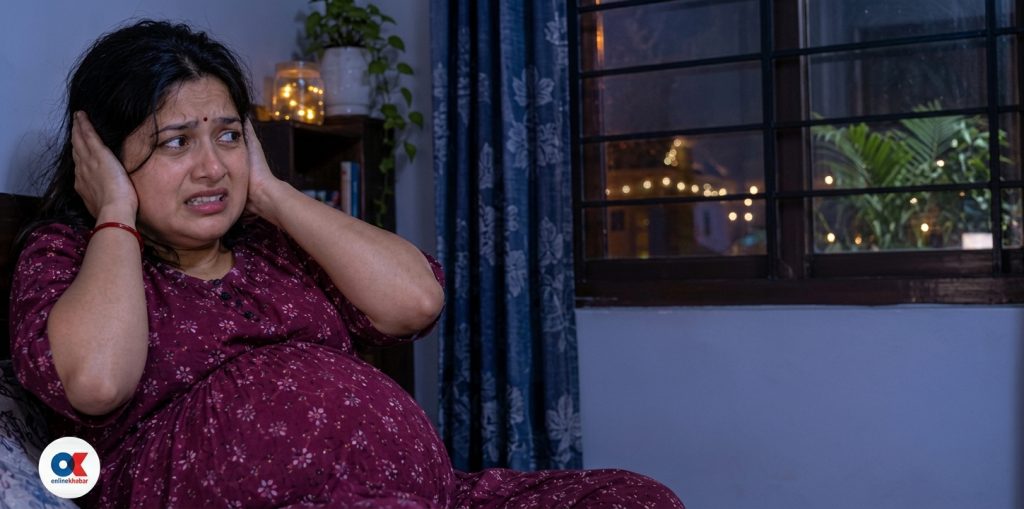
Although firecrackers are prohibited, they are being set off as if a major war were taking place. Whether using firecrackers as part of celebrations is appropriate is a separate cultural debate. However, they can pose health risks to pregnant women and their unborn babies.
Studies have shown that extremely loud explosions and smoke from firecrackers can harm the health of pregnant women and their babies. The level of risk depends on the intensity of the noise, duration of exposure, distance from the source and the woman’s health condition. Various scientific studies have highlighted the need to avoid exposure to loud noise and air pollution during pregnancy.
According to the National Institute for Occupational Safety and Health (NIOSH), under the US Centers for Disease Control and Prevention (CDC), exposure to excessive noise during pregnancy can cause hearing problems in newborns. A foetus’s ears develop by around the 20th week of pregnancy, while it begins responding to sounds from around the 24th week. Although sounds from outside the mother’s body become weaker as they travel into the womb, they are not completely blocked.
The CDC advises pregnant women to stay away from environments where noise levels exceed 115 decibels. While hearing protection devices can protect the mother’s hearing, they cannot completely prevent sound from reaching the foetus.
A 2014 meta-analysis on noise pollution, which reviewed 29 studies, found that women exposed to noise levels of 80 decibels or higher during pregnancy had a 27 per cent higher risk of pregnancy-related hypertension and a 19 per cent higher risk of giving birth to babies who were small for their gestational age.
Sudden loud noises can also startle pregnant women, increase stress and raise their heart rates. However, these findings are based on studies involving women exposed to loud noise regularly or over extended periods.
Smoke from firecrackers also contributes to air pollution. A study published in the journal Environmental Geochemistry and Health in 2024 found a significant increase in air pollution during Diwali celebrations in Bhubaneswar, India. On Diwali day in 2021, PM2.5 concentrations reached 113.83 micrograms per cubic metre, while PM10 levels reached 204.32 micrograms per cubic metre. The study reported that concentrations of both pollutants exceeded national standards at all seven monitoring stations.
Fine particles in firecracker smoke enter the body through the respiratory system. They can worsen asthma, coughing and breathing difficulties. Various studies have also linked exposure to air pollution during pregnancy with an increased risk of low birth weight and premature delivery.
A review published in the journal Obstetrical and Gynecological Survey in 2024 examined 25 studies on possible links between noise pollution and foetal development, maternal hypertension, diabetes and mental health.
To avoid potential risks, pregnant women should be kept away from places where firecrackers are being set off, protected from smoke and provided with an environment where they can breathe clean air.
Tihar is a festival of happiness and light. However, it is not appropriate to put the health of pregnant women and their unborn babies at risk for a few moments of entertainment. Tihar can be celebrated without firecrackers. Caring for the health and safety of others is also part of the spirit of celebrating festivals.
—Dr Balakrishna Sah, Obstetrics and Gynaecology Specialist