

Kathmandu, November 6
Indian Foreign Secretary Vikram Misri was scheduled to visit Nepal on May 11. During the visit, he wanted to meet Prime Minister Balendra Shah. However, after it became clear that Shah would not grant him an audience, Misri’s visit was called off.
The Indian foreign secretary had wanted to meet Shah after Indian Prime Minister Narendra Modi sent him a congratulatory message and invited him to visit India. Misri hoped to make arrangements for the visit as soon as possible.
Had Misri’s visit gone ahead in May and preparations begun at the time, Shah might have already travelled to India. New Delhi was keen to arrange the visit. During a meeting on the sidelines of the ninth Indian Ocean Conference in Mauritius, Indian External Affairs Minister S Jaishankar and Nepal’s Foreign Minister Shishir Khanal had agreed to facilitate the prime minister’s visit at the earliest.
But at the time, Shah had taken a firm public position that he would not meet foreign ambassadors individually or officials of a lower rank visiting Nepal. He had also announced that he would not travel to any foreign country for a year.
Perhaps for that reason, India invited Rastriya Swatantra Party (RSP) Chair Rabi Lamichhane to visit the country and extended him a particularly warm reception.
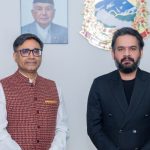
Since then, however, the prime minister has softened all three of his positions. Six months after the visit was originally scheduled, Misri finally travelled to Nepal and met Shah.
The meeting was significant because it laid the groundwork for preparations for Shah’s planned visit to India in the first week of Mangsir (mid-November).
Shah has already travelled to the United States to attend the United Nations General Assembly. However, the likely dates for his India visit had been discussed even before that trip, although neither country has formally announced them.
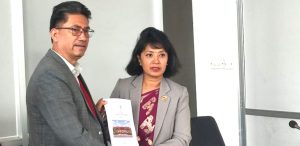
During his Nepal visit, Misri met not only the prime minister but also the foreign and finance ministers, as well as the energy and physical infrastructure ministers. He also held delegation-level talks with Nepal’s Foreign Secretary Amrit Rai.
Misri did not limit his engagements to government officials. He also met RSP Chair Lamichhane and Nepali Congress President Gagan Thapa, the leader of the main opposition party. The meetings conveyed India’s intention to remain engaged not only with the government but also with both ruling and opposition parties.
Nevertheless, the main purpose of the visit appeared to be strengthening preparations for Shah’s upcoming trip to India.
During his meeting with Shah, Misri conveyed Indian Prime Minister Narendra Modi’s message that preparations for the forthcoming visit were being accelerated.
He also said that regular meetings of bilateral mechanisms on energy, water resources, trade and transit, and aviation had been successfully completed. This suggested that the two sides could announce concrete outcomes in these areas during the prime minister’s visit.
Shah discussed potential cooperation with India in developing Nepal’s sports sector. He also thanked the Indian government for its assistance following the devastating Rasuwa-Bhotekoshi floods, including the supply of relief materials and the deployment of rescue teams as a first responder.
It has been three years since a Nepali prime minister last visited India. The previous visit took place in late May 2023, when then Prime Minister Pushpa Kamal Dahal travelled to New Delhi. Last year, a visit by then Prime Minister KP Sharma Oli was being scheduled, but the Gen Z protests brought about a change of government before it could take place.
Diplomats on both sides say Shah’s visit is significant given the new political circumstances and the long gap since the last prime ministerial visit.
Ranjit Rae, a former Indian ambassador to Nepal, says Shah’s upcoming visit is particularly important.
“Prime Minister Shah is visiting India as his first bilateral visit. This demonstrates the importance of the partnership between the two countries,” Rae told Onlinekhabar.
Referring to the earlier cancellation of the Indian foreign secretary’s visit over protocol concerns, he said such issues should not take precedence over bilateral cooperation.
“In my view, protocol-related issues are less important. What matters is how we can accelerate our cooperation,” he said.
Dr Shankar Sharma, a former Nepali ambassador to India, also says Nepal should remain open to cooperation with different countries based on its needs rather than taking rigid positions on what it will or will not do.
“Our partnership with India is very important. Therefore, the prime minister’s efforts to speed up preparations for the visit should be viewed positively,” he said.
Sharma believes the visit could produce meaningful outcomes because several agendas have matured over the three years since the last prime ministerial-level visit.
“Many projects have reached the stage where they can be inaugurated or have their foundations laid. So the outcomes could be quite substantial,” he said.
However, he cautioned against expecting major new agreements given the short preparation period. Rae, too, sees the visit as an opportunity for the two prime ministers to meet in person for the first time and renew and reinvigorate bilateral relations.
“High-level visits have already taken place involving RSP Chair Lamichhane, Foreign Minister Khanal, Finance Minister Dr Swarnim Wagle and Home Minister Sudan Gurung. Our foreign secretary has also visited India. These visits have already laid the groundwork for deeper cooperation,” Rae said.
He also expects important decisions to be taken in light of the recent Bhote Koshi floods, which he described as a Himalayan tsunami. He said he hoped major hydropower projects, particularly the Pancheshwar project, would gain momentum.
Sharma, however, is less optimistic about resolving the deadlock over Pancheshwar.
“There are deep political divisions in Nepal over the Mahakali Treaty, which is linked to the Pancheshwar project. India may therefore insist on broader political consensus in Nepal,” he said. “There may be little difficulty in resolving issues that can be settled at the technical level, but political agreement is necessary. I have not seen sufficient preparation for that.”
He is more hopeful that India will agree to provide an air route that would facilitate operations at Bhairahawa airport.
“We have not insisted that aircraft must enter through an air route directly to Bhairahawa. An entry route through Mahendranagar would also work. An agreement on this could be possible,” he said.
Sharma added that any ambition to secure other major outcomes would have required at least three to four months of intensive preparation.
“If major agreements had been reached at the technical, joint-secretary, secretary or ministerial levels, one could have expected them to be announced during the prime minister’s visit. But that has not happened. So there is a possibility that this visit will be largely a goodwill visit,” he said.
Among the issues attracting attention are longstanding disagreements between the two countries over the border, the Eminent Persons Group (EPG) report and recruitment under India’s Agnipath scheme, known as Agniveer.
Sharma said both countries have traditionally followed a strategy of continuing discussions on these contentious issues without allowing them to block cooperation in other areas. Even if no agreement is reached on them during this visit, he said, progress on other matters could continue.
Rae, meanwhile, believes Shah’s government, which commands a majority of nearly two-thirds in Parliament, is in a position to address longstanding problems that have remained unresolved for years.
“If both countries adopt a practical, solution-oriented approach based on mutual give and take, I believe this is an opportune time to find constructive solutions to outstanding issues that are acceptable to both sides,” he said.