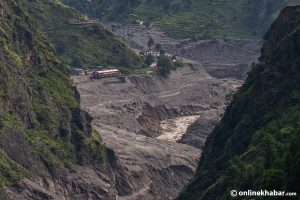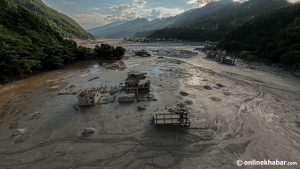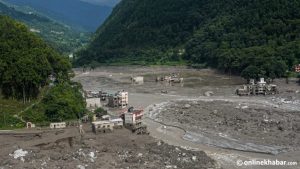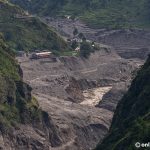

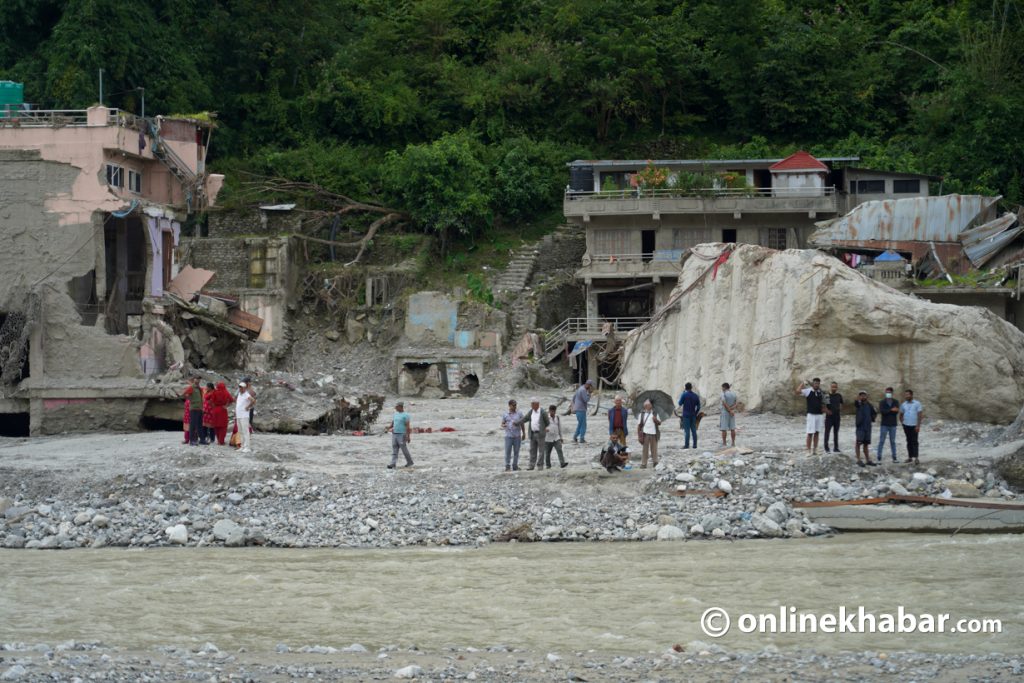
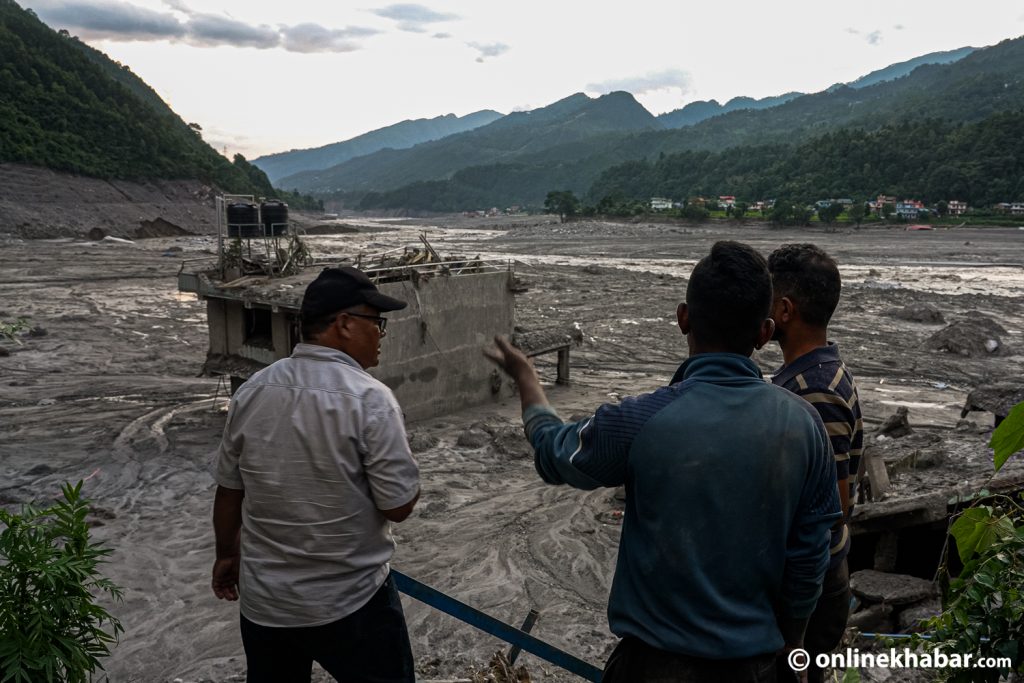
It has been two months since the devastating floods in the Bhotekoshi River. In the meantime, we have also witnessed landslides and floods in the Budhi Gandaki region. The effects of the glacial tsunamis triggered by the climate crisis remain just as severe.
Against this backdrop, Prime Minister Balen Shah’s appeal for climate justice at the United Nations General Assembly is worth recalling.
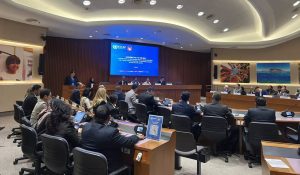
On August 31, Finance Minister Dr Swarnim Wagle and Minister for Agriculture, Forests and Environment Geeta Chaudhary jointly approached the board of the Fund for Responding to Loss and Damage, established under the United Nations Framework Convention on Climate Change (UNFCCC), seeking financial support for flood-affected areas of Nepal.
Now, the board of the same Loss and Damage Fund has decided to allocate more than $20 million to Nepal. Converted into Nepali currency, that amounts to around Rs 3 billion. But should this news genuinely make us happy or sad? That is the question this edition of Espresso seeks to examine.
With Nepal set to receive more than $20 million from the Loss and Damage Fund, another question has emerged about the fate of three project proposals the country had submitted earlier. Many have described the allocation as an important beginning towards achieving climate justice. Some have even argued that Nepal has become the first country in the world to receive an allocation from the Loss and Damage Fund through a special board meeting.
But for a country that needs around $5 billion for reconstruction, $20 million is an extremely small amount of assistance.
Amid this debate, however, an important aspect has been pushed into the background. It has received far less attention than it deserves. Journalist Navin Singh Khadka has brought it into the discussion through a Facebook post.
Khadka recalls that Nepal sought emergency assistance from the Fund following the devastating debris-laden floods in the Bhotekoshi-Trishuli region. But he points out that, long before making that emergency request, Nepal had already submitted applications for three other projects addressing loss and damage caused by climate change.
Last year, following the Fund’s call for proposals, it received a total of 176 applications from 119 countries. The three projects submitted by Nepal were among those applications, as Khadka noted in his post.
The Fund’s board is scheduled to decide at its meeting next December which of these proposals will receive financial support.
Khadka writes, “The Loss and Damage Fund itself is facing an acute shortage of money. A total of around $3 billion has been requested through 176 proposals, while the Fund has less than $350 million available.”
He then raises a pertinent question. “Now that $20 million has been allocated to Nepal for reconstruction in the Bhotekoshi-Trishuli region, what will happen to the three projects the country had submitted earlier?”
The question raised by Khadka is particularly important because, given the Fund’s limited resources, it is increasingly likely that only a fraction of the 176 proposals will be selected for financial assistance.
Government officials in Nepal, along with some experts, have argued that the emergency request made recently should not be linked to the country’s earlier project proposals.
They have also urged others not to view the two in the same light, arguing that the request for the Bhotekoshi-Trishuli disaster was separate and exceptional in nature. However, officials familiar with the Fund’s board have offered a different account.
According to senior sources associated with the board, although a special meeting allocated funds in response to Nepal’s emergency request, final approval is still pending.
This means Nepal’s proposal will still have to go through the same approval process as other proposals at the board meeting scheduled for December. There may not be enough time for that. Procedural complications remain an additional challenge. Beyond the existing process, there is no separate mechanism for selecting and approving requests for financial assistance.
The Fund does not yet have an agreed procedure for immediately releasing money in response to emergency requests of the kind made by Nepal.
For this reason, several board members who spoke at the recent special meeting stressed the need to develop a long-term mechanism to address emergency situations such as the one Nepal has faced. However, there appears to be little prospect of such a mechanism being established.
In these circumstances, have we in Nepal made too much noise about this compensation? Perhaps it is time to take a step back and review what has actually been achieved.
Although senior sources associated with the board have indicated that Nepal’s emergency request is likely to secure approval after completing the necessary procedural steps, the country will still have to submit a project proposal with a clear plan for how the money will be spent. There is hardly any time left to do so.
Nepali officials, meanwhile, maintain that the emergency request for the Bhotekoshi-Trishuli disaster will have no bearing on whether the three projects submitted earlier are approved or rejected. However, according to journalist Khadka, senior sources associated with the Fund’s board do not share that view.
An even more fundamental question arises. If the approval of the emergency request means that Nepal’s three earlier projects are put on hold or rejected, can that really be considered an achievement for the country?
If not, then setting aside the precedent Nepal may have established on climate justice at the international level, what has the country actually gained?
Or have we, in the name of making an emergency request, sacrificed the possibility of securing much greater financial assistance? In trying to claim a victory, have we ended up putting ourselves in a more difficult position?