Tehrathum, October 28
There was a time when farmers in the villages of Tehrathum were busy planting millet from Ashadh and Shrawan through the first week of Bhadra. Fields and farms were bustling with agricultural labourers and villagers helping one another through the traditional parma system of exchanging labour.
Villagers who gathered to plant millet in one farmer’s field would go to another farmer’s field the following day to help with the work. At the time, farmers cultivated millet on plots ranging from two to 70–80 ropanis. Millet was commonly grown alongside maize. The harvested grain was used to prepare dhido, bread and porridge, both for household consumption and for sale.
However, the agricultural system in the villages has changed. Finding agricultural labourers during the millet-planting season has become difficult, while the tradition of exchanging labour is gradually disappearing. More young people are moving to cities and abroad for employment and education. As millet cultivation requires considerable labour and effort, while cash crops offer better income opportunities, farmers are increasingly turning to other crops. This has gradually reduced the area under traditional millet cultivation.
According to Tank Bahadur Karki, a farmer from Chhathar Rural Municipality, Tehrathum, agricultural labourers were readily available in the past from Ashadh and Shrawan through the first week of Bhadra. Villagers took turns working on one another’s farms to complete agricultural tasks. Now, however, finding workers for farming has become increasingly difficult, and the tradition of helping one another through parma is disappearing. He says the shortage of agricultural labour in the village has made traditional farming difficult.
Similarly, Agra Bahadur Karki says farmers are reducing millet cultivation because there are fewer young people engaged in farming and growing millet requires considerable effort.
“There are no young people left in the village to work on farms. Millet cultivation requires a great deal of effort and labour. As cash crops provide better returns, farmers are reducing millet cultivation and turning to other crops,” he says.
Farmers’ experiences indicate that labour shortages, changing lifestyles and shifting economic priorities are the main reasons behind the decline in millet cultivation. Since cash income is necessary to cover household expenses, children’s education, healthcare and other daily needs, farmers have increasingly prioritised cardamom, ginger, broom grass, vegetables and other cash crops.
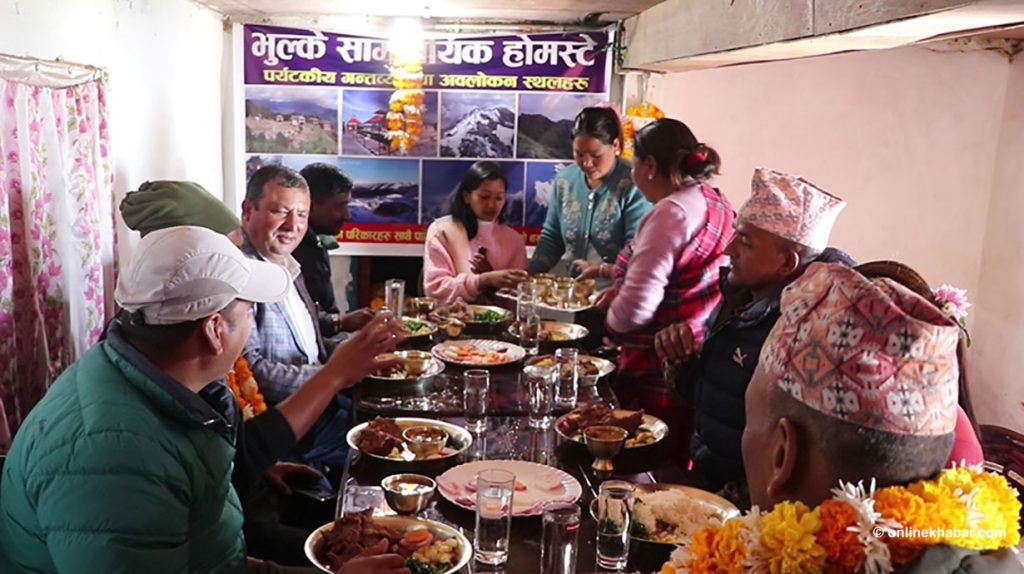
Millet need not remain limited to traditional dishes. Its flour can be used to make dhido, bread, biscuits, cakes and other food products. There is also potential to use millet flour in momo, a popular snack in recent years. The outer wrapper of momo can be prepared by mixing a certain proportion of millet flour with wheat flour. Achieving the right proportion, taste and texture is essential.
Nunthala Village and Resort in Dhankuta offers an example of how linking millet-based products with the market could help farmers sell their produce. According to the resort’s operator, Lokendra Karki, visitors enjoy millet dhido and momo. They also buy millet biscuits to take home as gifts.
“Visitors who come here enjoy millet momo and dhido. They also take millet biscuits home as gifts,” Karki says.
Once planted with the help of agricultural labourers and through the parma system, millet has long been part of village life. As the agricultural workforce shrinks and farmers increasingly turn to cash crops, the production and continuation of traditional millet farming face growing challenges. However, the growing acceptance of millet-based products such as dhido, momo and biscuits in the market points to new opportunities for the crop.