

Barcelona, October 26
Sapana Khadka, 33, had never dreamed of becoming a bus driver. When she moved to Denmark, she had other things on her mind. She needed to find a job, learn the language, build a life in an unfamiliar country and, above all, reunite with the two children she had left behind in Nepal.
Driving a bus was nowhere on that list.
Then came a six-week training course that changed the course of her life.
The training was free, and it offered a way into employment at a time when the financial support she received through Denmark’s job centre was nearing its end. Khadka had initially hoped to train for work in the hotel and restaurant industry, but she could not secure the financial assistance needed for a longer course.
Bus driving was not her first choice. It was simply an opportunity to learn a new skill. Five years later, she is still behind the wheel.
What began as an unexpected detour has become a profession, a source of independence and, for other Nepali women who have followed her into the field, an example of what might be possible.
A life divided between two countries
Khadka married Mohan Khadka in January 2011 and gave birth to their daughter that November. When her husband moved to Denmark in 2014, she remained in Nepal, caring for their growing family. Their second child was born while she was still there.
Family responsibilities meant she could not immediately join her husband.
When she finally travelled to Denmark in March 2016, she did so alone. Her daughter stayed with her sister, while her son remained with relatives on her husband’s side of the family.
There was work to find and a new life to establish. But beneath the practical demands of settling in was the constant ache of separation.
“After coming back from work, I would cry thinking about my children,” she says. “From the outside, people see Europe as a place where you can earn money and live a better life. They don’t see the pain of being away from your children.”
For migrants, the promise of a better life often comes with a private cost. There are bills to pay, unfamiliar systems to navigate and opportunities to pursue. There is also the distance from the people for whom much of that effort is undertaken.
For Khadka, the priority was always to bring her children to Denmark.
When she returned to Nepal in May 2018, she promised them that they would soon be together again. In December that year, she brought both children to Denmark. After roughly two and a half years apart, the family was reunited. But reunion did not make life simpler. It gave her a different set of responsibilities.
Her children needed to settle into school, the household needed to run, and she still had to build a future for herself in a country where she was learning to navigate everyday life from scratch.
The next stage would require her to acquire skills, improve her Danish and find work that could offer greater stability.
Learning to stand on her own
About two months after arriving in Denmark, in May 2016, Khadka began working in housekeeping. She did not yet speak Danish, and English was enough to get her through the early days of the job.
But she understood that language would determine how far she could go.
She began attending Danish classes in the summer of 2016, initially twice a week. As she progressed through the levels, her studies became a regular commitment, sometimes extending into the weekends. Work and language lessons occupied much of her time.
Without the language, she found, it was harder to look for jobs, communicate with offices, access training or understand her rights.
She continued working in housekeeping until around 2018, but she was already thinking about what might come next.
Bringing her children to Denmark made the need for independence even more immediate. Her daughter’s school was about three kilometres from home, and her son was not yet old enough to attend school. Her husband worked long hours, leaving her to manage much of the family’s daily routine around her own work and training.
In Nepal, she had never ridden a bicycle. In Denmark, she learned because it was what she needed to do.
She began cycling her daughter to school, with her son sitting behind her. Later, she obtained a driving licence, making it easier to travel to schools, appointments at the job centre and training sessions.
Each new skill made daily life more manageable. Each also demanded that she do something she had never done before.
Yet even after learning to cycle and drive a car, she had no plans to drive a bus.
Six weeks that changed everything
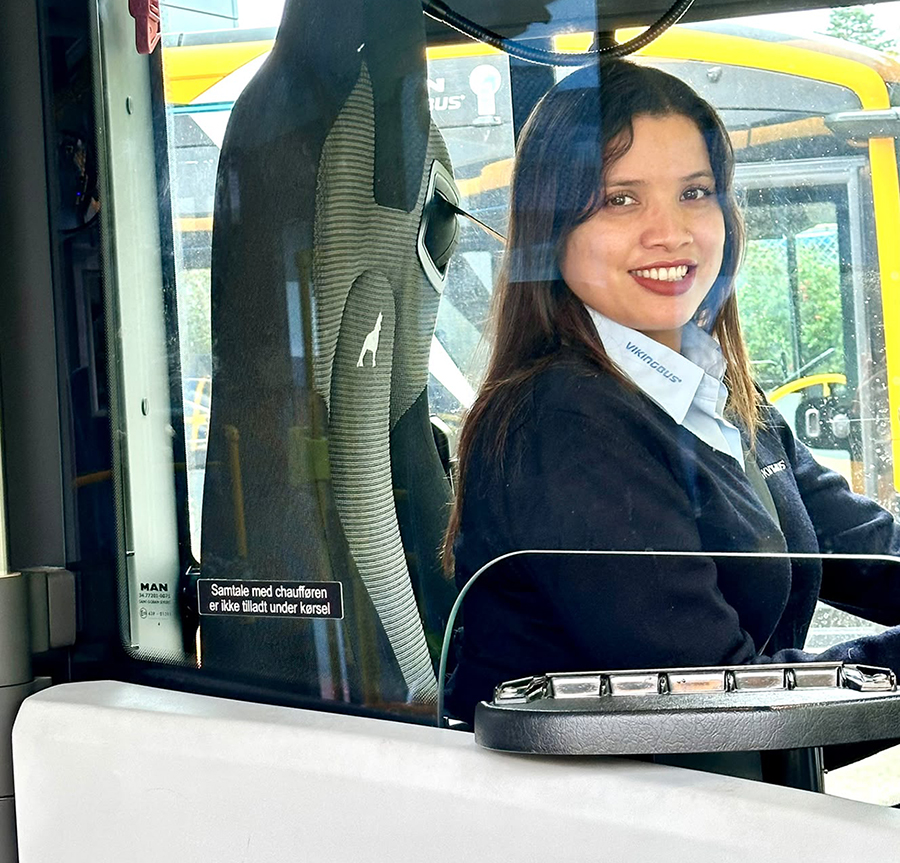
Khadka had been interested in training for work in hotels and restaurants, including learning to cook. But the longer course she wanted was financially out of reach, while the support she had been receiving through the job centre was coming to an end.
She needed a practical route into employment. A six-week bus-driver training course presented itself as an option. It was free, and it offered the chance to qualify for a new job. She decided to give it a try.
The first obstacle was not driving itself, but the language in which she had to learn to do it.
Everyday Danish was one thing. Technical vocabulary about vehicle mechanics, safety systems and road regulations was another. Understanding a lesson often meant translating it into a language she could process, then working through the material before she could move on.
Classes ran from 8am to 3.30pm, Monday to Friday, combining theory with practical instruction. For the first two weeks, she wondered whether she would be able to finish.
“I thought, perhaps I can’t do this,” she recalls.
The demands of the course were considerable, and the process of translating and understanding the material took time. But at home, her husband stepped in to take on the responsibilities that might otherwise have competed with her studies.
He looked after the children, prepared meals and managed the household.
“I didn’t have to come home and cook or do anything else,” Khadka says. “He took care of everything.”
That support allowed her to concentrate on the course and keep going when she was struggling. Then came the practical challenge of learning to handle a bus.
Driving a car and driving a bus were very different experiences. In a car, the driver sits behind the front wheels. In a bus, the driver’s seat is ahead of them, making it harder at first to judge the vehicle’s front end and its distance from obstacles.
During training, when an instructor told her to move further forward, she worried that the bus was about to collide with something.
Gradually, she began to understand the vehicle’s dimensions, the space it needed to turn and the distances she had to judge. Practice made the unfamiliar more manageable.
She came to recognise that the hardest part of starting a new job was not always the task itself. Sometimes it was the fear of not being capable of doing it.
An exam, a failure and another chance
Khadka worked hard on the theoretical part of her training, but the practical examination proved more difficult. On her first attempt, things went wrong within about five minutes. It could have been the end of the road. Instead, her instructors continued to believe she could pass.
They arranged additional practice before her second examination and encouraged her to trust the skills she had developed.
“You will pass,” they told her.
This time, she did. The qualification opened the door to a profession she had never imagined for herself.
On her first day as a bus driver, Khadka woke at 5am. Her shift was due to begin at around six. She went to the garage, collected her bus and drove to the designated station. Then, for the first time, she began carrying passengers.
The training room, where she had spent weeks wrestling with unfamiliar terminology and worrying about whether she could manage, was behind her. Now she was responsible for taking people where they needed to go.
Five years at the wheel
By August, Khadka had completed five years as a bus driver.
She says that around 30 to 35 Nepali men were already working as bus drivers in Denmark before she entered the profession, and she believes she was the first Nepali woman to do the job there. Since then, other Nepali women have joined the field.
Hearing that some of them drew inspiration from her experience has been a source of happiness. She knows what it means to begin with doubts. As a foreign woman taking charge of a public bus, she initially wondered how passengers would react. Would they question her ability? Would she face discrimination or harassment?
Five years of experience have largely eased those concerns. She says she has not experienced discrimination or mistreatment from passengers. Instead, she has often received positive responses.
Some passengers greet her warmly or compliment her. For Nepalis travelling on her bus, the encounter can be particularly meaningful. Seeing a Nepali woman in the driver’s seat sometimes prompts surprise, conversation and requests for photographs.
Some tell her that meeting her has made them realise they, too, might be able to do similar work.
For Khadka, such encounters bring her own beginnings into focus: the woman who arrived in Denmark without her children, struggled to understand a new language and accepted a training course without knowing whether she would succeed.
She is no longer the person who wondered whether she belonged behind the wheel. But she remembers what it took to get there.
The question of safety
Confidence has grown with experience, but Khadka does not suggest that driving a public bus is without its challenges. On early-morning shifts, when she sometimes had to drive alone through quiet streets in the dark, she worried about her safety. There was the uncertainty of encountering unfamiliar passengers, particularly at times when few other people were around.
Her company provided an emergency button that could summon assistance and alert the police if a problem arose. Knowing that help was available made her feel more secure.
For her, safety is not simply a matter of having rules in place. Workers must also believe that someone will respond when those rules are needed.
That is one of the lessons she believes Nepal should consider if it wants more women to work in public transport.
“Whether you are a woman or a man, you need safety,” she says. “But we need to create an environment in which women feel even more secure.”
The point, she argues, is not merely to encourage women to enter a male-dominated profession. It is to ensure that they have the protection and support needed to remain in it.
Danish buses, Nepali roads
Since beginning her job, Khadka has returned to Nepal two or three times. Travelling on public buses there has made her more conscious of the differences between the transport systems in the two countries. She points to the places where buses stop, the observance of timetables, the safety of drivers and passengers, and the conditions under which vehicles operate.
In her experience, Denmark places clear boundaries around a driver’s responsibilities. Drivers have a separate, protected space in the bus, and unnecessary conversation while driving is discouraged. Timetables are taken seriously, and if a bus is delayed, the company is informed.
In Nepal, she has observed drivers using mobile phones, passengers getting on and off at places other than designated stops, and more direct interaction between drivers and passengers while a vehicle is in motion.
These differences have left her thinking about what could be improved.
She believes better driver training, safer working conditions, passenger safety, reliable schedules, designated bus stops, vehicle maintenance and regular monitoring should all be priorities.
One principle from her training has stayed with her in particular: the driver’s own safety must come first.
A driver who is safe and able to concentrate is better placed to get passengers to their destinations safely. For Khadka, that principle is not simply a Danish workplace rule. It is an essential part of any conversation about improving public transport in Nepal.
The comparison is not just about roads or buses. It is about the systems surrounding the people who operate them, and whether those systems allow drivers to do their jobs safely and consistently.
No job is too big or too small
Khadka did not set out to become a bus driver. She entered the profession because a free training course offered a way forward when other plans proved difficult. Five years on, she is satisfied with her work.
Driving a bus is more than a means of earning a living. Every shift brings responsibility for the people on board, and getting them safely to their destinations is central to the job.
She does not describe the pay as exceptionally high compared with other professions. But regular employment, opportunities for overtime and additional allowances or pay associated with weekend and early- or late-shift work can make the job attractive.
After spending her first four years with one company, she moved to another closer to home. The shorter commute has made it easier to balance work with family life.
Her advice to Nepali women living abroad is straightforward. Decide what kind of future you want, learn the language and do not dismiss a job because it appears small or unfamiliar.
“No profession is big or small,” she says. “It is the way you look at it that makes it special.”
‘Turns out, I can’
Khadka grew up in a village in Baglung, Nepal. Today, she drives public buses on the roads of Denmark.
Sometimes, passengers from Nepal find themselves on her bus. When they realise their driver is Nepali, they are delighted. They strike up conversations, ask for photographs and tell her that they had never considered that a job like hers might be within their reach.
Those encounters take her back to the years when she was still trying to establish herself in a new country.
She remembers struggling to understand Danish while looking for work. She remembers returning to an empty room and crying for the children she had left behind. She remembers learning to ride a bicycle, then sitting behind the wheel of a bus for the first time, unsure whether she could judge its size or control its movements.
Back then, becoming a bus driver was not even a possibility she had considered. Her immediate concern was simply how to make a life in Denmark.
Now, taking the wheel early in the morning is part of her routine.
The transformation did not come from a long-held ambition or a carefully mapped career plan. It began with an opportunity she had not expected, a decision to try something new and the determination to continue when the first weeks seemed overwhelming.
Five years ago, she asked herself a question that many people face when confronted with an unfamiliar challenge: Can I really do this?
Today, she needs only a few words to answer it.
“Turns out, I can.”