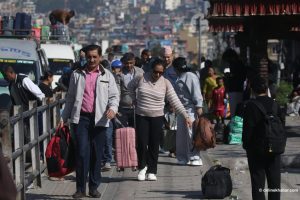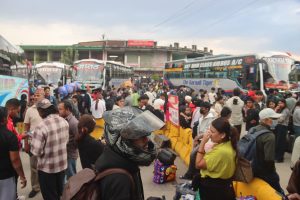


More than 1.3 million people left Kathmandu Valley for last year’s Dashain alone. For a few days the capital empties out, and every road leading away fills up. In those same days, families buy and carry home close to 100,000 goats, a trade worth over three billion rupees. Homes stay lit for five nights of Tihar, enough to push the country’s electricity demand toward 1,300 megawatts. This is what an ordinary year looks like: people moving, money changing hands, lights in every window.
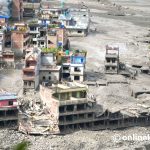
The rivers have not let up since August. The Bhote Koshi came first, into Rasuwa, after a glacier gave way above it. That water killed 1,455 people and left 5,285 more missing. It took down over 7,500 houses and upended 84,000 lives, more than a third of them children. The search was called off in early October. Five weeks later, it was the west’s turn. Twenty-one people died across Baglung, Myagdi, Palpa and Dhanusha. More than 1,500 lost their homes, and Manang and Mustang went dark.
Put those numbers side by side. In a fortnight, this country can move 1.3 million people across its own hills and trade three billion rupees in goats. It could not bring 5,285 of its own people home this year. Against the scale of the season, that number is small. To the families still waiting, it is everything.
It shows at Dashain first, which began on the eleventh and builds to Tika on the twenty-first. On the first day, Ghatasthapana, a family sows barley seed in a tray of sand. They set it somewhere dark in the house and water it for nine days. By the tenth the shoots come up pale and soft. They are cut and pressed onto the heads of everyone the family loves, with an elder’s blessing. It is a small ritual, and it asks for two people: one to sow the seed, one living to receive it. This year, in some houses, the one who would have sown the tray is among the missing. In others it is the one who would have knelt for the blessing. The tray may simply stay empty.
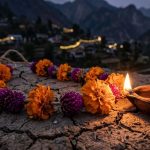
Tihar comes a fortnight later. Its best-known day, Bhai Tika, belongs to sisters and brothers. A sister strings a garland of Makhamali, the globe amaranth. It holds its colour long after it is cut. She puts it around her brother’s neck. The gesture repeats an old bargain: Yamaraj, death himself, agreed to spare a brother’s life as long as that garland kept its colour. Sisters do this every year without thinking of it as bargaining with death. This year, in homes across the flood-hit districts, there is no brother to put the garland on, and no one to strike the bargain with. The lamps that push the country’s power demand to its Tihar peak are meant to welcome people home. Some will burn this year for someone who did not come.
Then comes Chhath, kept at the river’s edge. On the third evening people stand waist-deep in the water and pray to the setting sun; on the fourth morning they come back to greet it rising. For families across Nepal it means wading into the same rivers that took a neighbour, a cousin, a friend this season. The sun will still set. The rite still calls them to the water.
The trays were meant to be sown on the morning of Ghatasthapana. The third river came down before dawn that same day. A landslide above the Budhi Gandaki seems to have dammed a tributary and then let go, carrying the water into Gorkha. Thirty-five to forty houses went at Jagat Bagar, Salleri and Ghattikhola. So did four bridges, among them the one at Arughat that ties Gorkha to Dhading, and the camp of the 341-megawatt Budhi Gandaki project. Helicopters worked through the day, and several people are still missing. It arrived on the morning Dashain began.
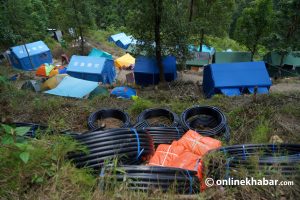
What Gorkha faces now, Rasuwa has been living with for six weeks. Nepal marked a national day of mourning on the seventh of September, the thirteenth day, when Hindu rites close mourning. Flags came to half-mast and the formal grieving ended on schedule. More than 14,500 children are still making up lost lessons. Most of the 4,500 who sheltered in tarpaulin camps now rent rooms around Bidur. The camps became unlivable, and the resettlement they were promised has still not come.
The festivals will arrive anyway, on schedule, as they always do. Households that lost nothing will keep them. So will households still waiting for word on someone who has not come home, often in the same village, sometimes the same street. The country holds both. What it owes the second has not changed since the water went down: rebuild their schools, their roads, their houses. And in a season built around who gets to come home, leave room for the ones who have not.
The villages still standing are owed something too. Each time, the warning started only once the water was moving, late for anyone near the top of it. Watching the slopes before they let go takes more eyes than one country keeps on a range this long. The families below them need more minutes than they are getting. A few minutes is not a large thing to ask the world for.
That kind of help takes years. Meanwhile Nepal has always been good at the quieter thing: standing close to each other when it is hard. Over the coming days people who waited months for a flight will touch this soil again. More than a few will walk into a house that is missing someone. The smile at that door may come a little unsure of itself this year. Nepalis have long known the harder kind of welcome anyway: sitting with someone’s grief without talking them out of it, and making room at the table whatever god a neighbour prays to, whatever language a guest greets them in.
Somewhere this season a family with little will cook enough for the family next door with less. A blanket will move from a house that can spare it to one that cannot, as it has in every hard winter this country has known. No report will record any of it. The hope is simple: that people find their feet with a hand on their shoulder, that they say the names of the ones they are missing out loud instead of alone, and that the hills hold so no one else has to be counted. Maybe they will find something in each other’s eyes brighter than any diya lit this Tihar.
None of that needs a ritual or an occasion. On a bus home this week, or in a courtyard strung with lights, a stranger’s eyes will hold someone else’s a moment longer than usual. It costs nothing to let that moment turn into a greeting with a smile. Whatever joy these festivals carry has always come from the people inside them, one smile at a time. This year, more than most, that smile is worth giving.