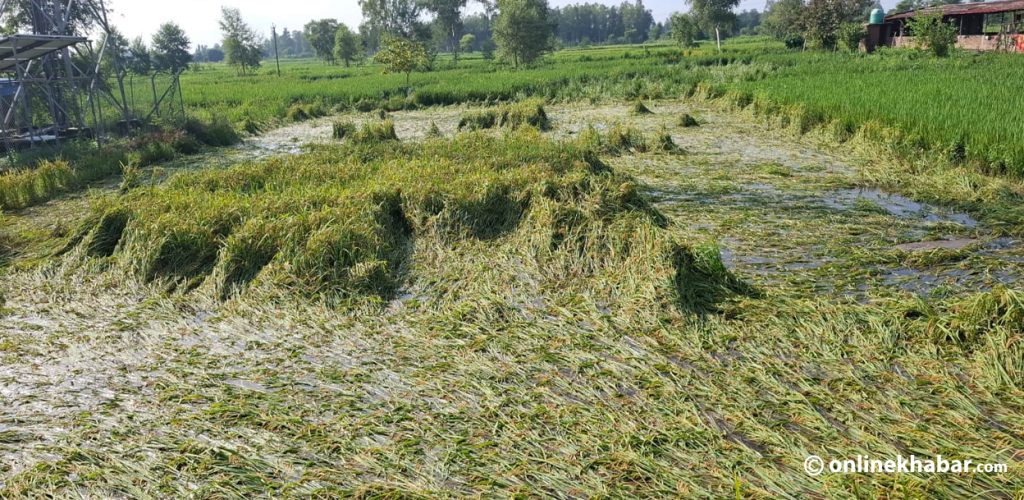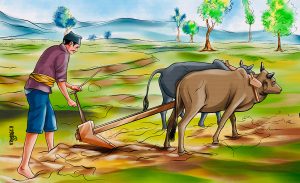


Continuous rainfall and strong winds across the country towards the end of the monsoon have caused extensive damage to agricultural crops, including paddy, sugarcane and vegetables that were ready for harvest.
Farmers who had hoped for clear weather are now struggling as harvested paddy left to dry in the fields and crops awaiting harvest have been soaked or submerged.
After struggling with shortages of irrigation facilities and fertilisers, farmers have seen their year-long efforts and investments threatened by untimely rainfall just as they prepare to bring in their harvest. With agricultural production expected to decline, Nepal could face additional expenditure of billions of rupees on food imports.
Seed paddy damaged in Banke, crops at risk of rotting in Dang and Salyan
In Dang’s Gadhawa, Rajpur and Rapti rural municipalities, paddy harvested and left to dry in the fields has been thoroughly soaked. Farmers fear the grain could rot or deteriorate in quality if they cannot dry it promptly.
The Kumakh Rural Municipality in Salyan said a flood in the Ikhre stream in Ward 3 had completely destroyed nearly 50 ropanis of paddy fields where the crop was nearing maturity.
Himal Yogi, a farmer from Ward 1 of Sharada Municipality, said continuous rainfall had flattened and damaged paddy crops.
He expects paddy production to decline this year compared with last year because of fertiliser shortages during cultivation and the impact of the recent rainfall.
“The paddy has already been flattened and damaged. The rain has had a significant impact,” Yogi said. “Production is unlikely to increase compared with last year. We could not get fertiliser this year either. We somehow managed to plant the crop, only for the fields to be flooded by the rain.”
According to Yogi, harvesting has already begun in some areas of Salyan. Paddy grown from early-maturing seed varieties and harvested earlier has also been soaked by the rain. He said harvesting would begin in most areas around the district headquarters within a week.
Farmers plan to dry and store their paddy even if water remains in the fields, using plastic sheets as a base if necessary.
Wednesday’s rainfall also damaged seed paddy in Banke. Jaman Singh Wali, manager of Sakar Agricultural Cooperative in Rapti Sonari, said strong winds and rain had damaged seed paddy planted on around 150 bighas of land, raising concerns about a possible shortage of seeds next year.
Sujita Sharma, information officer at the Agriculture Knowledge Centre in Banke, said rainfall at harvest time had caused extensive damage to paddy crops. According to her, paddy had been planted on 33,503 hectares in the district this year. As reports of damage continue to arrive from different areas, authorities are collecting data to establish the extent of the losses.
Sugarcane farmers in Mahottari and Sarlahi face double losses
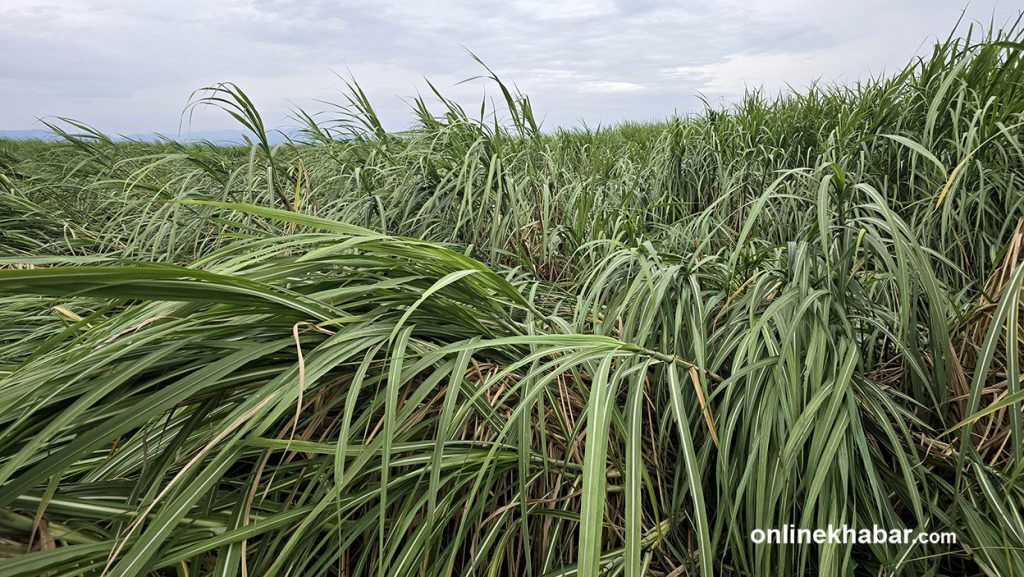
In much of Madhes Province, considered the country’s grain belt, ripe paddy has been flattened and fields inundated. In northern Mahottari, sugarcane farmers have also suffered a double setback.
Farmers had borrowed money and hired labourers to lift and tie sugarcane that had been flattened by strong winds in July. However, the recent rainfall and strong winds flattened the crop again, forcing farmers to incur additional labour costs for the same crop. Local farmers say their production costs have risen, while their hopes of making a profit have faded.
Continuous rainfall accompanied by strong winds for three to four days from September 24 caused heavy damage to the sugarcane farm of Gopindra Yadav in Ward 1 of Bishnupur Rural Municipality, Siraha.
Yadav had leased around three bighas of land to cultivate sugarcane. He is worried after strong winds flattened the crop in which he had invested nearly Rs 400,000, borrowing money to cover the costs.
He had expected to earn up to Rs 1 million if the crop yielded well. However, with the sugarcane plants flattened by the disaster, he now fears he may not even recover his investment.
Rajkumar Upreti, central president of the Sugarcane Producers’ Farmers Association, said the recent rain and strong winds had flattened around 70 to 75 per cent of sugarcane crops in Sarlahi and Mahottari. He said the winds had knocked down sugarcane that had grown well after receiving adequate rainfall.
“The strong winds have devastated the sugarcane crop. Almost all the well-grown sugarcane has fallen over. Once flattened, it becomes vulnerable to rats and may rot, decay or dry out,” Upreti said. “It cannot easily be lifted now, as doing so would break the stalks and cause further damage. This is a major loss for farmers.”
He complained that despite the extensive damage, local governments, Agriculture Knowledge Centres and administrative authorities had shown little interest in assessing the losses.
“So far, no one from the government, municipalities, rural municipalities, administration or Agriculture Knowledge Centres has come to assess the damage, understand the losses or make inquiries,” he said.
The Agriculture Knowledge Centre in Mahottari said recent rainfall had left fields waterlogged just as farmers were preparing to harvest paddy.
Abiral Kumar Mahato Kushwaha, horticulture development officer at the centre, said the fields had been inundated, although a complete assessment of the damage had yet to be received.
“Paddy that has only recently begun to produce ears has not suffered much damage. However, farmers are struggling to harvest crops that were ready to be brought in because of the rain,” he said. “Farmers are worried because their ripe paddy has been submerged.”
The centre is coordinating with all local governments in the district to assess the impact on crops. Based on information received from local governments, Kushwaha said the situation did not yet appear to warrant serious alarm.
The centre expects the inundated crops to recover as the weather improves. “The weather is beginning to clear. As it does, the water levels will recede, and the crops will recover,” he said.
Widespread damage to crops and livestock
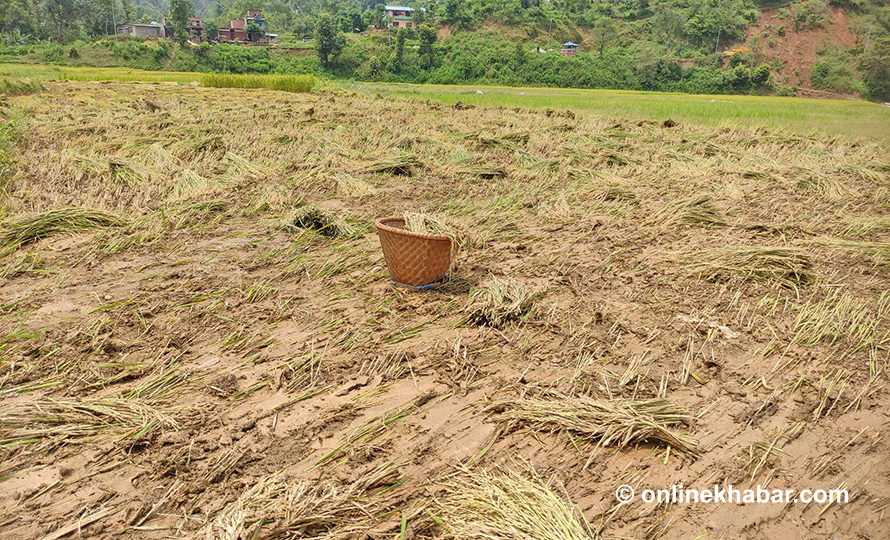
The damage has extended beyond paddy and sugarcane to millet, soybeans, black gram and vegetables. A rapid assessment report by the National Disaster Risk Reduction and Management Authority had earlier documented extensive losses caused by devastating floods in areas including Rasuwa and the Bhotekoshi region.
Floods and landslides are estimated to have destroyed 5,843 tonnes of paddy grown on 1,669 hectares and 1,843 tonnes of vegetables cultivated on 137 hectares. More than 252,000 livestock and poultry have also died across the country, while numerous fish ponds have been washed away.
Floods and landslides have deposited mud and sand on some agricultural land, turning it into barren riverbeds and making cultivation impossible even in the next planting season.
Untimely rainfall and strong winds damaging ripe crops in October are not new. Last year, similar unseasonal rainfall in October and November inundated paddy, maize, millet, orange and vegetable crops across thousands of hectares, causing losses worth billions of rupees.
Farmers in Sudurpashchim, Lumbini, Bagmati and Koshi provinces were particularly hard hit as harvested paddy left to dry in the fields, along with crops ready for harvesting, rotted before they could be brought home.
In recent years, unexpected rainfall towards the end of the monsoon has increasingly become a recurring challenge for farmers.
Farmers have repeatedly expressed frustration over what they describe as the government’s lack of attention to disaster preparedness, effective implementation of agricultural insurance and timely relief distribution, despite such disasters recurring almost every year.
Crop damage poses technical challenges as government assesses losses
When paddy fields remain submerged for extended periods, the roots can be deprived of oxygen, causing the stalks to rot. Mature grains may also sprout while still on the panicle, while rice quality can deteriorate and the grains may turn black. Fungal and bacterial diseases, including bacterial leaf blight and sheath blight, can also spread rapidly.
Agricultural technicians advise farmers to drain standing water from fields immediately by opening drainage channels. They also recommend removing flattened or harvested paddy from muddy fields and spreading it on tarpaulins or in elevated, dry areas with adequate ventilation. Before storage, the grain should be dried thoroughly to reduce its moisture content.
If standing, immature crops show signs of disease, farmers are advised to consult experts and apply appropriate fungicides as recommended once the weather clears.
Meanwhile, the government says it has begun collecting data on damage to agriculture and livestock across the country.
Prakash Sanjel, director general of the Department of Agriculture, said provincial and local governments were collecting the figures.
“We have requested damage reports from the provinces, and data collection is underway there. A complete report has not yet arrived at the federal level,” he said.
As local governments and Agriculture Knowledge Centres continue to assess the losses, affected farmers are demanding immediate relief and assurances of compensation through agricultural insurance.