

Kathmandu, October 8
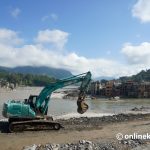
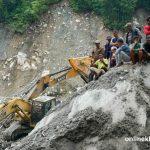
The government has begun preparations to build temporary homes for people affected by the devastating Bhotekoshi-Trishuli floods of August 26.
The National Disaster Risk Reduction and Management Authority has called on non-governmental organisations willing to construct temporary homes to provide details of how many houses they plan to build and in which local governments.
The authority has asked organisations to specify the number of temporary homes they intend to construct, their locations and the names of the respective local governments. They have also been asked to submit work plans indicating the estimated time required for construction and the deadline for completion.
Organisations that have already signed agreements to construct temporary homes in flood-affected areas have also been asked to provide details of those agreements.
NGOs will be allowed to construct the temporary homes in coordination with the Department of Urban Development and Building Construction and the concerned local governments.
According to Prakash Aryal, deputy director general of the department, proposals submitted by organisations will be assessed against basic building code requirements. Designs meeting the required standards will be approved and organisations will then be permitted to proceed with construction.
“Since these are temporary homes, the same design cannot be applied to every geography, location and district,” Aryal said. “But we will assess whether the proposed structures meet the minimum safety standards required for the particular location.”
The government’s own temporary housing programme will also follow the same standards, he said.
Aryal said the government was prioritising safety because it was unclear how long families would need to remain in the temporary homes.
“We do not know exactly when families will leave temporary housing,” he said. “Therefore, the structures will be built to provide safe accommodation and minimise the risk of being affected by another disaster.”
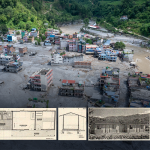
The government is generally preparing to build two-room temporary houses covering around 320 square feet for each family.
The 37th meeting of the Disaster Risk Reduction and Management Executive Committee, held on September 30, had approved model designs for temporary housing. The meeting decided that the designs would be used as reference materials for construction.
The meeting also decided to identify potentially safe locations for temporary settlements based on a report submitted to the government by a committee formed by the Ministry of Land Management, Cooperatives and Poverty Alleviation and the Ministry of Federal Affairs and General Administration.
Local governments will identify suitable locations from those listed in the report. The Department of Mines and Geology or geological experts will then conduct geological assessments of the identified sites.
Based on the assessment, the Ministry of Physical Infrastructure Development will coordinate with district administration offices and the authority to construct temporary settlements, with partner organisations also being mobilised.
Relevant government agencies will arrange essential infrastructure such as roads, electricity, drinking water, sanitation and communications at the sites. The meeting also decided that relevant ministries would amend existing legal provisions if necessary to facilitate these arrangements.
400-500 families may need temporary homes initially
The Department of Urban Development and Building Construction had earlier conducted a survey in coordination with local governments to determine the number of flood-affected families requiring temporary housing.
The initial assessment indicates that around 400 to 500 families may require temporary homes.
“Some affected families are currently living in rented accommodation, while others are staying with relatives,” Aryal said. “At the first stage, we have identified a need to build temporary homes for around 400 to 500 families. This number could increase as the work progresses.”
The state will also have a responsibility to provide temporary housing to affected families currently living in rented accommodation if they wish to move into such homes, he said.
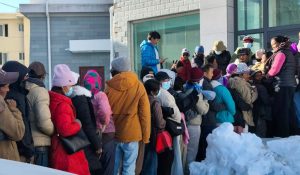
According to the latest figures, 17 holding centres are still operating in the flood-affected areas. Four centres in Nuwakot are housing 121 people, while nine centres in Rasuwa are accommodating 843 people. Another 121 people are staying at four holding centres in Dhading.
The government has decided to provide families unwilling to remain in holding centres with up to six months of accommodation and livelihood support until alternative housing is arranged.
A family of up to four members will receive Rs 15,000 per month. Families with more than four members will receive an additional Rs 2,000 per additional member.
The authority said the procedure for receiving the assistance has been finalised and sent to the concerned local governments for implementation.
Temporary homes could cost up to Rs 500,000
According to the department, the cost of a temporary home could range from Rs 200,000 to Rs 500,000.
The houses will not follow a single model across all locations. Organisations will also propose designs based on their available budgets, which could result in differences in construction costs.
Aryal said the estimated cost was necessary to provide safe accommodation with basic facilities.
The government has yet to prepare a detailed reconstruction plan for the flood-affected areas.
However, Minister for Physical Infrastructure Development Sunil Lamsal has already informed a parliamentary committee about plans to develop a new smart city in the affected areas.
Such permanent arrangements will take considerable time to develop, meaning affected families are expected to rely on temporary housing in the interim.
The Bhotekoshi-Trishuli floods affected a total of 32,936 people, according to authority data.
A total of 8,317 households were affected, while 7,570 private buildings were damaged in the disaster.