

Kathmandu, October 5
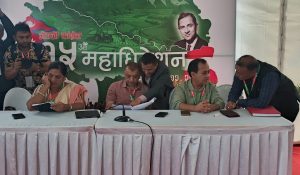
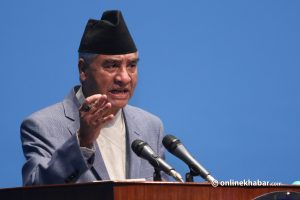
Had Sher Bahadur Deuba arrived to occupy the chief guest’s chair at the Nepali Congress general convention, Gagan Thapa might have had one less thing to worry about.
As he began addressing the gathering, the newly elected Nepali Congress president briefly appeared unsure about whom to acknowledge first. Then he seemed to remember that he was no longer simply one of the party’s leaders. He was its president, and the responsibility of managing the moment was now his.
The small hesitation was symbolic of a larger transition underway in Nepali politics.
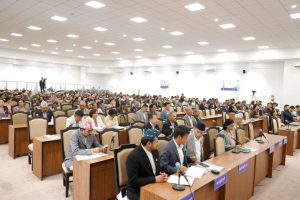
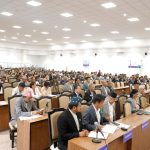
Thapa was presiding over a Nepali Congress convention at which the party’s old leadership was conspicuous by its absence, while leaders of newer political forces were on the stage questioning the party’s legacy, its relevance and even its claim over its own voters.
Rastriya Swatantra Party President Rabi Lamichhane, who spoke before Thapa, captured that tension with a carefully chosen line.
“You have become party president at the age of 50. If you had taken the inspiration to become president at 40, I might have become a Nepali Congress member too,” he said.
The remark was delivered almost poetically, and Lamichhane returned to the phrase several times. It was both a compliment and a provocation.
He was speaking at the convention of a party that had dominated Nepali politics for decades, while leading a party that has emerged as one of the strongest challengers to that political order.
Lamichhane then offered perhaps the most telling assessment of Nepali Congress.
“Nepali Congress’s strength is its history. But its weakness is also its history.”

There was little need to explain the contradiction.
Nepali Congress’s history is inseparable from Nepal’s democratic struggles. But the same history carries the weight of its years in power, its compromises, its failures and the public frustrations that have helped create space for parties such as the RSP.
Lamichhane pushed that point further by telling the Congress gathering that some of those present may have voted for the RSP’s election symbol, the bell.
The message was clear. No political party owns its voters.
If a party does not perform, voters can leave.
That was more than a jab at Nepali Congress. It was a statement of the political philosophy that helped bring the RSP into existence in the first place.
Yet Lamichhane’s speech also revealed the limits of the new politics he represents.
He was at a Congress convention, criticising an old party for its history, while leading a party that is itself now part of the establishment. His remark, “Jai Nepal. But not for the party, for the country,” was another attempt to draw a line between national politics and partisan politics.
But the line is becoming increasingly difficult to maintain.
Political movements that begin by challenging the establishment eventually acquire establishments of their own.
That may explain some of the unusual chemistry between Lamichhane and Thapa.
The two have been allies at times and fierce opponents at others. Their disagreements, particularly during the cooperative fraud controversy and its political fallout, were public and bitter.
Yet there remains a sense of familiarity between them.
Lamichhane has previously pushed Thapa to take a more assertive leadership role. At that time, Thapa was not ready to make that leap, and Lamichhane himself had not yet decided to establish a new political party.
Now the political landscape has changed dramatically.

Thapa leads the Congress. Lamichhane leads the RSP. Balendra Shah, the RSP-backed prime minister, occupies the centre of government.
And yet neither Thapa nor Lamichhane appears entirely comfortable with where they have arrived.
Nepali Congress has lost electoral ground despite its enormous political legacy. The RSP has demonstrated extraordinary electoral strength but has also become part of the very system it once challenged. Lamichhane has helped bring a prime minister to power but does not himself hold the government.
Their exchange at the Congress convention therefore felt less like a battle between two political winners and more like two leaders negotiating the pressures created by their own success.
Thapa’s response to Lamichhane made that particularly clear.
When Lamichhane suggested that some people at the Congress convention had voted for the RSP, Thapa reminded him that Congress had also sent many people into the RSP—including office-bearers and lawmakers—and had, in his words, trained them.
It was a clever retort, but hardly a knockout blow.
Neither man truly defeated the other.
Instead, their exchange exposed the insecurity running beneath both political projects.
That insecurity was also visible in the symbolism of Khulamanch.
Thapa has repeatedly used the open ground as a metaphor for the kind of politics he believes Nepal needs. Khulamanch has historically been a place where anger, dissent, questions and political demands could be expressed openly.
His criticism of Prime Minister Balendra Shah’s absence from Parliament was therefore not merely about attendance.
For Thapa, a Parliament that does not have the prime minister appearing before lawmakers cannot truly function as an open political forum. The absence becomes symbolic of a wider closing of political space.
He extended that argument to political parties themselves.
Questions must be allowed. Leaders must be challenged. Party members should not lose their membership simply because they disagree with their leaders.
In other words, democracy cannot be demanded from the state while being denied inside political parties.
That argument is particularly significant coming from a new Congress president who has inherited one of Nepal’s oldest political organisations.
Thapa’s speech also carried a personal dimension that was less visible in his earlier appearances.
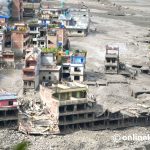
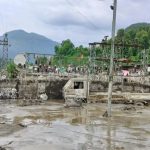
When he recalled the two Congress workers swept away in the Rasuwa floods, his voice became emotional. For a moment, the political contest disappeared and the new Congress president sounded less like a party leader delivering a carefully managed address and more like a politician confronting the human cost of the country’s continuing crises.
Lamichhane, meanwhile, took a different opportunity.
Thapa had strongly criticised the prime minister for not attending Parliament. Lamichhane was even more pointed about Deuba’s absence from the Congress convention.
His message was that the absence of one or several individuals should not determine the fate of a political institution.
For Thapa, that argument may have offered some relief. The Congress convention did not collapse because Deuba was absent.
But it also exposed the irony of the moment.
The RSP was born by questioning the relevance of old political leadership. Yet its own rise has now placed it in a position where its leaders must answer questions about institutional responsibility, government performance and the conduct of power.
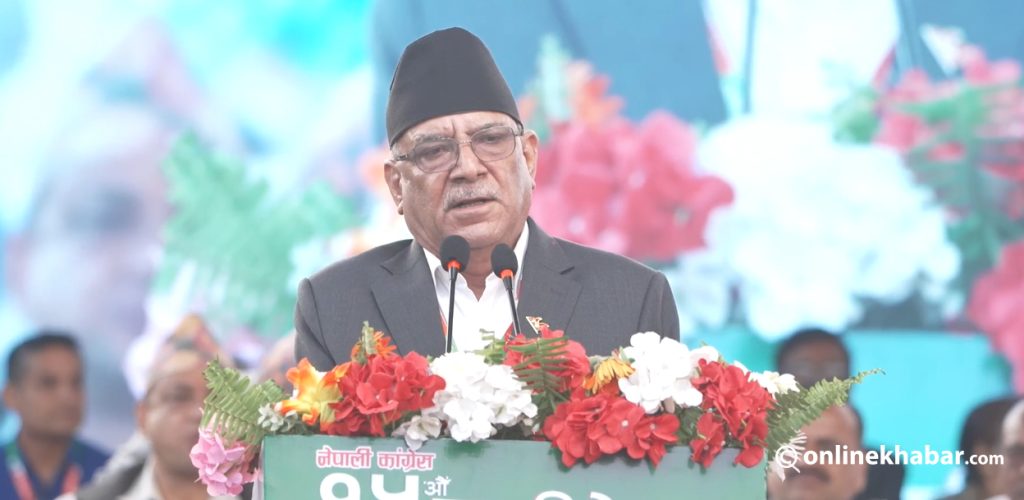
This is perhaps where Pushpa Kamal Dahal “Prachanda’s” intervention becomes interesting.
Prachanda looked back at the political journeys of leaders who had once served under him and spoke of “breaking the pattern.”
“There was a time when I used to break the pattern. The kind of pattern-breaking I used to talk about has been done by Gaganji. Now Ravi-ji should do it too,” he said.
The phrase was deliberately vague.
What exactly is the next pattern Lamichhane is supposed to break?
Prachanda did not say.
Perhaps the answer is power. Lamichhane helped disrupt the old party system but has yet to translate his personal political influence into formal power within government.
But there was another irony in Prachanda’s call.
A leader who once built his political identity around breaking established political patterns was now asking the leaders of other parties to do the breaking.
That may say as much about the present state of his own party as it does about Congress or the RSP.
Prachanda also urged Thapa not to leave behind those who had been separated from him, telling him to move forward while taking them along.
His emphasis on respecting history was understandable. But political change has always involved questioning history.
Every major political movement in Nepal has, in one way or another, challenged the order that came before it.
Prachanda himself knows that better than most.
The question now is whether the new generation of politicians will merely inherit that history or genuinely challenge it.
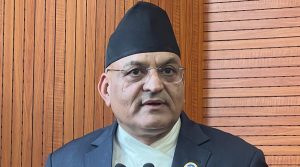
That question was also present in UML General Secretary Shankar Pokharel’s remarks.
Pokharel recalled the days when he and other student leaders stood against the Rana regime, the Panchayat system and King Gyanendra’s rule.
“We stood together against the Rana regime, the Panchayat and Gyanendra’s rule. Now is the time for us to stand together again so that we do not allow frustrated young people to become even more frustrated,” he said.
It was an appeal for political cooperation at a time when the traditional parties are under increasing pressure from younger voters.
But Pokharel also acknowledged that simply changing faces would not be enough.
“Simply changing faces will not solve anything. The need for a new political revolution still remains,” he said.
That may have been one of the most important lines delivered at the Congress convention.
Because the political debate in Nepal is no longer simply about who should lead Congress, who should lead the RSP or who should become prime minister.
It is increasingly about whether changing political faces can produce a fundamentally different political system.
Congress is attempting to renew itself under Thapa without abandoning its history. The RSP is attempting to remain a force of disruption while exercising the responsibilities of power. The UML is arguing for cooperation while confronting the demand for generational change. And Prachanda, once the great disruptor himself, is urging others to break the patterns that he once claimed as his own.
The contradictions are obvious. But perhaps that is precisely what made the Congress convention revealing. The speeches were full of history, rivalry, nostalgia, criticism and political theatre. Beneath them, however, was a common recognition that Nepal’s political order is no longer as stable as it once appeared.
The old parties cannot rely on history alone. The new parties cannot rely on novelty alone. And changing faces, as Pokharel himself acknowledged, may not be enough. The real test is whether any of them can change the political habits that produced the frustration in the first place.