
Gumsipakha, in Laprak of Dharche Rural Municipality, Gorkha, is more than a remote mountain settlement. It is an ancestral homeland of the Gurung community, shaped by generations of social relationships, cultural traditions, agriculture, livestock, natural resources and collective life. Its homes, landscape, cultural practices and community institutions remain central to local identity and belonging.
Yet an important question is emerging. Why are younger and economically active residents increasingly reluctant to live permanently in Gumsipakha despite their strong ancestral, cultural and family ties?
The answer cannot be explained by migration, housing conditions or declining attachment alone. Settlement decisions are increasingly shaped by livelihoods and employment, education, healthcare, connectivity, basic services, disaster and environmental safety, digital access, household needs and changing aspirations.
People may remain deeply connected to Gumsipakha while living elsewhere because the settlement does not yet provide the opportunities, services, security and quality of life they require.
The challenge, therefore, is not simply to retain the population. It is to create conditions that allow people to choose to stay, return, invest and build a secure and dignified future in Gumsipakha.
The changing meaning of permanent settlement
In traditional agrarian societies, permanent settlement was closely tied to land, agriculture, family, culture and community networks. Today, residential decisions are increasingly shaped by livelihood opportunities, education, healthcare, connectivity, basic services, safety, mobility and aspirations for personal and professional development.
A household may own a house and farmland in Gumsipakha, participate in cultural and community life, and maintain strong ancestral ties while living elsewhere for employment, education, healthcare or other opportunities.
Migration or temporary residence, therefore, does not necessarily indicate weakened attachment. It may simply reflect changing household needs and aspirations.
Permanent settlement cannot be measured by housing or land ownership alone. A sustainable settlement must enable people to live safely and with dignity, secure livelihoods, access essential services and opportunities, maintain social and cultural connections, and adapt to changing economic and environmental conditions.
For Gumsipakha, the priority is not merely to preserve houses and infrastructure, but to create a safe, inclusive, economically viable, culturally vibrant and environmentally resilient community for present and future generations.
Livelihoods: The foundation of settlement
Reliable and diversified livelihoods are essential to Gumsipakha’s long-term viability. Agriculture and livestock remain central to household food security and income, but limited and fragmented land, steep terrain, high transport and input costs, weak market access, labour shortages and climate variability constrain their profitability.
Traditional farming may support household consumption and supplementary income, but often does not generate sufficient and predictable cash income to meet growing needs for education, healthcare, transport, communication and other services.
Limited economic diversification further encourages working-age residents to migrate. Opportunities in high-value agriculture, livestock, agro-processing, tourism and homestays, small enterprises, construction, services and digital or remote work remain limited.
This can create a reinforcing cycle: fewer working-age residents reduce local economic activity and demand, which limits jobs and services and further increases incentives to migrate.
Breaking this cycle requires a diversified, market-linked local economy that builds on agriculture and livestock while expanding value addition, tourism, entrepreneurship, skills, digital connectivity, financial services and access to wider markets and employment.
The objective is not to prevent migration, but to create viable choices to live, work, invest, return and build sustainable livelihoods in Gumsipakha.
Migration: Opportunity and challenge
Migration should not be viewed inherently as a negative development. For many households, migration and foreign employment provide essential income, improve living conditions, support education and healthcare, and strengthen household resilience.
However, prolonged out-migration can alter the demographic and economic structure of Gumsipakha. When working-age people spend much of their productive years elsewhere, older residents may increasingly bear responsibility for households, agricultural land and community affairs. This can contribute to labour shortages, declining agricultural activity and weakening local institutions and social networks.
Migration also changes aspirations. Exposure to urban environments, higher education, technology, new occupations and different lifestyles can reshape younger generations’ expectations of life and opportunity.
The objective should therefore be to expand meaningful choices rather than prevent migration. Gumsipakha should provide conditions that enable people to stay, return, invest or work while maintaining strong connections with their ancestral community.
Migrants can also be an important resource, bringing skills, savings, professional networks, technology and investment back to the settlement.
Education and healthcare
Education and healthcare are fundamental to long-term settlement viability. Families make residential decisions largely around the wellbeing and future prospects of their children and dependants.
Limited access to quality secondary education, technical and vocational training, higher education and specialised learning can encourage families to relocate closer to educational centres. Over time, children’s education, employment and social networks established elsewhere may further weaken a household’s residential connection with Gumsipakha.
Healthcare is equally important, particularly for older people, women, children, people with disabilities and households requiring regular or specialised care. Limited access to reliable primary healthcare, essential medicines, emergency services and timely referral can make remote settlement increasingly difficult.
For Gumsipakha to remain viable, residents need reasonable and dependable access to quality education and essential healthcare, including emergency and referral services. These are not simply social priorities; they are conditions that influence whether families remain, return and invest in their community.
Accessibility and connectivity
Physical accessibility is another fundamental determinant of rural settlement viability. A road can improve access to services, markets and economic opportunities, but the presence of a road alone does not guarantee effective accessibility.
Road quality, year-round reliability, maintenance, travel time, transport availability, affordability and seasonal disruptions all shape actual mobility. Poor or unreliable connectivity increases the cost of agricultural inputs, food, construction materials, healthcare and other essential goods and services. It can also limit market access and reduce the competitiveness of local products.
Digital connectivity is becoming equally important. Reliable mobile networks and internet access can expand opportunities for education, information, financial services, markets, government services, remote employment, entrepreneurship and social interaction.
For younger generations, digital exclusion can reinforce the disadvantages of physical remoteness.
Settlement viability therefore depends not only on improved roads, but on reliable and affordable physical and digital connectivity linking residents to essential services, markets, institutions and wider economic opportunities.
Disaster risk and confidence to stay
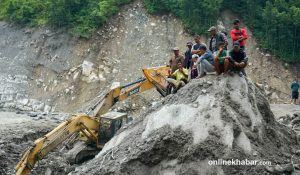
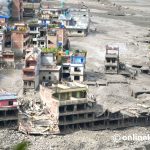
The 2015 Gorkha earthquake underscored the importance of settlement safety and disaster resilience in mountain communities. Gumsipakha remains exposed to multiple hazards, including earthquakes, landslides, slope instability, intense rainfall, floods, road failures and other climate- and terrain-related risks.
Reconstructing or strengthening individual houses alone is not sufficient. Long-term settlement viability depends on residents’ confidence that the settlement as a whole is safe, accessible and resilient to future hazards.
This requires risk-sensitive land-use planning, hazard-informed site selection, resilient housing and public infrastructure, stable access roads, reliable water systems, effective drainage, emergency preparedness, early warning where appropriate, and functional disaster-response and evacuation arrangements.
A permanent settlement requires more than a physical place to live. It requires a safe and resilient environment that gives households confidence to remain, return and invest in their future.
Changing families and social relationships
Family structures and social relationships in rural communities are changing. Traditional extended households are increasingly influenced by nuclear families, migration, intergenerational separation, education and changing employment patterns.
A household may have parents living in Gumsipakha, children studying elsewhere and working-age members employed in Kathmandu or abroad. Such families may retain strong emotional, cultural, social and economic ties to the settlement without maintaining year-round residence.
This highlights an important distinction between belonging and habitation.
People may continue to identify with Gumsipakha, maintain property and social relationships, participate in community affairs and return periodically without permanently residing there.
Recognising this distinction is essential for realistic settlement planning. The future of Gumsipakha should be understood not only in terms of permanent residence, but also through continuing community affiliation, cultural identity, family connections, periodic residence and engagement from outside the settlement.
Cultural attachment is not enough
Gumsipakha’s cultural heritage is a major source of identity, continuity and community cohesion. Its language, traditions, rituals, architecture, social institutions and ancestral practices reflect generations of cultural knowledge and collective life.
However, cultural attachment alone does not guarantee permanent residence.
Younger generations may retain a strong emotional and cultural connection to Gumsipakha while seeking education, employment, healthcare and other opportunities elsewhere. If this pattern continues across generations, traditional knowledge, language, cultural practices and community institutions may gradually weaken.
Cultural preservation should therefore be integrated with broader economic and social development. A culturally vibrant settlement must also be a socially, economically and physically viable place to live, work, raise families and maintain intergenerational connections.
From reconstruction to sustainable settlement
The central lesson is clear: reconstruction and sustainable settlement are not synonymous.
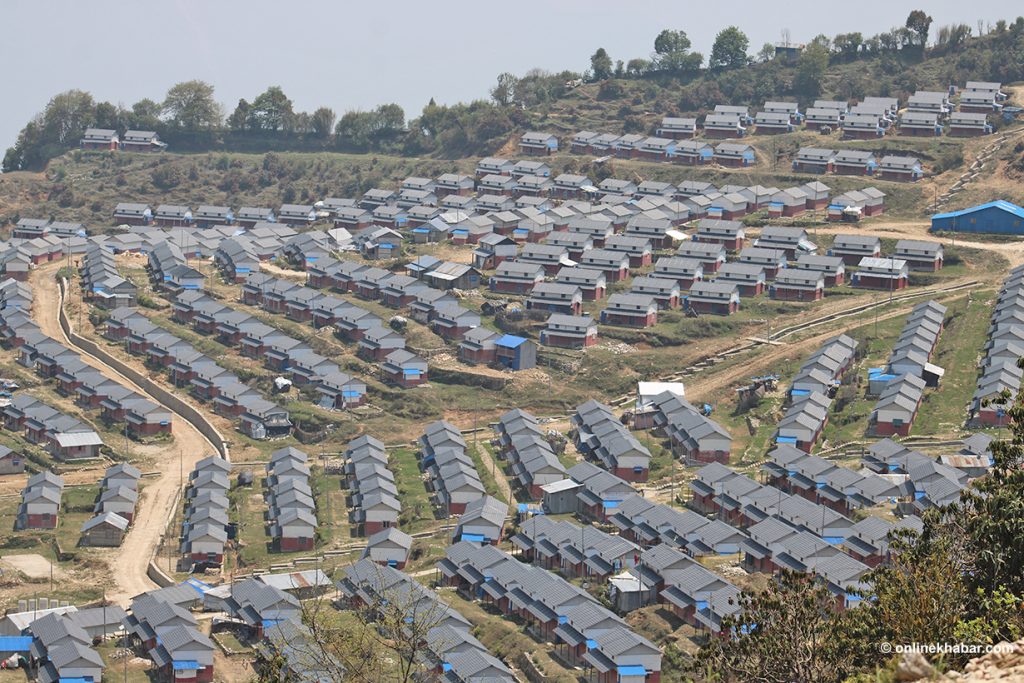
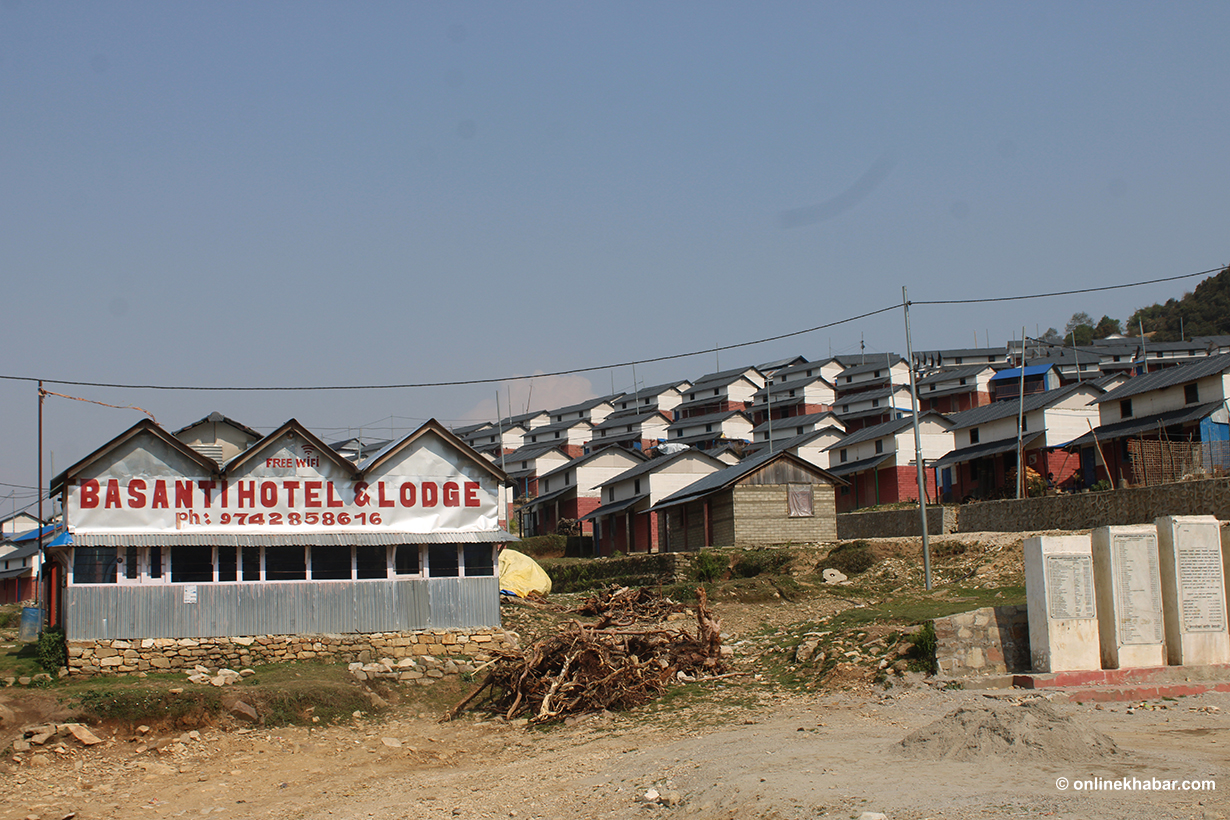
Rebuilding houses restores physical assets, but does not by itself ensure that households will return, remain or invest in the community. Houses may remain vacant where employment and livelihood opportunities are limited, essential services are inadequate, transport and digital connectivity are unreliable, or households continue to face disaster risks and uncertainty about the future.
Sustainable settlement requires an integrated approach combining safe and resilient housing, reliable infrastructure, essential services, viable livelihoods, quality education and healthcare, physical and digital connectivity, disaster-risk reduction, cultural continuity and opportunities for future generations.
The focus must therefore shift from a predominantly house-centred reconstruction model to a people-centred and settlement-based development strategy.
What could make Gumsipakha more livable?
A long-term strategy for Gumsipakha should focus on a mutually reinforcing package of interventions rather than isolated projects.
The local economic base could be strengthened through high-value agriculture, livestock development, agro-processing, local products, cooperatives, small enterprises and stronger market linkages. The emphasis should be on commercially viable production, value addition, income diversification and reliable market access.
Young people also need opportunities through vocational and technical training, entrepreneurship support, digital skills, remote employment and skills-based enterprises. This would provide alternatives to permanent out-migration while enabling young people to participate in the local economy.
Essential services should be treated as core settlement infrastructure. Quality education, primary healthcare and emergency referral services, safe drinking water, sanitation, electricity, telecommunications and reliable internet are fundamental to household wellbeing and influence decisions to remain, return or relocate.
Reliable all-season roads, regular maintenance, affordable transportation and dependable links to nearby service and market centres are equally important for households, producers, students, businesses and patients.
Disaster resilience should be integrated into settlement planning through hazard assessment, risk-sensitive land-use planning, slope management, resilient housing and infrastructure, effective drainage, early warning, emergency preparedness and response arrangements.
Gumsipakha and the wider Laprak area could also benefit from carefully planned community-based tourism centred on homestays, local cuisine, traditional architecture, handicrafts, cultural experiences and local products. Such development should remain consistent with community capacity, environmental limits and local priorities.
Cultural preservation should similarly be integrated with social and economic development. Local language, traditions, festivals, architecture, crafts, traditional knowledge and community institutions should be documented, transmitted across generations and incorporated into education and appropriate cultural initiatives.
Meaningful community participation is equally important. Residents should be involved in identifying priorities, planning investments, implementing activities, monitoring results and maintaining infrastructure. Locally informed planning can strengthen relevance, ownership, accountability and long-term sustainability.
People living outside Gumsipakha should also be recognised as potential contributors. Migrants and the wider diaspora can provide skills, knowledge, investment, professional networks, technology and social support. A structured engagement mechanism could help mobilise these resources while maintaining strong economic, social and cultural connections with the settlement.
Finally, Gumsipakha’s natural resource base must be protected. Forests, water sources, agricultural land, biodiversity and fragile mountain ecosystems should be managed sustainably, with development aligned with environmental conservation, climate adaptation and disaster-risk reduction.
Together, these measures can help create a more economically viable, socially connected, service-supported, environmentally sustainable and disaster-resilient Gumsipakha.
Planning must start with people
Effective settlement planning should begin with a clear understanding of why different households choose to stay, migrate, return or maintain seasonal residence.
This requires evidence-based assessment through household surveys, community consultations, focus-group discussions, demographic analysis, livelihood assessments and participatory settlement planning.
Needs will vary across population groups. Young people may prioritise employment, skills and digital connectivity. Families may place greater emphasis on education, healthcare and basic services. Older residents may require accessible services and social support. Farmers may prioritise irrigation, agricultural inputs, transport and market access, while vulnerable and disadvantaged households may require targeted support and inclusive services.
Settlement development should therefore not rely on a single standardised package of interventions. Planning should be evidence-based, locally informed, inclusive and responsive to the different needs, capacities and aspirations of households.
A new vision for Gumsipakha
The long-term objective should not be to prevent migration or compel people to remain in Gumsipakha. Individuals and families should have the freedom to pursue education, employment and other opportunities wherever they choose.
The development challenge is to ensure that remaining in, returning to or investing in Gumsipakha is a viable and meaningful choice.
This requires a settlement where people can earn sustainable livelihoods, access quality education and healthcare, benefit from reliable physical and digital connectivity, live in a safe and resilient environment, participate in community life, and maintain their cultural identity and social connections.
The vision should therefore be to make Gumsipakha not simply a place of ancestral belonging, but a viable, resilient, inclusive and forward-looking community for present and future generations.
The reluctance of local people to maintain permanent residence in Gumsipakha is a multidimensional settlement challenge shaped by livelihoods, migration, education, healthcare, accessibility, infrastructure, disaster risk, changing household structures, cultural and social dynamics, environmental conditions, governance and evolving aspirations.
Gumsipakha’s strong ancestral identity, cultural heritage and community networks provide an important foundation for its future. But cultural attachment alone cannot ensure permanent habitation.
Long-term settlement viability depends on whether households have practical and sustainable conditions to remain, return and invest in the community.
The future of Gumsipakha should therefore not be assessed solely by the number of houses reconstructed or residents returning. It should be assessed by whether the settlement provides sustainable livelihoods, essential services, safety and resilience, reliable connectivity, dignity, social inclusion, cultural continuity and opportunities for future generations.
Sustainable development consequently requires a shift from physical reconstruction towards an integrated, people-centred settlement strategy combining local economic development, resilient infrastructure, quality public services, disaster-risk reduction, cultural preservation, environmental sustainability and participatory governance.
The ultimate objective is not simply to bring people back to their ancestral homes, but to create conditions in which people have a genuine and sustainable choice to live, work, return, invest, participate, belong and prosper in Gumsipakha.