Peacocks have long occupied a distinctive place in Sabita Dangol’s paintings. Sometimes she paints them almost realistically, allowing their brilliant colours and familiar forms to command attention. At other times, the artist takes them apart, turning their feathers, anatomy and intricate details into elements of her visual vocabulary. A feather becomes a pattern; the interior of the bird’s anatomy becomes an outline; and within those forms, her brush moves freely, filling them with vivid colours and elaborate motifs.
For Dangol, the peacock is more than a decorative presence. It is a recurring visual and symbolic element—one that carries associations of beauty, renewal and watchfulness. Its significance becomes particularly resonant in A Sacred Union: Eternal Harmony, her eighth solo painting exhibition, which draws inspiration from Lord Krishna, his teachings and the enduring relationship between Radha and Krishna.
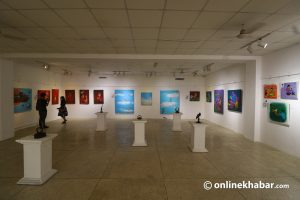
The exhibition explores love, companionship, spirituality and coexistence through Dangol’s distinctive fusion of traditional imagery, ornamental patterns, vibrant colours and meticulous detail. It is currently on display at 108 Gallery in Durbar Marg, Kathmandu, where it will continue until October 4.
The connection between the peacock and Krishna is particularly relevant to Dangol’s latest works. The peacock feather, traditionally associated with Krishna, becomes part of a larger visual world in which cultural memory, spirituality and personal expression intersect. Dangol does not simply reproduce familiar religious imagery; she reworks it through her own ornamental language.
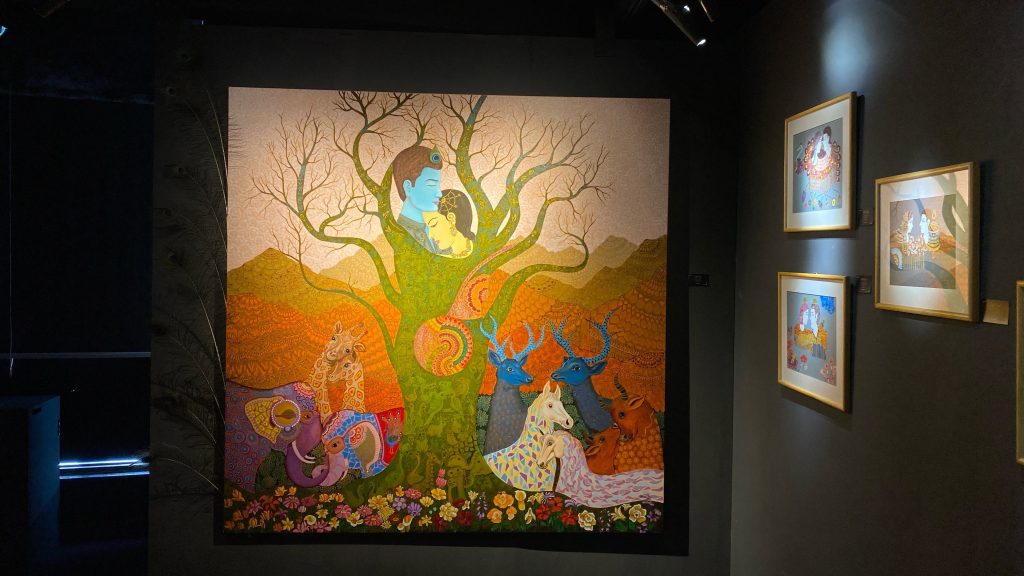
That approach is evident in one of the exhibition’s striking paintings, where a monumental tree trunk covered in intricate patterns of insects and beetles gradually transforms into an embracing couple. The couple appears to emerge from the tree itself, making their relationship inseparable from the natural world.
The roots suggest the foundations of love, while flowers emerging from the branches evoke peace, creativity and spiritual growth. The tree appears to move from barrenness towards renewal, as though love itself has the power to restore life.
Behind it, patterned mountains carry a sense of history and cultural memory. Elephants add another layer of symbolism, recalling their longstanding presence. Dangol brings these elements together not as isolated symbols but as parts of a single ecosystem in which people, animals and nature coexist.
Another work moves from the earthly to the cosmic. A lotus base supports a slender green stem that rises through swirling atmospheric forms, carrying fantastical creatures towards a golden Kalasha at its apex. Set against deep indigo and violet tones, the composition draws on Hindu-Buddhist and South Asian visual traditions while creating a dreamlike space of spiritual transformation.
The artist’s fascination with transforming ordinary objects into carriers of meaning is also evident in her recurring comb motif. An oversized wooden comb appears as both a three-dimensional object and a painted form, its surface covered with elaborate patterns.
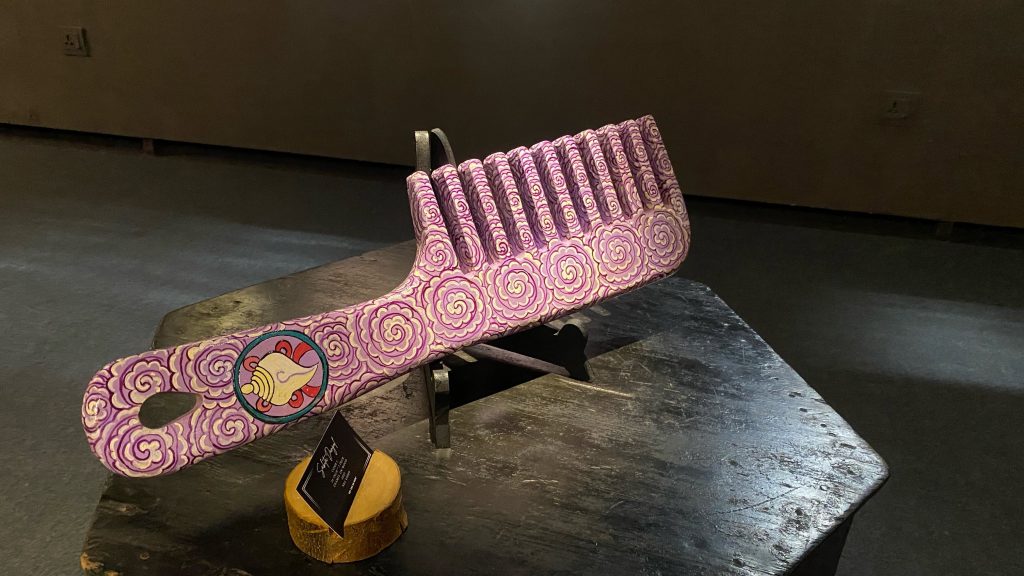
Dangol describes the comb as “a manifestation of the feminine essence,” associating the act of combing hair with releasing emotional baggage and with collaborative synthesis. In her visual language, the comb also becomes a metaphor for the human mind: just as a comb untangles hair, it can represent the process of working through anxiety, confusion and the complications of life.
This transformation of familiar objects and cultural symbols is central to Dangol’s practice. A peacock is no longer simply a bird. A feather becomes a field for pattern and colour. A tree becomes a metaphor for love. A comb becomes an instrument for untangling the mind. A lotus becomes a point of spiritual ascent.
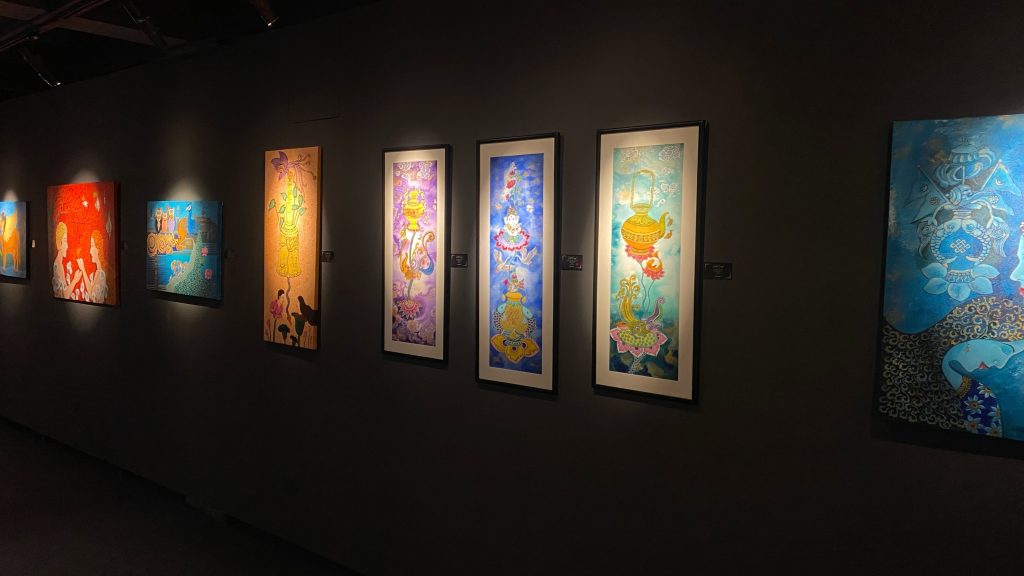
Through these transformations, A Sacred Union: Eternal Harmony brings together the personal and the universal. Its imagery is rooted in cultural traditions, but its concerns are contemporary: how people form relationships, how they live with nature, how they carry emotional burdens and how they seek balance.
The exhibition opened on September 4 and continues until October 4 at 108 Gallery. Ten per cent of sales from the exhibition will be donated to the Prime Minister Disaster Relief Fund.
For Dangol, harmony is not presented as something static. It is something that grows, changes and is continually renewed—much like the peacock feathers that return each season, carrying with them the colours and patterns that have become an enduring part of her artistic world.
‘Art Can Do More’ by At 108 Gallery
The “Art Can Do More” initiative by Gallery 108 has successfully brought together Nepali artists in a powerful collective gesture of solidarity, mobilising art to support communities devastated by the recent natural disasters.
According to the latest inventory data, the initiative has catalogued a total of 73 artworks. Of these pieces, 33 artworks have been sold, leaving 40 available for art collectors and humanitarian buyers.
This collective action has generated a total value of Rs 981,800. Out of this gross value, the gallery has recorded a massive total contribution of Rs 512,800, with 100% of these proceeds directed entirely towards the Nepal Prime Minister Disaster Relief Fund.
The contributed artworks are being actively exhibited physically at Gallery 108 and featured online simultaneously. The collection continues to expand with rolling updates; as new artwork contributions arrive from local creators, both the physical gallery space and the digital storefront are updated to reflect the new additions.
Supporters looking to acquire available pieces can visit the exhibition in person or place direct orders using the official communication channels below:
• Instagram: @gallery108_nepal
• Phone: +977 9705801108
• Email: mail.gallery108@gmail.com