Kathmandu, September 27
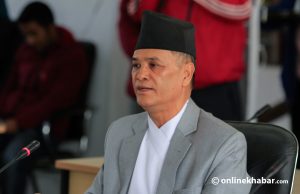
Former Chief Justice Cholendra Shumsher Rana was taken from his Maharajgunj residence late Saturday night, in an unprecedented episode involving a former head of Nepal’s judiciary.
But more than the detention itself, questions have been raised over why Rana was taken into custody, under what legal authority, and whether he was actually arrested or taken into protective custody.
Police have not publicly disclosed any criminal charge against Rana.
Senior Superintendent of Police Santosh Khadka of the Criminal Investigation Office, Teku, told Onlinekhabar that Rana was brought to the office after police received information about a security threat.
“After learning that there was a security threat to him, we brought him to our office at night because something could happen,” Khadka said.
Another police account reported by Kantipur said Rana was being kept in a safe place because of a perceived security challenge and that there was no plan to pursue a criminal case against him.
Why was Rana taken from his home?
The exact nature of the alleged security threat has not been publicly disclosed.
Rana’s brother, Prabhu Shumsher, said police told Rana that there was a threat to him from Gen Z protesters when they arrived at his residence.
Rana was subsequently taken to the Criminal Investigation Office in Teku.
Reports say police did not provide Rana with an arrest warrant when they took him from his residence.
The distinction is significant because police have described the action as being linked to Rana’s security, while the initial reports described it as an arrest.
Legal questions over the procedure
The manner in which Rana was taken from his residence has prompted questions among legal professionals.
Senior advocate and Nepal Bar Association President Professor Dr Vijay Prasad Mishra said the government should clearly explain the basis and purpose of its action.
“The government must clearly answer on what basis and for what reason this step was taken,” Mishra said. “It is necessary to immediately clarify the government’s intention and objective.”
Mishra said that if the purpose was to address a security threat, the state could have increased security around Rana rather than taking him away from his residence.
Senior advocate Tikaram Bhattarai also questioned the procedure.
According to Bhattarai, regardless of a person’s background or alleged conduct, the state must remain transparent in its treatment of citizens.
“Even if the alleged offence is serious, the government itself cannot become mysterious. The state must guarantee the constitutional rights and legal protection of every citizen,” Bhattarai said.
He argued that if police had genuinely received information about a threat to Rana’s safety, security personnel could have been deployed at his residence and the alleged threat investigated.
What does the law say about urgent arrests?
Legal experts have also referred to the Supreme Court’s previous interpretation of circumstances in which an urgent arrest order may be issued.
According to that interpretation, an urgent arrest authorisation may be justified in circumstances where there is an immediate risk that evidence could be destroyed, the person could abscond, or failing to take the person into custody could lead to another serious offence.
Bhattarai said it was not clear whether any of those circumstances existed in Rana’s case.
“If the state has taken him into custody citing a security challenge, he could have been provided security at his own residence,” Bhattarai said.
He added that any action taken without a clear legal basis and proper procedure would raise questions about the rule of law.
Rana had already been a controversial figure
Rana’s detention comes against the backdrop of his controversial tenure as chief justice.
An impeachment motion was registered against him in Parliament in February 2022, after which he was suspended from his position.
The impeachment process was never brought to a final conclusion during his tenure, and the issue continued to generate legal disputes.
Earlier this month, the Supreme Court’s Constitutional Bench ruled that the impeachment motion against Rana had lost its purpose and dismissed four writ petitions related to the dispute.
Allegations of political and judicial involvement
Separately, government and judicial sources have claimed that Rana had recently become increasingly active in political and judicial affairs.
Sources have alleged that complaints had been lodged at the Office of the Prime Minister and Council of Ministers accusing him of attempting to influence governance and judicial proceedings.
According to those sources, Rana’s activities fell broadly into two areas.
One involved alleged political activity and interest in a possible future political role. The other involved his reported interest in cases pending before the courts.
Sources have also claimed that people associated with sensitive cases had continued visiting Rana after his retirement.
Government sources have alleged that Rana met stakeholders before hearings in several high-profile cases, including the Teramox case involving the Nepal Telecommunications Authority and the case involving Birgunj Mayor Rajeshman Singh.
However, Singh has rejected that claim, telling Onlinekhabar that he has never met or even seen Rana and that he was being unnecessarily linked to the matter.
The allegations remain claims from sources and have not been established as the reason for Rana’s detention.
What happens next?
For now, the central question remains unresolved.
Police have cited a security threat as the reason for bringing Rana to the Criminal Investigation Office, while authorities have not publicly identified the nature of the threat or the person or group allegedly responsible.
At the same time, questions have been raised about why Rana was taken from his home rather than being provided security there, and what legal procedure was used to bring him to Teku.
The latest police account indicates that Rana was expected to be released and that the matter was not necessarily linked to a criminal case.
As a result, the circumstances surrounding the former chief justice’s late-night detention remain unclear, with both the security explanation and the legal procedure used by police now under scrutiny.