

“I don’t need anything.”
The boy stood among other children at a relief distribution centre and watched them choose what they could carry.
Some were looking through piles of clothes. Others were reaching for food. A child who had received a new toy had already begun playing with it.
The boy wanted none of it.
“What’s the point of taking it?” he said. “There’s nowhere to keep it.”
It was an unusual response to a relief distribution, but it made sense once you understood what the flood had taken from him.
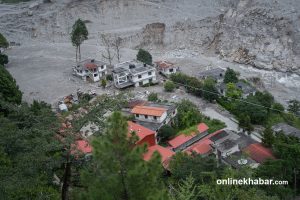
His home was gone. So was his family. The place he once knew as somewhere he could return to was no longer there. For him, a bag of clothes could not replace that.
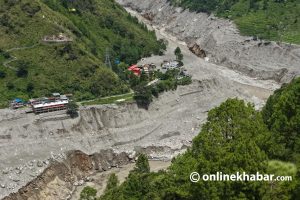
The roads were beginning to reopen. Relief was reaching the affected areas. The immediate crisis was slowly giving way to the long work of recovery. But for the boy, the flood had not ended. He was still living in it.
That is what psychosocial counsellors working with children in Rasuwa, Nuwakot and Dhading are beginning to understand.
At a distance, many of the children look as though they are recovering. They play. They laugh. They queue for food. Some run around holding new toys.
Then someone sits down beside them and starts talking. The difference can be startling.
Some children barely speak. Some keep looking for their parents. Some are frightened by water or loud noises. Others have trouble sleeping. And some are still waiting for people who may never return.
A rapid assessment by the National Child Rights Council found 1,233 children in 30 holding centres across the three districts. At least 102 had lost both parents, while 439 had been separated from their parents. Another 691 were living with either their mother or father.
There were 21 children with disabilities.
Those numbers provide a measure of the disaster. But they do not explain what it means for a child to wake up without knowing where their mother is.
They do not capture the child who no longer knows where home is. And they do not explain why a 14-year-old girl continues to believe that her younger sister will come back.
‘My sister will come’

The sisters were together when the flood came. Then their hands were separated. The younger girl disappeared. The 14-year-old does not know where she is. She is also unsure where her father is. Yet she keeps saying the same thing.
“My sister will come.”
During counselling, she explained why.
“My father will save my sister.”
For adults, the reality of a disaster often becomes clear quickly. For children, it can be different. They may hold on to an explanation, a person or a promise because they need something familiar in a world that has suddenly become unfamiliar.
That is why counsellors do not necessarily begin by asking children to talk about the flood. They give them something else to do. They play. They draw. They make space for children to decide what they want to say and when they want to say it. Sometimes the story emerges on paper.
One child drew a house and looked at it for a while.
“Our house was swept away by the flood,” she said. “Maybe our house will become like this again.”
Another drew a large river.
Others drew their parents carrying children.
For children who cannot find the words, a drawing can become a way of saying what happened without having to describe it.
Tara Bhandari, a psychosocial counsellor and chairperson of Bishwas Nepal, saw another expression of that fear when teams tried to move children to a temporary safe place.
Some refused.
“If you take us down, the flood will sweep us away,” they said. “A big river will come again.”
The river had stopped rising. The children’s minds had not.
When safety does not feel safe
For Bhandari, that moment illustrates why simply moving children to a physically safe place is not enough. A child has to feel safe too. Food, water, clothing and shelter remain essential. But so is listening to what children are afraid of.
Grishma Paneru, who works in psychosocial support, says the children she has encountered have reacted to the disaster in very different ways.
“Some have become withdrawn. Some are afraid. Some prefer to be alone. Some cannot sleep at night,” she said.
Water can trigger memories of the flood. So can rain. So can a sudden loud noise.
Others continue to play.
That can be reassuring, but it should not be taken as proof that everything is fine.
“A child playing does not mean they are okay,” Paneru says.
What matters is the change in the child — whether their sleep, appetite, behaviour, relationships or ability to concentrate have changed.
Child and adolescent psychiatrist Dr Utkarsh Karki says such reactions are common after disasters and should not immediately be treated as signs of mental illness.
A child may become unusually quiet or unusually talkative. They may cling to their parents, cry suddenly, have nightmares or struggle to sleep.
Most children gradually return to normal. But some do not.
In some cases, children may develop acute stress reactions, anxiety, depression, behavioural changes or post-traumatic stress disorder.
They may repeatedly relive the flood, have nightmares, become intensely afraid of water or rain, avoid reminders of the disaster or remain constantly alert to danger.
They may also struggle to concentrate or withdraw from friends.
The important distinction, Karki says, is time and severity.
Symptoms that persist for four to six weeks, worsen or interfere with eating, sleeping, playing or studying need greater attention.
But the first response to a traumatised child is not necessarily psychiatric treatment.
It is safety. A safe place. Food and water. A familiar routine. And, where possible, a family to return to.
The children who are no longer where they were
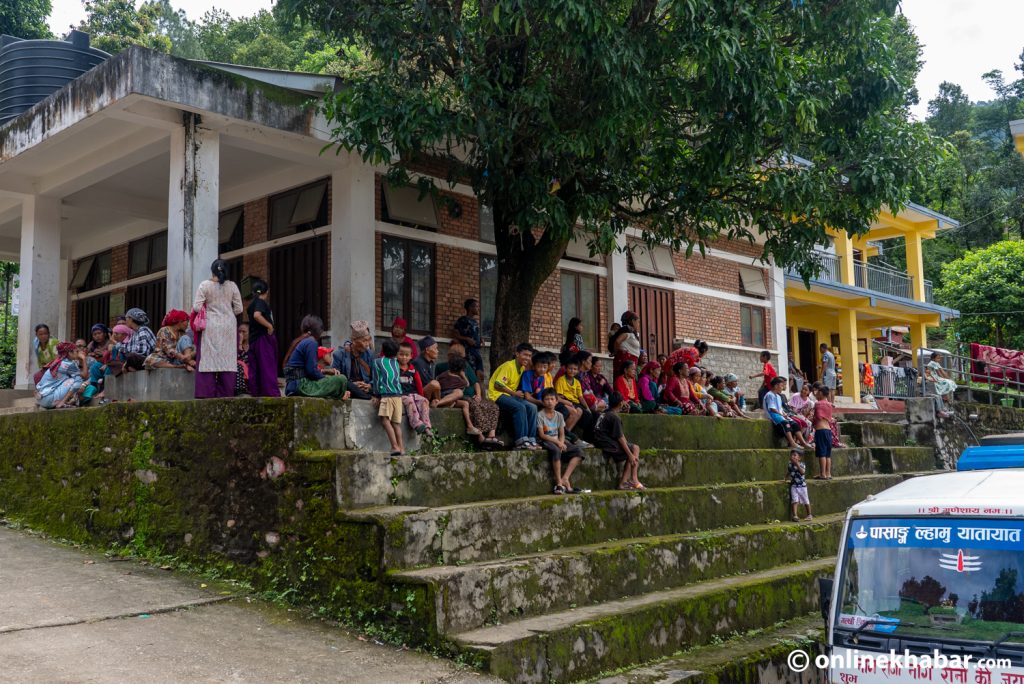
That last part is becoming increasingly difficult.
As the emergency phase passes, one of the most troubling questions is not only how children are coping, but where they are.
Bhandari recalls one day when 65 children were placed in a safe holding centre.
The following day, only 37 remained.
The whereabouts of the others were not immediately clear.
Some children were reportedly being taken into private homes by people who said they were relatives. In some houses, several children were being kept together.
But not every claim of kinship had been verified.
For children already separated from their families or left without parents, that uncertainty creates another danger.
They can become vulnerable to trafficking, child labour, child marriage and sexual abuse.
Tilottam Paudel, a child-rights activist and chair of Jagriti Child and Youth Concern Nepal and the Child-Friendly Peace Zone Campaign, says children should not be moved elsewhere without information from and approval of their families or relevant local authorities.
The problem is made harder by the loss of documents.
Birth certificates and other records may have been swept away with homes.
Without those records, even establishing who a child is and where they belong can become difficult.
The scale of the uncertainty is visible in the figures coming from the affected districts.
In Rasuwa’s Uttargaya Rural Municipality, at least 57 children are reported to have lost their parents and could not be found in the camps. Around 200 children are reportedly missing there.
In Nuwakot’s Bidur Municipality, 614 children have been affected. Twenty-seven have lost both parents and 203 have been separated from their parents.
In Belkotgadhi, 52 children are reported to have been left without parents.
The numbers are still being established.
And that is part of the problem.
‘How many people do we have to tell our story to?’
There is another danger in the rush to understand what happened. Children are being asked to tell their stories repeatedly. One organisation arrives with relief. Another arrives to provide counselling.
Someone asks what happened. Someone else asks the same question. Photographs are taken. Then the visitors leave.
For the adults involved, each visit may serve a different purpose.
For the child, it is the same flood. Again, and again, and again.
At one point, a girl asked a counsellor a question that captures the exhaustion of being repeatedly made to revisit the worst moment of her life.
“How many people do we have to tell our story to?”
The question has implications beyond counselling.
Children who have experienced trauma need support, but they also need privacy.
Their stories cannot become material to be repeatedly photographed, recorded or shared simply because adults want to document the disaster.
Psychosocial support, counsellors say, works through trust. And trust takes time.
The person who has earned a child’s confidence may need to keep showing up long after the first relief distribution has ended.
Then there is school

For many children, school could become one of the simplest ways of beginning to rebuild that sense of normality. But schools remain closed in affected areas, leaving children without one of the basic structures of their daily lives. Some have little to do.
Others are helping retrieve belongings from damaged houses and shops. Some are entering dangerous areas in search of possessions. The longer that continues, the more difficult it becomes to separate recovery from risk. Reopening schools, therefore, is about more than education.
A functioning school provides routine. It gives children a place to see friends, play and interact with trusted adults. It can also help authorities answer basic questions.
Who has returned? Who is absent? Who is missing? Who has moved elsewhere?
But schools themselves must first be safe. Buildings and access routes need to be assessed. Psychosocial support needs to be available. And where floodwaters have destroyed school records, local governments, schools and child-protection organisations will have to work together to reconstruct them.
The second wave of the disaster
The most difficult part of a disaster may not always be the moment when the water rises. For some children, it comes later.
When the relief queues become shorter. When the roads reopen. When schools resume. When families return to the places where their homes once stood.
That is when the enormity of what has happened may finally become clear.
A child who was too busy surviving to grieve may begin to grieve.
A child who kept waiting for a parent may begin to understand that the parent is not coming.
A child who remained silent may begin to speak.
Karki says children who have lost parents, been separated from their families, lost contact with relatives or lost their homes entirely may require psychosocial support for months or longer.
“One or two counselling sessions cannot heal such deep trauma,” he says.
“They need continued relationships, a safe environment, school, places to play, friends and reunification with their families. Where necessary, they need access to specialist mental health services.”
But perhaps the most important thing is also the simplest.
They need to know that someone will listen.
From relief to rebuilding
In the first days after the flood, relief is measured in food, clothes, water and shelter.
Those things are still needed.
But for children, recovery will demand something much larger.
Paudel says the focus must now begin moving beyond immediate relief.
“We need reliable information on missing children,” he says. “We need family identification and reunification. Children without parents need safe protection. They need protection from trafficking, child marriage, child labour and sexual abuse.”
Birth certificates and other records need to be restored.
Schools need to reopen safely.
Psychosocial support needs to continue.
Families need to be reunited where possible.
And children need places where they can play without being afraid of the next sound of rushing water.
The boy at the relief centre was right about one thing.
Another bag of supplies could not give him what he had lost.
The harder work begins after the relief trucks leave — finding the missing, rebuilding families, restoring routines and helping children believe that the world around them can become safe again.
The flood has gone.
For many of Nepal’s children, the work of surviving it has not.