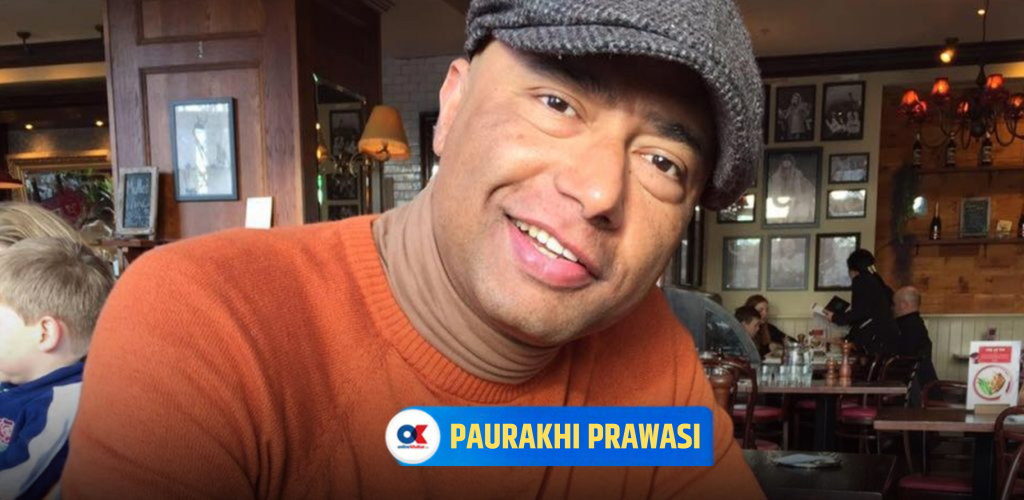
At 16, Navin Singh Khadka was already teaching English to children in Kathmandu.
He was still a student himself.
Money was tight, so he taught during the day and studied when he could. At Adarsha Vidya Mandir, where he later taught, he began putting together a small school magazine. He collected stories, poems and essays written by the children and turned them into something that looked, to him, like a real publication.
Then something unexpected happened. Some of those children’s pieces were picked up by The Rising Nepal and Gorkhapatra. Khadka had found his way into journalism without quite realising it.
More than three decades later, his work appears on the BBC World Service, where he reports on climate change, biodiversity and environmental crises for an international audience.
He has reported from United Nations climate conferences, travelled to around 50 countries and covered some of the most consequential environmental stories of the past two decades.
But when he talks about his work, he rarely begins with London. He talks about the mountains.
“The mountains are coming down,” he says.
It is an arresting way of describing what he has watched happen across the Himalayas.
Snow and ice are disappearing. Springs are drying. Rainfall is becoming less predictable. A farmer can face drought when water is needed and flooding when it is not. And beneath all of that, Khadka sees a story that is still not being told loudly enough.
The story of what climate change looks like from the mountains themselves.
The boy who learned English from war stories
Khadka’s path to becoming an international journalist began with a language. His father, the late Puran Singh Khadka, had served in the army and was determined that his son should learn English. He brought home comics and stories about the Second World War.
“He taught me in a way that would keep me interested and stop me from getting bored,” Khadka recalls.
The lessons stuck. After the family returned to Kathmandu from India, Khadka continued teaching himself. He watched English films, read newspapers and wrote his college answers in English. When people spoke in Nepali, he would often make notes in English.
He did not know it at the time, but he was building the foundation for a career that would eventually depend on moving between languages and audiences. His own education followed a less straightforward path.
He completed his schooling at Nandi Ratri Secondary School in Naxal and went on to study management at Public Youth Campus, followed by a bachelor’s degree at Shanker Dev Campus and a master’s at Ratna Rajya Campus.
Journalism was not his subject. Survival, however, was.
“I started teaching when I was 16,” he says.
His first job was at Deep Shishu Niketan in Bishalnagar. He later taught at Adarsha Vidya Mandir and became head of the English department at Gyanodaya Bal Batika.
At the same time, something was beginning to pull him towards journalism. The school magazine was the first clue. The newspapers that later published the children’s work were the second. Soon, he wanted to know how the people who wrote those newspapers actually did their jobs.
Jumping into the swimming pool
Khadka enrolled in a 10-month journalism course at the Nepal Press Institute.
Even that was difficult. Classes were held in the morning, but he was also teaching and attending college.
“I could only go on Sundays, so I couldn’t attend all the classes,” he says.
After completing the course, he needed an internship.
He wanted The Kathmandu Post. Instead, veteran journalist Sushil Sharma offered him a place at Spotlight, the weekly he edited.
“If you want to work at Spotlight as well, you’re welcome,” Sharma told him.
Khadka took the offer. For the next few years, he lived two professional lives. Teacher by day, journalist alongside it. Eventually, he realised he could not keep doing both.
“If journalism was what I wanted to do, I felt I had to jump into the swimming pool,” he says.
So he did and left teaching.
What followed was a tour through Kathmandu’s media landscape — Spotlight, The Rising Nepal, The Himalayan Times, SpaceTime, Nepali Times, Radio Sagarmatha and Channel Nepal.
His beat was initially tourism. But Khadka was less interested in telling people where to go than in asking what was happening behind the industry.
He began looking at civil aviation, government projects, money and power.
Where was the money going in Melamchi? What happened to the money connected to Lauda Air? What really happened during the privatisation of Butwal Power Company?
“I always gave importance to the story,” he says. “I didn’t have an ambition to reach a big media organisation. But I believed that only strong stories could bring about change.”
That attitude would eventually take him somewhere he had not expected – The BBC.
The BBC had one problem with him
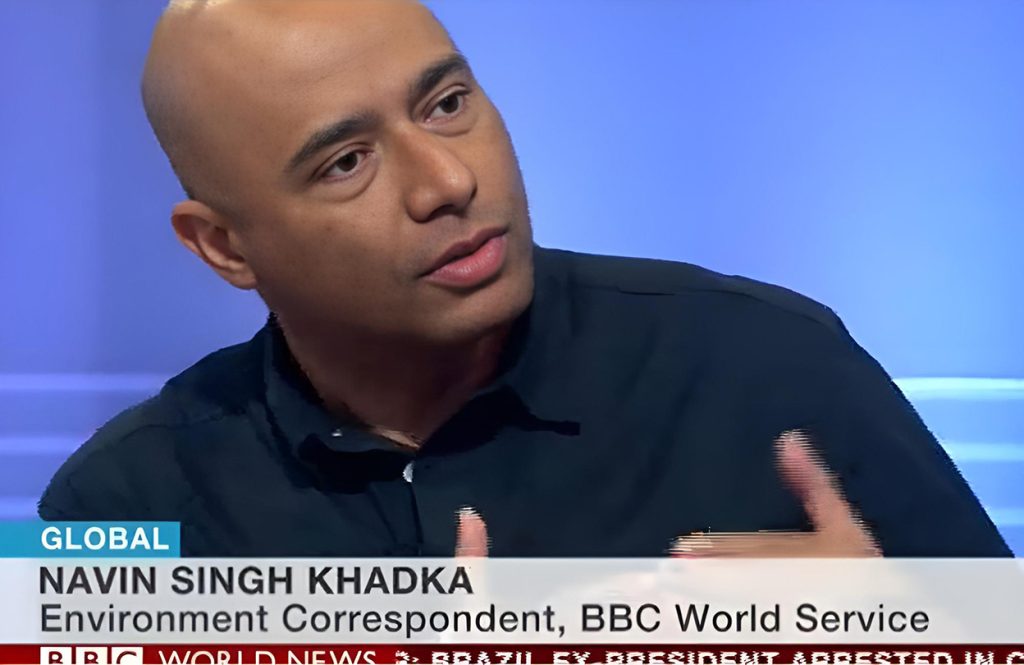
When Khadka joined the BBC Nepali Service in March 2002, he had a problem. He could speak English. He could report. But he had never worked as a Nepali-language news reporter.
The timing was unforgiving.
Nepal was deep in a conflict. Political confrontation between the seven-party alliance and the monarchy dominated the headlines. News had to be written, translated, recorded and delivered quickly.
Khadka had to learn on the job. Again, Sharma became his teacher.
“He would keep a clock in front of me and say, ‘You have to finish this in this many minutes,’” Khadka recalls.
“It wasn’t just about writing. I had to read it, send it and record it as well.”
There were people who doubted him. Some dismissed him as an English-speaking journalist who could only read what somebody else had written. He kept going.
“I give all the credit to the late Sushil Sharma,” he says. “He believed I could do it more than I believed in myself.”
In 2005, Khadka travelled to London to work on a BBC special programme. It was the first glimpse of the world that would eventually become his professional home. But something else was happening at the same time.
Khadka was becoming increasingly convinced that environmental journalism mattered. Not as a specialist niche. As one of the defining stories of the future.
The story he could not leave alone
His interest in the environment had started years earlier.
When the 1992 Rio Earth Summit was taking place, the internet was barely accessible in Nepal. There were no social media feeds delivering the latest developments to a phone.
So Khadka went to the British and American libraries in Kathmandu. He read newspapers. He followed the international debate. And he began to understand that environmental issues were becoming inseparable from global politics.
“I realised even then that this issue would not only matter to our generation,” he says. “It would be even bigger for the generations that followed us.”
He began looking at environmental stories wherever he went. Eventually, he told the BBC that he did not want to remain only a producer in the Nepali Service. He wanted to report.
There was a larger argument behind that decision.
Climate change was increasingly being discussed on the world’s biggest stages, but much of the conversation was still being shaped by people in powerful countries and institutions.
What happened when the story was told from the Himalayas? What did climate change look like to people living at altitude? What happened when a farmer, rather than a government minister or scientist, became the starting point of the story?
Khadka thought those questions mattered.
The BBC agreed to give him a one-year pilot opportunity to develop environmental reporting from the Himalayan perspective. Then came two stories that changed the course of his career.
The plants that travelled illegally from the Himalayas
One began with flowers.
Rare Himalayan plants growing above 4,000 metres were being targeted for their seeds. The seeds were being collected and sold in Europe. Khadka began investigating.
The trade was not as straightforward as it appeared. He found allegations that plants were being taken without proper permission, while local people were being misled about how those permissions had been obtained.
He followed the trail. The story eventually reached major public gardens and attracted the attention of authorities.
In India’s Sikkim state, arrest warrants were issued against people allegedly connected to the case. For Khadka, the significance went beyond the headlines.
“I investigated the story properly and when I saw the impact it had, I felt that our work could actually bring about change,” he says.
It was proof of something he had believed since his days chasing stories in Kathmandu. A journalist did not have to be powerful to make a story powerful. Then came the glacier story. And this time, the mistake was much bigger.
The number that was wrong
In 2009, a scientist told Khadka that if the existing trend continued, glaciers could disappear by 2300. But somewhere in the process of publication, the date became 2030.
A mistake of almost three centuries.
The incorrect figure later appeared in an IPCC report and became ammunition for people challenging climate science. The claim travelled rapidly through the international media. But Khadka was not convinced.
He began looking at the evidence. There was a problem with treating the Himalayas as one uniform system. Glaciers in parts of the eastern Himalayas were retreating. But in the Karakoram region to the west, some glaciers were behaving differently.
The story was more complicated than a single dramatic number. Khadka reported the contrasting trends, using scientific evidence and images to show what was actually happening. The reporting impressed the BBC.
His pilot period ended with the organisation creating a new position for him. He had found his place.
Not simply as a Nepali journalist working for an international broadcaster, but as an environmental journalist bringing stories from a part of the world that was often talked about without being heard directly.
What does “normal” mean to a farmer?
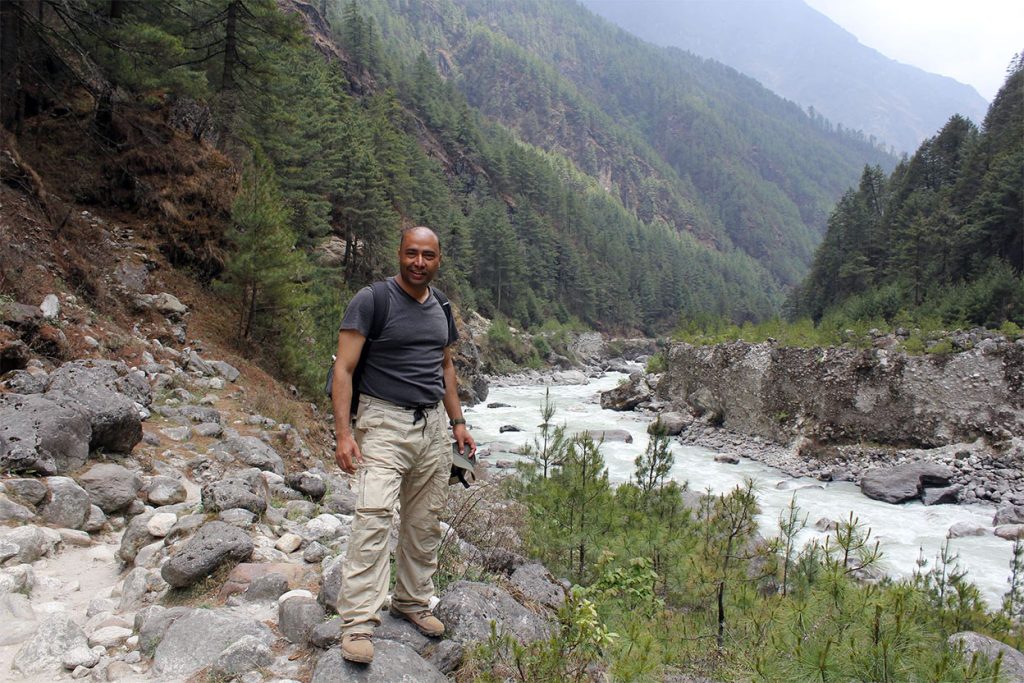
Today, climate change remains at the centre of Khadka’s work. But he is sceptical of stories that stop at statistics. Take the monsoon. A meteorological department might describe a season as “normal”. A farmer might tell a completely different story.
“If you ask the meteorological department, they might say the monsoon was normal this year,” Khadka says.
“But if you ask a farmer, they might say, ‘Drought damaged my crops when I needed rain, and then three months’ worth of rain fell in a week and washed everything away.’ “Why don’t the department’s understanding and the farmer’s experience match? That’s where journalists need to go.”
For Khadka, that gap is where climate journalism becomes human.
In Nepal’s hills, he says, springs are drying. Snow is becoming less predictable. Farmers can be left without water when they need it and overwhelmed by it when they don’t. And the consequences are spreading beyond farms.
Roads, bridges, hydropower projects and settlements are increasingly exposed to unstable slopes, landslides and floods. Khadka worries particularly about what happens when melting ice and changing rainfall destabilise mountain slopes. Snow and ice, he says, once helped bind the mountains together.
“It was almost like cement holding a house together,” he says.
When that ice disappears, the landscape changes. Heavy rainfall can then bring down soil, rocks and debris. The danger is not limited to visible glacial lakes.
“The more dangerous ones can be the hidden lakes,” he says. “If lakes form inside mountains or beneath rock and then suddenly break through, there may be no way of predicting it.”
A journalist caught between two worlds
Khadka now works across four languages — English, Nepali, Hindi and Urdu.
He appears on BBC television, radio and online platforms and contributes analysis to the BBC’s Pashto and Persian services, where his comments are translated for audiences in those languages.
He has travelled to almost every continent. He has reported from some 50 countries. Yet his journalism keeps bringing him back to Nepal.
Perhaps because the country’s environmental story contains the contradiction that has defined so much of his career.
Nepal is one of the countries most exposed to the consequences of a changing climate, while also being a country racing to build roads, hydropower projects and other infrastructure.
Development is urgently needed. So is caution.
“Where we should be more careful, we are becoming even more careless,” Khadka says. “That is a path towards destruction.”
It is a strikingly blunt conclusion from a journalist whose career has otherwise been built around asking questions rather than delivering answers. But perhaps that is the point. Khadka’s job is not to tell the world what to think about the Himalayas.
It is to make sure the Himalayas are part of the conversation. The teenager who once filled a school magazine with children’s stories eventually found himself reporting to a global audience. The teacher became a journalist. The journalist became a broadcaster.
And the broadcaster became, almost by accident, one of the international media’s recurring voices on a region undergoing profound environmental change.
His career has taken him a long way from that school magazine in Kathmandu. But the instinct remains the same.
Find the story. Follow it. And, if it matters, make sure people hear it.