As a boy in Gorkha, Bishnu Bastakoti studied by the light of a smoky kerosene lamp. Today, thousands of kilometres away in the United States, he is researching a different kind of light — hydrogen, which could one day help power a cleaner future.
The journey from a remote village in Nepal to the laboratories of Harvard University has taken him through scholarships, setbacks and years of research. But the memory of those dark evenings in Gorkha has never quite left him.
Now an associate professor of chemistry at North Carolina Agricultural and Technical State University, Bastakoti is working on ways to produce hydrogen more cheaply and make clean-energy technologies more accessible.
For someone who grew up experiencing Nepal’s power shortages, the work is more than an academic pursuit. It is, in a sense, a search for the light he once studied by.
A village boy with limited horizons
In Aampipal, Gorkha, life followed the rhythm of the village.
School meant an uphill walk. After returning home, there were cattle to tend, fields to help with and lessons to study. At night, the kerosene lamp provided the light.
For children growing up in farming families, this was simply life.
The people they saw as successful were usually those who had gone abroad to work and returned home during the festivals, men serving in the Nepal Police or Army, or teachers at the local schools.
There was little reason to imagine a career in scientific research, let alone one that would take a village boy from Gorkha to some of the world’s leading universities.
This was the world in which Bishnu grew up.
Some of his friends left school after Grade 7 or 8 to find work. But Bishnu, the youngest of three children, continued studying. His parents were illiterate, but they had a clear belief that their children should receive an education. His elder brother, Rishi, was doing well academically and became an important influence on him.
In 1995, Bishnu passed his School Leaving Certificate examination from Janata Secondary School in Aampipal in the first division. But passing the SLC was only the beginning. He now had to decide what came next.
At the time, education was largely viewed as a route into employment. Young people tended to choose subjects according to the jobs they could eventually lead to.
Agriculture could lead to becoming a junior technical assistant. Engineering could lead to becoming an overseer. Forestry could lead to becoming a ranger. Science or education could lead to teaching. Cost and distance mattered too. Then his brother sent him towards an opportunity he had not expected.
The exam that changed his direction
After completing his SLC, Bishnu travelled to Pokhara to visit Rishi, who was studying forestry. His brother sent him to sit an entrance examination at SOS School in Rambazar.
It was Bishnu’s first time in a city. He remembers looking around at the other candidates, many of them from urban, English-medium schools, and wondering how he could compete with them.
He sat the examination anyway. He was selected. He received a full scholarship for two years. The decision did more than give him an education. It changed the direction of his life.
He moved towards science, eventually completing higher secondary education in science, a bachelor’s degree from Birendra Multiple Campus in Bharatpur and a master’s degree in chemistry from Tribhuvan University Central Campus in Kirtipur in 2004.
By then, teaching seemed the natural next step. He taught at private colleges in Kathmandu and became a popular lecturer. But teaching also exposed him to something else — a desire to understand more, go further and continue studying. In 2008, that opportunity arrived.
From teaching to research
Bishnu received the Japanese government’s Monbukagakusho scholarship and an opportunity to pursue a PhD at Saga University. It was the beginning of a second transformation.
He moved from the classroom into scientific research, working on the synthesis of polymers and nanomaterials and their applications in energy. The work was demanding, but it opened a new academic world.
His doctoral research was published in scientific journals. After completing his PhD, he received a Japan Society for the Promotion of Science fellowship and spent three years conducting research at the National Institute for Materials Science in Japan.
He later spent a year as a research associate at the University of Sydney in Australia and worked as a visiting researcher at other research centres. The distance between Aampipal and the laboratories in which he now worked was enormous. But Bishnu saw the journey differently. For him, each new opportunity simply opened another horizon.
From Handikhola to Harvard
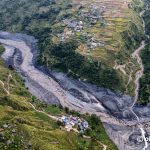
As a child, Bishnu had spent time herding cattle and goats in Handikhola, Pathibhara. He now uses the landscape of his childhood to describe his journey.
When you are walking through a narrow gorge, he says, you can see only what is immediately in front of you. Climb higher and the view begins to widen. Keep climbing and an entirely different horizon appears. His career followed something like that pattern.
While working at the University of Sydney, he applied for a research associate position at Harvard University. After a lengthy selection process, Professor Juan Pérez-Mercader offered him the position. The appointment was another extraordinary step for someone who had grown up in rural Gorkha.
But one question from the professor stayed with him.
“Your parents must be so happy to know that their son has got an opportunity to do research at Harvard. How will you give them this surprise?”
The question struck Bishnu. His parents had never received a formal education. They had worked hard to raise their children and had insisted that education was their best chance at a different life. Bishnu shared the news with his elder brother, Rishi, who was living in Canada. The two brothers became emotional as they reflected on their childhood, their parents and the distance they had travelled.
Their parents might not have fully understood what research at Harvard meant. But they understood that their son had gone much further than anyone in their village could once have imagined.
For Bishnu, Harvard became another important stage in his development as a researcher.
Searching for a cleaner source of energy
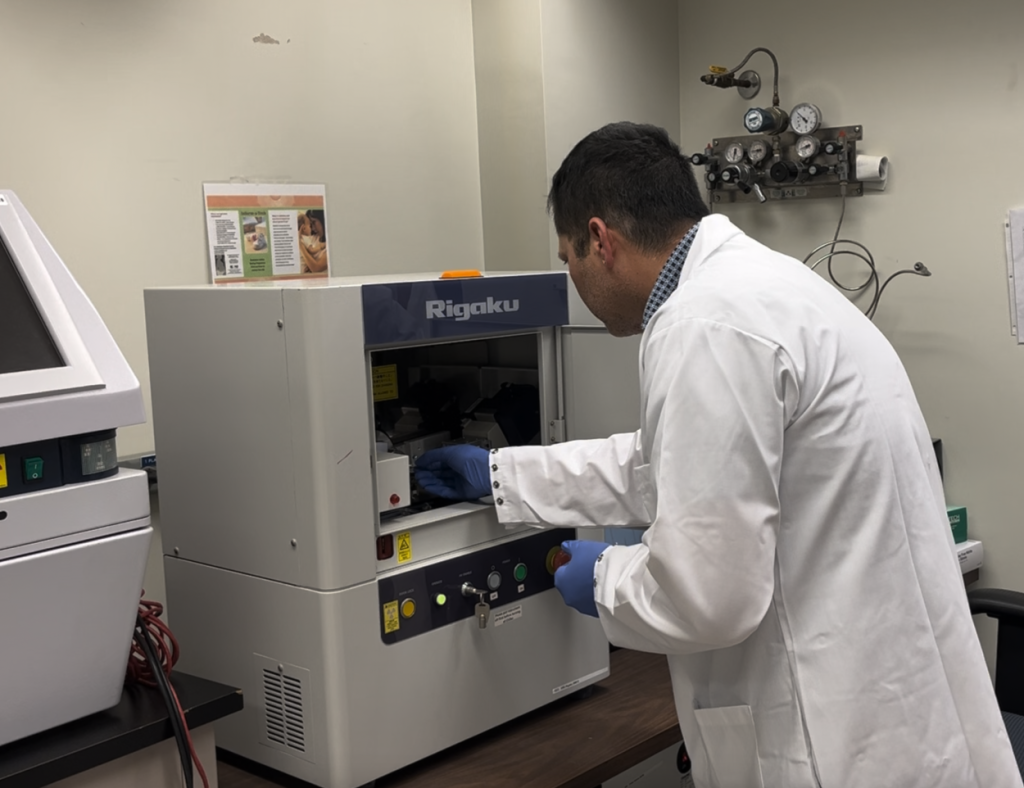
Today, his research focuses on some of the biggest challenges facing the modern world. At North Carolina Agricultural and Technical State University, Bishnu is involved as a principal investigator or co-principal investigator in around 15 research grants.
According to university data, he has received about $15 million in research funding from institutions including the US National Science Foundation, the Department of Energy and the National Institutes of Health.
Much of his work centres on finding ways to convert atmospheric carbon dioxide into useful chemicals and fuels through chemical and electronic processes. Another major area is hydrogen.
Hydrogen can be produced from water and used as an energy source, offering the possibility of cleaner energy. But turning that possibility into an affordable, practical technology remains difficult.
“Hydrogen production from water began many years ago, but the nanomaterials required for the process are expensive,” Bishnu says. “Hydrogen energy is possible in the laboratory, but more work is needed to make the technology accessible to everyone in real life.”
His research group is therefore exploring relatively inexpensive nanocatalysts that could help reduce the cost and improve the practicality of hydrogen production.
The work has resulted in more than 100 academic papers in scientific journals and around 3,800 citations, according to Google Scholar.
But the numbers only tell part of the story.
Bishnu also teaches and supervises postgraduate and PhD students, helping train researchers who may eventually take the science further.
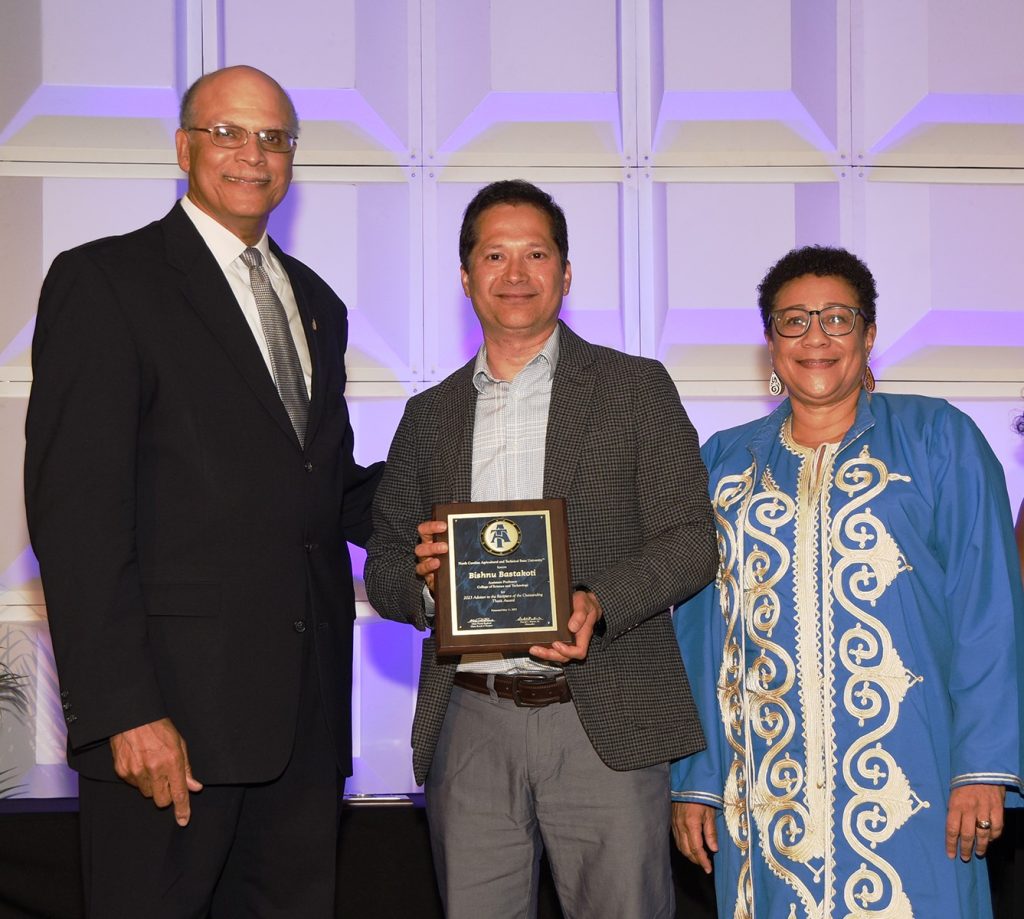
His work has been recognised through several awards, including the Interdisciplinary Research Award and Outstanding Graduate Coordinator Award in 2025, the Outstanding PhD Research Adviser Award in 2023 and the Outstanding Young Researcher Award in 2021.
A scientist who still looks towards Nepal
Despite spending much of his professional life abroad, Bishnu has remained closely connected to Nepal.
He wants his experience to benefit Nepali universities, research institutions and young scientists.
“I want the stories of struggle, achievement and lessons from someone born in a remote place and who worked his way here to inspire the next generation,” he says.
That ambition has already taken concrete form.
In collaboration with the Nepal Chemical Society, he has helped organise two international conferences in Kathmandu.
He has also worked with the Department of Chemistry at Tribhuvan University to co-supervise PhD researchers.
Last year, the Nepal Science Journalists Forum invited him to the sixth edition of its “Meet the Scientist” programme, where he presented his work on hydrogen energy, including its opportunities and challenges, to policymakers, researchers and representatives of the private sector.
His research group has also begun collaborating with researchers at Kathmandu University working on hydrogen energy.
“I hope we can increase institutional collaboration with Nepali universities and research institutions in the future,” he says. “Our knowledge, skills and research could then benefit our homeland.”
The student who brought the story back to Nepal
There is another connection to Nepal that has stayed with Bishnu. One of his American students once wrote about visiting Nepal with his father after finishing high school. The student experienced hours of power cuts during the trip. The experience made him wonder whether there had to be an alternative source of energy.
Could hydrogen be part of the answer?
That question eventually helped lead him towards hydrogen research. When Bishnu read what the student had written, he was deeply moved.
“How would he know that I am from Nepal, that I grew up studying by a kerosene lamp and experienced load-shedding?” he says.
The connection was striking. The student had travelled to Nepal and encountered the same problem Bishnu had known as a child. Years later, that experience had helped inspire research into a possible solution.
For Bishnu, it was a reminder that scientific research does not exist in isolation from people’s lives.
The questions scientists pursue often begin with ordinary experiences — a power cut, an expensive fuel source, a polluted environment, a child studying after dark.
Finding the light
Bishnu’s journey began in a place where the boundaries of possibility seemed narrow. He grew up in a farming family in Gorkha, walked to school, helped look after cattle and studied under a kerosene lamp. He became a teacher, then a researcher. Scholarships took him to Japan. Research took him to Australia and Harvard. He eventually established himself as a scientist in the United States.
But he does not describe the journey as a straight line.
It has been shaped by uncertainty, opportunities, hard work and the willingness to take the next step even when the destination was unclear.
“One dream after another, along with struggles and opportunities, has brought me to where I am today,” he says.
The dream now is not simply to publish another paper or win another award. It is to help make hydrogen energy practical and accessible, and to build stronger links between the scientific communities he has become part of and the country where his own journey began.
The boy who once depended on a smoky kerosene lamp is now working on ways to produce a cleaner source of energy.
The light he is looking for is no longer only for himself.
“We still have a lot of work to do to find the light.”