

“Phul ko rang failina nyano chahinchha”
A flower needs warmth to spread its colour, says Pirati to Apsara, as she drops some blue flowers, collected from deep in the forest, into a bucket of warm water. Perhaps people are not so different from flowers and we require warmth too.
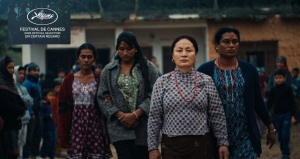
In the Abinash Bikram Shah-directed Elephants in the Fog, before joining Pirati at her work, Apsara rubs her hand and holds her hands against Pirati’s face so she can feel its warmth. This is a small gesture but beautifully encapsulates their relationship. They are each other’s warmth. In each other’s presence, they are unafraid to laugh carelessly and throw their heads back, to sing about their desires and dreams, to just be. We see them braiding each other’s hair and making TikToks. Pirati not only rescued her but gave her a place where she can be herself without constantly having to watch herself. Something her birth family and parents couldn’t give. And in turn, Apsara gives Pirati something too: a glimpse of an ‘ordinary life.’ A little happiness. A little normalcy.
Another source of warmth for Pirati is the Drum Master. He sees what the rest of the world chooses to look past. With him, she finds a love she had never imagined for herself. He is ready to build a life with her. Suddenly, a life in which she is loved for who she is becomes possible.
But how could a society which is barely accepting her existence accept the possibility that she might want to love and live life like anyone else?
Society is willing to tolerate trans people as long as they remain within the borders it has drawn for them. Early on in the film, when the villagers are on patrol, they shout at the elephants: Don’t cross the sacred boundary, or else we will crush, grind and destroy you. This reflects what society indirectly tells trans people. It is okay when they come to weddings, to childbirth, when they give blessings. But the moment they dare to think for themselves, the moment they ask for more, even the limited tolerance disappears.
The Kinnar community can offer a place to call home and a sense of belonging for those who are comfortable living within that community and its traditions. But there are rules, a particular way of life you are expected to follow. And if you do not want that life, there are very few places left to go. Outside the Kinnar community, a trans woman doesn’t get the same tolerance as she would when going from house to house, dancing and giving blessings. She is much more likely to be exploited or hurt. That’s why so many of them are pushed into sex work. And the same society looks down on them. Men seek them out, yet it is the trans women who are called immoral, who are accused of corrupting men’s minds. What are you supposed to do when you are given so few choices to begin with? They are not really being asked what kind of life they want but what kind of limitation they can live with.
Anything outside the options you’ve been dealt seems impossible. When you have been told all your life that it is not possible, you start believing it too. This can be seen in the scene on the tempo where they are returning from a wedding. There, they joke about opening different businesses. Chameli imagines Pirati expanding her herbal workshop, Joon starting a tailoring business and herself managing it all. Their faces light up. Even if it’s fleeting, there is colour in their faces. But they laugh it off. That scene is devastating precisely because all of their dreams are so ordinary. They are talking about making enough money to live with some dignity. Dreams that most of us would barely call dreams. But they laugh it off as if it is a far-fetched idea.

Maybe their business would succeed. Maybe they wouldn’t. No one knows, but that is the point: they are never given the chance to find out. They aren’t allowed the luxury of making mistakes. They cannot afford it. It is as if society is waiting for them to make a mistake, so that it can use that mistake as proof that they never belonged there in the first place. Let alone respect, they don’t even get indifference; all they get is coldness.
When you grow up without warmth, you are very cautious with yourself, your body, your mannerisms, your desires, your dreams. You learn what parts of yourself are safe to show and what parts must be hidden. You stop talking about your dreams because you know what will happen if you say them aloud. You change the way you speak. You learn to look away. You learn whom you can love and how much of yourself you can reveal. Pirati, Apsara, Joon and Chameli have all lived through some version of that coldness. They have been pushed away from the families they were born into and forced to find warmth elsewhere. In each other, they find people who understand the parts that they keep hidden. With each other, they find some of the warmth that has been denied them. But it’s only a sliver of what so many others receive without having to ask for it.
Most of us grow up with this warmth without ever realising it is there. Our families love us without asking us to explain ourselves. We are allowed to be silly, difficult, ambitious, and embarrassing. We are encouraged to dream. We can fail and come home. We can fall in love. We can make mistakes, change our minds, try again. We are allowed to grow into ourselves. But queer people are denied this warmth. Even if they get it, it is conditional. And when you have lived in the cold for long enough, you fail to recognise warmth when it is right in front of you. You become afraid to reach for it.
As a queer person, you learn to make yourself strong because you have been taught that nobody will be there for you. There is a scene where Chameli says to Maya, who is recovering from a self-inflicted wrist injury, “Afule aafulai baliyo bana. Jindagi ma koi pani hunna afno.” That is the voice of someone who has learned that the only person they can depend on is themselves. When the entire world treats you like an aberration, it becomes frighteningly easy to turn that hatred inward. You are forced to grow up too soon. You stiffen yourself, harden yourself. Because there is no other choice. You have to be soft with others but never with yourself. Early in the film, Pirati tells Apsara, “hami milera basna parchha.” Even after being treated with coldness all their life, they are the ones most skilled at creating warmth for others.
A little warmth is all it takes to not hate yourself. A little bit of warmth is all it takes not to crush your dream. A little bit of warmth is all it takes not to run away from happiness. A little bit of warmth is all it takes for someone to keep living. Like a flower placed in warmth, slowly opening, releasing the colour and fragrance.
And the warmth doesn’t have to be something grand. Meeting their eyes without accusation or disgust. Not running from them. Laughing with them, not at them. Giving them a shoulder to cry on. Listening when they talk about their dreams. Watching them fight for their dreams. Letting them be.
Kindness is not tolerating someone at the edges of society. It is helping them enter the centre of ordinary life; it is allowing them to work, to fail, to love, to dream, to come home.
I choose to imagine a world where Chameli is running a business, wearing an open-cut blouse and dancing. Someone says she is more beautiful than Katrina Kapoor. I see Joon with her own tailoring business. I see Apsara working in music videos, dancing and acting her heart out. I see Pirati with her lover, a bigger workshop, her daughters braiding her hair, their warm hands resting against her cheek as they laugh together.
All of us are flowers, waiting to bloom, waiting to share our fragrance, waiting to let our colours show. All we need is a little warmth. A little kindness.