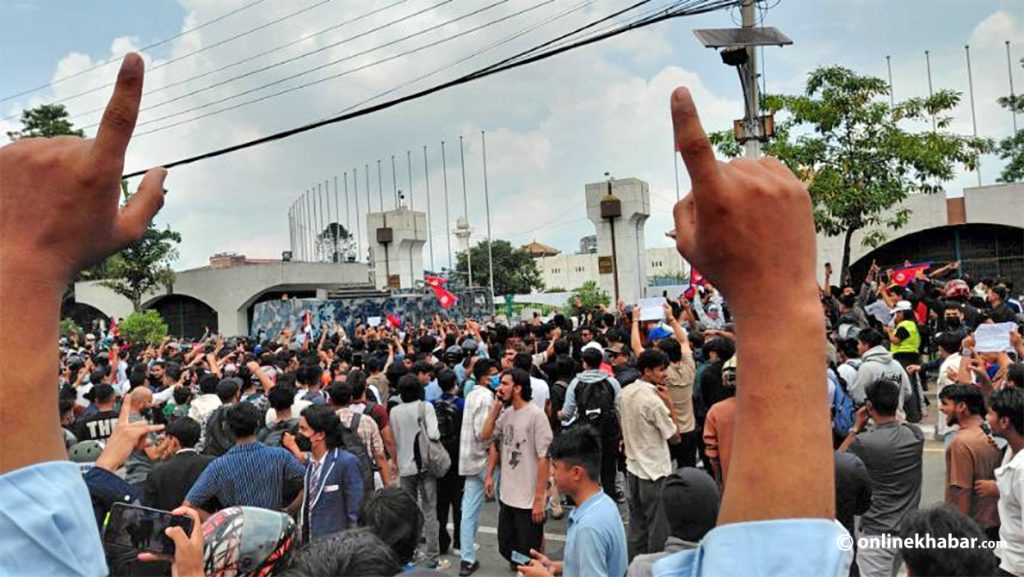

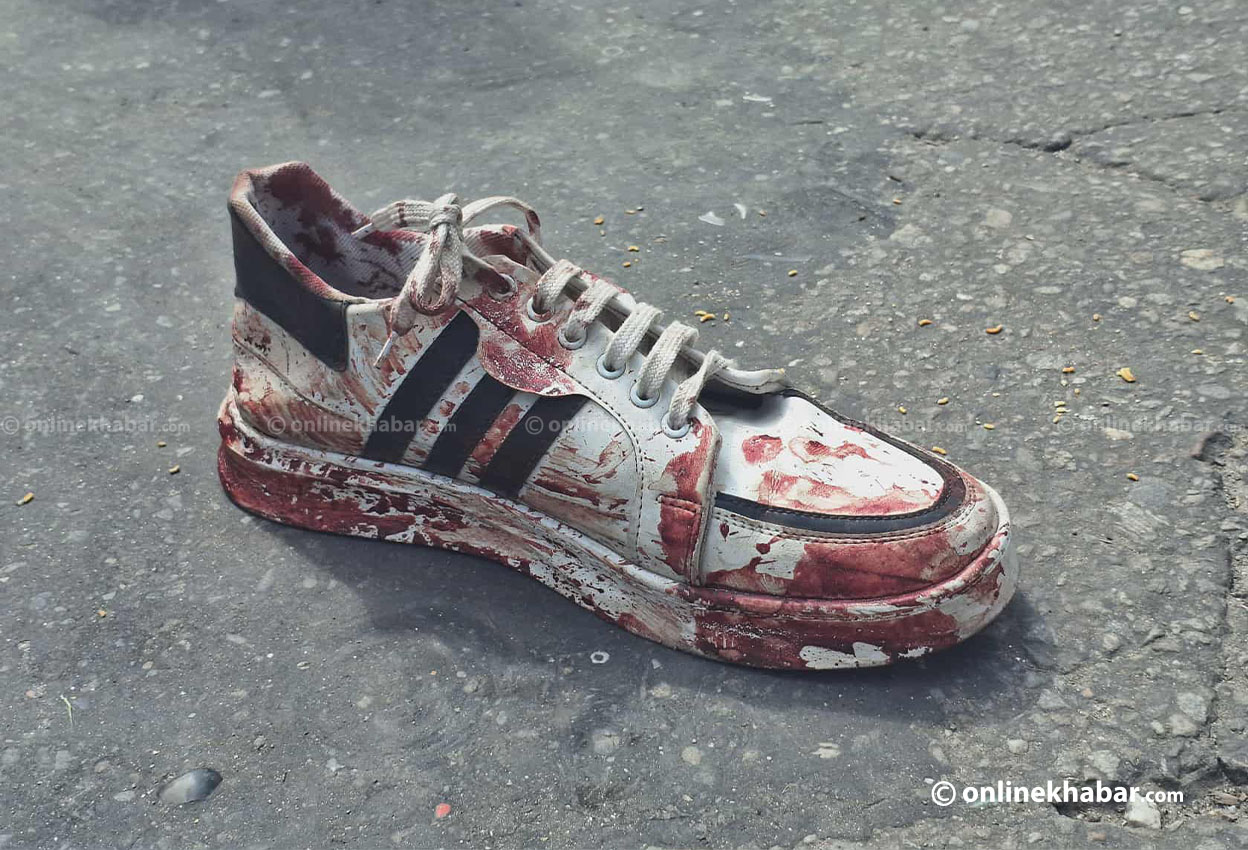
Until September 6, 2025, there had been no public discussion about when Nepal’s Gen Z protest would take place. Yet preparations were already underway from the day the government shut down major social media platforms.
Who called the protest? Who decided the date? Why was September 8 chosen? And who took part in the discussions?
One year on, these questions remain largely unanswered. But the events of September 8, 2025, cannot be understood without looking at what happened in other countries—and how those events travelled through social media into Nepal.
From Indonesia and the Philippines to Nepal
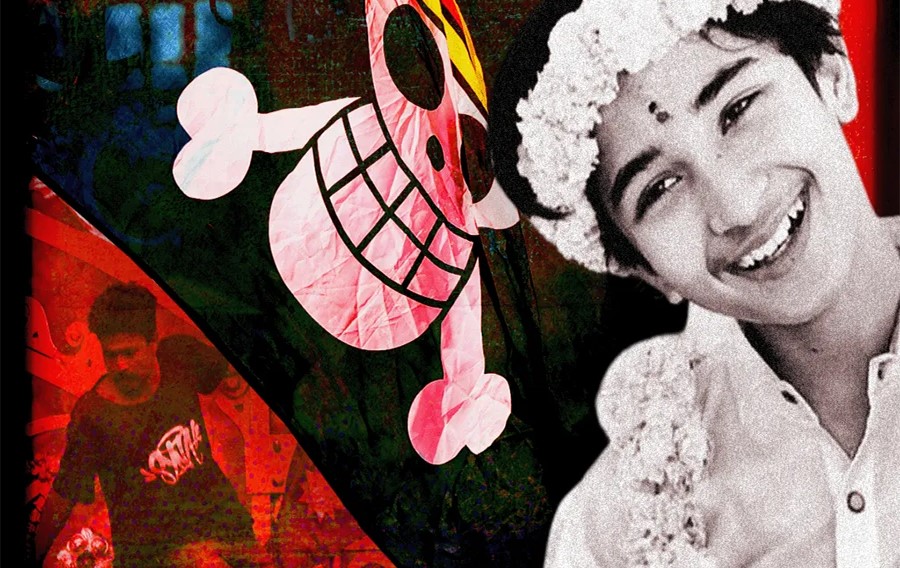
Gen Z protesters surrounded Parliament as police tried to contain them with force. At the same time, a police van pushed through a crowd and struck 21-year-old Affan Kurniawan, a delivery worker who was not participating in the protest. The van did not stop and ran him over.
But the incident had not happened in Nepal.
It took place on August 28, 2025, roughly 4,500 kilometres away, outside Indonesia’s Parliament in Jakarta.
Affan’s death intensified protests in Indonesia. The following day, protesters set fire to a provincial parliament building in Makassar and targeted police and government buildings. Homes belonging to ministers and politicians were also vandalised and looted. CBC reported that 10 protesters had died and dozens had been injured as the unrest escalated.
The protests had already been building for weeks over taxes, the rising cost of living and a government decision to increase lawmakers’ allowances. Gen Z was at the forefront.
Videos contrasting the lifestyles of ordinary Indonesians with those of politicians and their families spread rapidly online. Hashtags including #GelapIndonesia, or “Dark Indonesia”, and #ResetIndonesia trended.
As violence escalated, Indonesia’s President Prabowo Subianto appeared with political leaders on August 31, 2025, and announced that lawmakers’ allowances would be cut.
A similar movement was unfolding in the Philippines.
Around 1,400 kilometres from Indonesia, Filipino Gen Z protesters took to the streets after allegations of corruption in government flood-control projects. Their central question was: “Where did our tax money go?”
Large amounts of public money had been allocated for flood protection while people were still drowning in floods. Gen Z users searched for and posted photographs and videos of politicians and contractors, exposing their families’ luxurious lifestyles.
The hashtag #NepoBaby spread alongside slogans such as “It’s not floods drowning our country, it’s greed” and “We are drowning in floods while their children live luxury lives.”
The movement developed in stages. During the first week of August, information about alleged corruption in flood-control projects began circulating. The following week, videos documented deaths and property losses caused by flooding. In the third week, the lifestyles of politicians’ and contractors’ children came under scrutiny. By the fourth week, Gen Z and others were on the streets.
By the last week of August, international media were extensively covering the youth protests.
It was around this time that the Indonesian and Philippine “Nepo baby” trend suddenly appeared on Nepali social media.
Videos began highlighting the luxurious lifestyles of children of Nepali politicians and officials, juxtaposed with the hardships of ordinary people.
But how did the trend reach Nepal? Who made the first videos? And how did it spread so quickly?
The Nepo Baby trend reaches Nepal
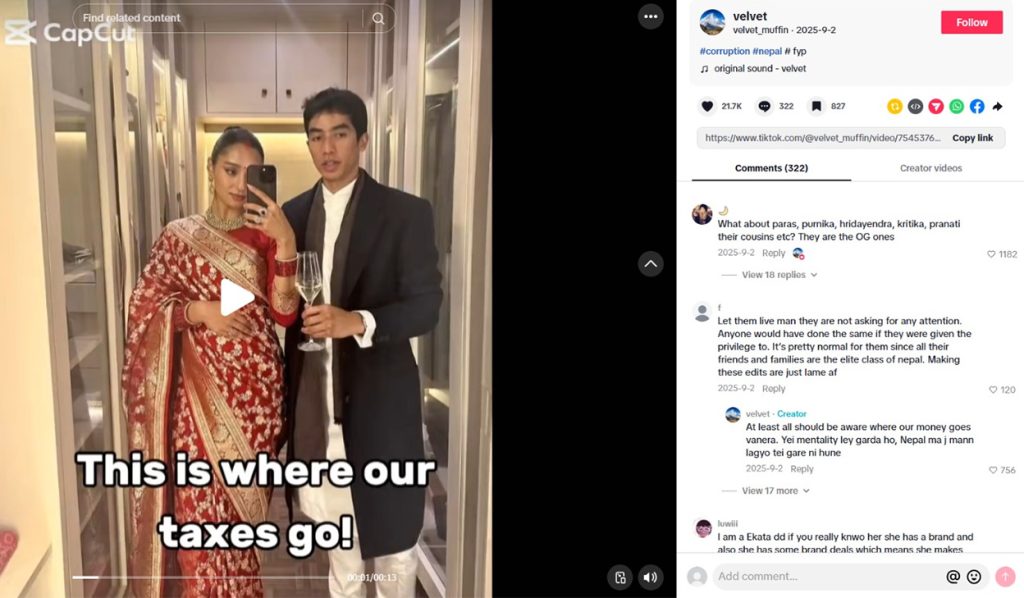
One of the earliest Nepo baby-related videos found on TikTok was posted by an account called “Velvet Muffin” on September 2, 2025. The identity of the account holder is unclear.
The video received more than 350,000 views. Comments called for more such content, with some users writing, “Now it’s Nepal’s turn.”
The video showed the lifestyles of Jaiveer Singh Deuba and his wife, Shrinkhala Khatiwada and Smita Dahal, alongside images of people affected by floods and landslides in the Philippines. Although it appeared to have been uploaded from Nepal, it clearly drew influence from the Philippine movement.
The account had four videos. Three more, all focused on Nepo babies, were posted on September 6. One said, “We have to work and struggle here so their passports keep getting thicker.” Another said, “Our struggle, their enjoyment.”
A third said ordinary people in Nepal could not even exercise basic rights while the children of powerful people were posting photographs and videos of luxurious lives.
Other early accounts, including “Wakeup Nepal” and “Nepal GenZ,” also posted Nepo baby videos, although those accounts have since been deleted. Another account, identified by the number 7545709787246365908, was also active at the time.
After September 4, Nepo baby-related content began appearing across countless accounts.
The discussion, however, had started even before TikTok became the main platform.
Anger was already building on Reddit
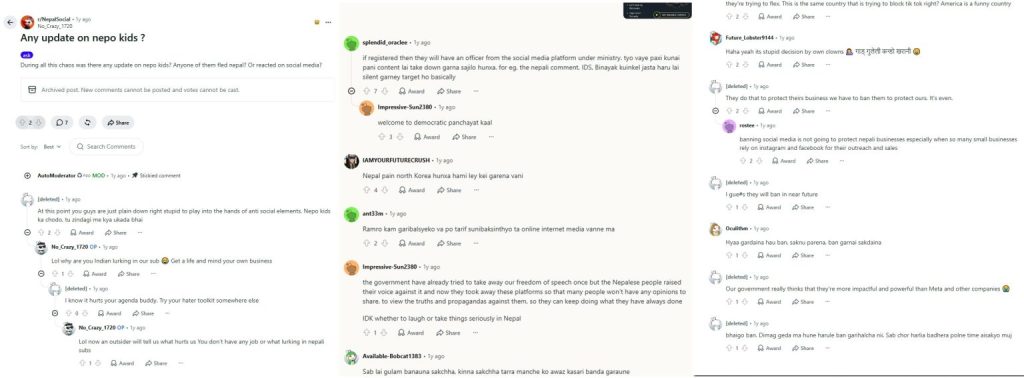
Reddit had become a space for intense discussions about the protests in Indonesia and the Philippines. Because users can operate anonymously or under pseudonyms, it also became a place where Nepali young people could openly discuss the government’s decision to restrict social media.
On March 20, 2025, the Ministry of Communications and Information Technology had warned that social media platforms would be blocked if they did not register with the government within one month.
That same day, the Nepal Social subreddit carried a warning about the decision. One user questioned whether the government had made the decision for the public or for its own benefit.
The issue resurfaced on August 28, when the ministry issued another notice requiring social media platforms to register within seven days.
By September 3, none had registered. A Cabinet meeting the following day decided to shut down the platforms.
Based on the Cabinet decision, the Nepal Telecommunications Authority instructed mobile and internet service providers to block 26 platforms including Facebook, Messenger, Instagram, YouTube, WhatsApp, Twitter, LinkedIn and Snapchat. The decision triggered an immediate backlash.
Reddit remained accessible, and discussions intensified throughout the day.
At 11:05 am, a user named “Rosti” warned that the ban could destroy Nepali businesses dependent on Facebook and Instagram. At 12:20 pm, “Somaymoni” wrote that the government could not simply ban social media. At 4:05 pm, another user, “Aculithym”, insisted that the government would not shut the platforms down.
By 5:29 pm, the tone had changed. One user wrote that the shutdown had happened and that the time had come to “tie up all the thieves and burn them.”
The anger that was not obvious earlier in the afternoon was becoming increasingly visible.
Some people turned to VPNs. Others gathered in tea shops to discuss what was happening.
On Instagram, an activist using the name “iih” was among the early recognisable voices calling for action. In a post from Manang’s Yak Kharka, iih said most people relied on Messenger and WhatsApp to communicate with family, while some businesses depended on social media. The government’s decision, the post said, would disrupt communication and trade.
iih called for a campaign demanding the resignation of then Communications Minister and government spokesperson Prithvi Subba Gurung, and for a younger minister who understood the internet.
The post received around 3,000 likes. Comments included calls for a protest and comparisons with movements in Indonesia, Malaysia and the Philippines.
Who actually set September 8?
Until September 6, there was no clear public announcement about the protest date.
Yet according to people involved in the early discussions, preparations had already begun on the day social media platforms were blocked.
Several people who later emerged as Gen Z leaders—including Miraj Dhungana, Tanuja Pandey, Anil Baniya, Yujanraj Bhandari, Dhiraj Joshi, Majid Ansari, Pradeep Gyawali, Monika Niraula, Manish Khanal, Rijana Rana Magar, Prakash Bohora, Amit Khanal, Bhawana Raut, Ojaswi Thapa, Nimesh Shrestha, Aditya Karna, Aakriti Ghimire and Rakshya Bam—said they did not know who had ultimately called the protest or fixed the date.
Their answer was broadly the same: they found out through social media.
On September 7, Sabal Gautam and Purushottam Yadav went to the Kathmandu District Administration Office seeking permission for a peaceful protest.
Gautam says the date—September 8, or Bhadra 23—was chosen by them.
According to him, six school friends, all under 20, discussed the date after the social media shutdown. Purushottam joined later.
Gautam had created the TikTok account “Wakeup Nepal” on the day the platforms were blocked and posted Nepo baby-related content. That night, they decided on September 8.
The Nepo baby trend had been circulating for three or four days. With social media blocked, they wanted to take the anger onto the streets.
Saturday was considered unsuitable because it was a holiday and they feared fewer people would attend, so Monday was selected.
But Gautam says the protest eventually became very different from what they had expected and went beyond their control.
A person active on Discord gave a slightly different account. According to the user, September 6 was initially discussed because Saturday was convenient for young people. But some felt it was too soon and that information would not reach enough people. The discussion then shifted towards Monday, September 8.
The user, who requested anonymity, said only around 15 or 16 people were involved in the Discord discussion that evening and that the names of those present were not remembered.
That night, AI-generated posters stating “Date: September 8, Location: Parliament Building” began circulating.
The following day, the Discord server suddenly grew to more than 10,000 users.
Some discussions became increasingly aggressive, including talk of “head hunting” and wearing full-face masks to prevent police from identifying protesters. Other users discussed how to remain safe during the protest.
Because TikTok had already registered in Nepal, it remained accessible while most other platforms were blocked. Many users therefore moved to TikTok.
Until September 5, there were relatively few posts about a September 8 protest. From September 6, however, TikTok was flooded with videos and posters announcing the date.
The protest call spreads
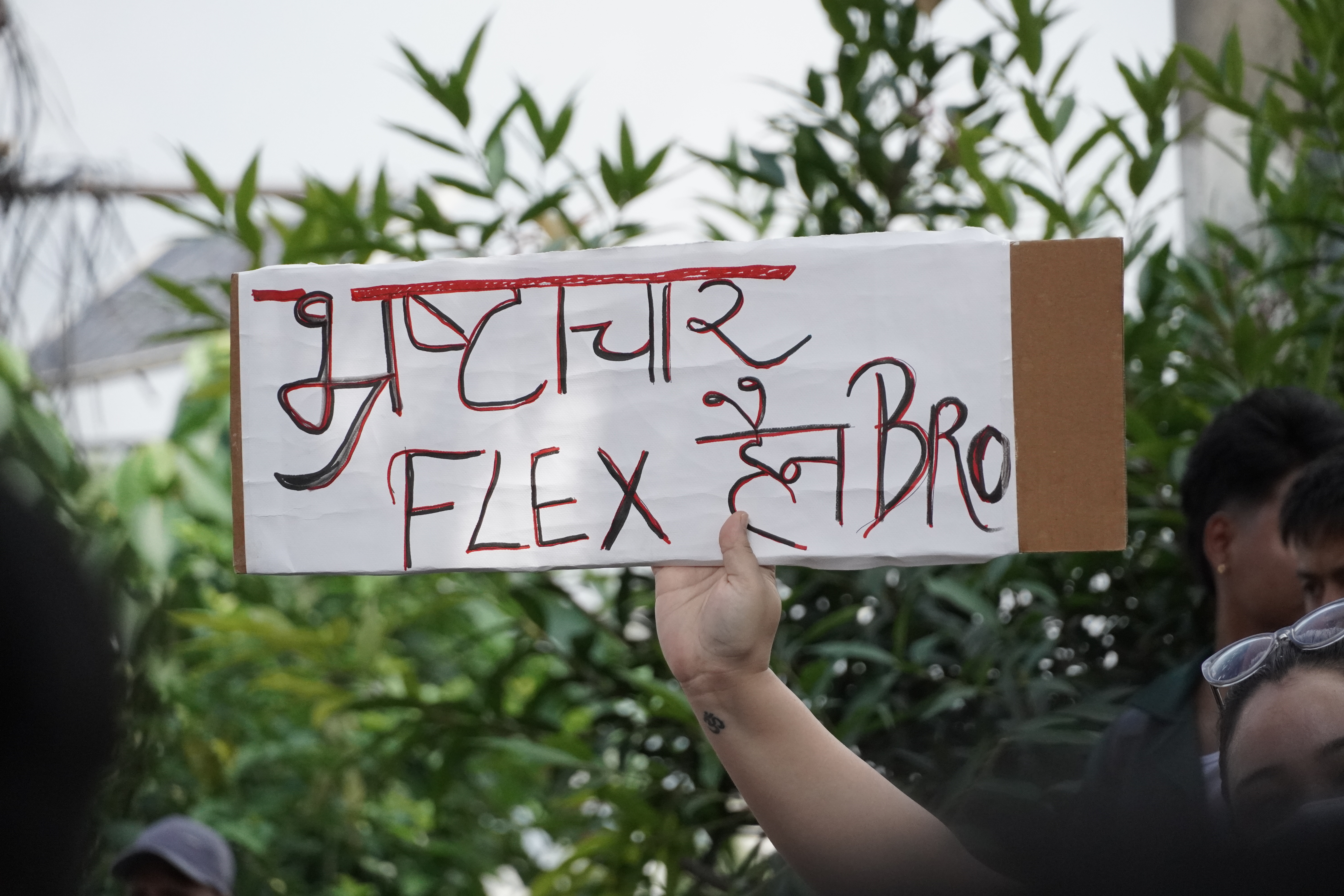
Gen Z participant Aditya Karna says that after seeing the posters, he organised a Zoom meeting on September 6 with activist iih and others.
Karna argued that Parliament at New Baneshwor was a prohibited area and that protesters should instead gather at Maitighar. He actively circulated information about the restriction and says many people were redirected to Maitighar, although many still went towards the original location.
Another incident also fuelled public anger.
On September 6, a vehicle carrying Koshi Province Minister for Economic Affairs and Planning Ram Rana Magar, who had come to Kathmandu to attend the CPN-UML statute convention, hit a girl in Harisiddhi, Lalitpur, and fled.
Locals briefly blocked the road and protested, angry that the minister’s vehicle had hit the girl without stopping to check her condition.
Then Prime Minister KP Sharma Oli defended the minister and urged people not to politicise the incident.
He said it was an unfortunate accident, that the girl had been taken to hospital and that the party would bear her treatment costs.
The response further fuelled anger among young people.
“Numbers were estimated, violence was not”

Before September 6, many popular TikTok creators were posting their usual content. From September 6, however, influencers began uploading videos calling on young people to join the September 8 protest at Baneshwor or Maitighar.
Ravi Chand Thakuri, who had around 140,000 followers, urged young people to gather at Maitighar, saying the country would not change unless they acted.
Ratan Karki, with more than 350,000 followers, also called for the protest but stressed that it should remain peaceful.
“Movement should begin from every part of the country,” he said, while urging protesters not to vandalise government offices or stop vehicles.
Suruchi Budhathoki, who had around 52,000 followers, called on young people to protest against the older political generation and demanded greater youth representation.
Thousands of other accounts also called for September 8, although there was no single, clearly defined agenda.
Their videos and banners pointed to opposition to the social media ban and corruption. Slogans included “The Final Revolution,” “We Are Punching Up,” “Stop Corruption,” “Time for Youth” and “Enough Is Enough.”
Even accounts with relatively few followers—including Brief Nepal, Save Nepal, Defector, Finding My World and Truth Talks—received hundreds of thousands or even millions of views.
The movement was clearly being framed as a Gen Z protest, but its leadership remained unclear.
Among the prominent voices were content creator Nimesh Shrestha and then Pathao Managing Director Asheem Man Singh Basnyat.
Basnyat posted on Saturday afternoon that he would go to Maitighar on September 8 and urged others to join him. He argued that digital support alone was not enough.
“Physical presence matters even more than digital presence,” he said, announcing that he would personally attend the Monday protest and calling for a peaceful movement.
At the same time, numerous fake accounts appeared. Many young women called for a peaceful protest, while some male users also expressed support. Others warned that the protest could turn violent and urged participants to remain safe.
Pseudonymous accounts posted provocative AI-generated videos showing Parliament being burned, gunfire and tear gas, and protesters occupying Parliament.
The YouTube channel InDepth Story (IDS), which had more than 600,000 subscribers and over 100,000 TikTok followers, also reshared an older video about Bangladesh ahead of the protest. The video referred to the student movement that forced then-Prime Minister Sheikh Hasina to leave and showed students occupying the prime minister’s residence.
Popular accounts such as Routine of Nepal Banda, NEB Result and News and No Next Question expressed support. Then Kathmandu Mayor Balen Shah, Deepak Raj Giri, Karishma KC, Ranju Darshana and other artists and politicians also backed the movement.
Royalist activist and medical businessman Durga Prasai said he supported the September 8 protest and would attend. Gen Z accounts subsequently asked him not to come, and Prasai said he would stay away.
Police prepare for unrest
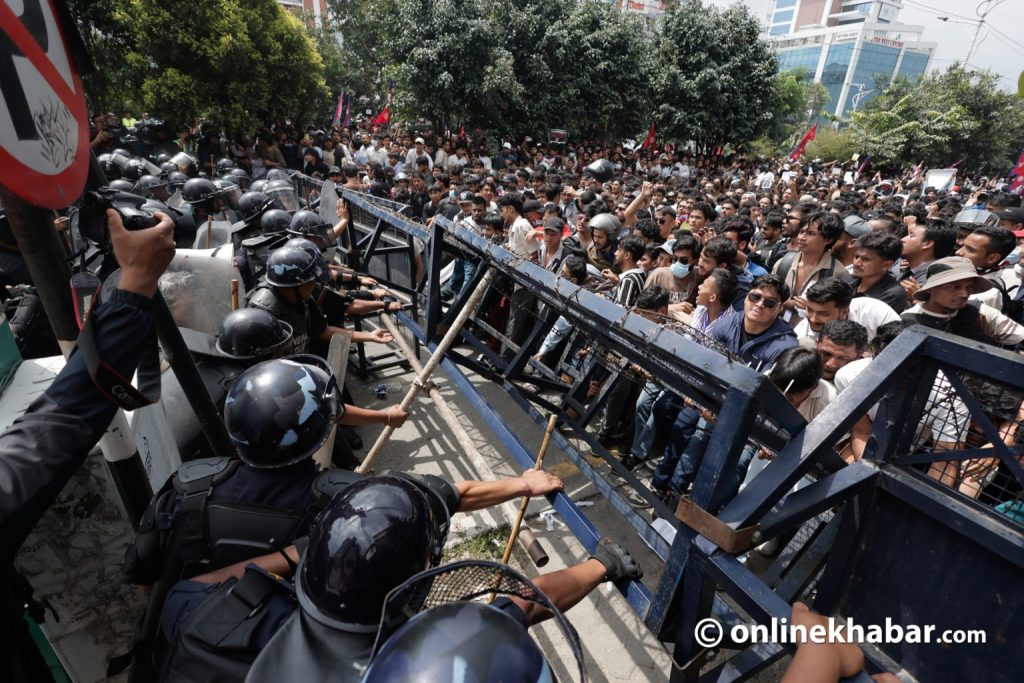
Police were also watching the rapidly changing situation.
Then Kathmandu Police spokesperson SP Apilraj Bohora said security forces were on high alert and had received numerous videos calling for a peaceful protest but showing Parliament and Singha Durbar being burned.
He said security would therefore be strengthened around sensitive areas, with more police deployed than usual.
If the protest turned violent, he said, those violating the law would face action.
By September 6, therefore, the protest had acquired a date, slogans, online mobilisation and thousands of supporters—but no clearly identifiable central organiser.
What began with anger over the social media ban had absorbed the Nepo baby trend from Indonesia and the Philippines, grievances over corruption, frustration with Nepal’s political leadership and a growing sense among young people that they had little control over the country’s direction.
The call to protest was everywhere.
The people who made it, however, remained difficult to identify.