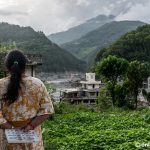


Nepal is right to demand climate justice. The harder question is what happens to the money once it arrives in Kathmandu. On the morning of 26 August, a mass of rock and ice came off Langtang and a wave went down the Bhotekoshi River. It destroyed the Rasuwagadhi border post, bridges, hydropower stations and long stretches of the road to Tibet.
By the disaster authorities on September 7, 1342 people were confirmed dead in Nepal, and 4,996 were still listed as missing. Those figures are provisional, and they are still moving. Hold on to that shape, because it is the shape of the whole problem. In this country, climate impacts travel. Climate finance does not.
Nepal’s climate finance gap
Nepal has contributed only marginally to the emissions driving global warming; the figure our own government uses in its submissions to the UN climate process is about 0.027 per cent of the global total. Warming is increasing the instability of glaciers, permafrost and high-mountain slopes across the Himalaya, and while scientists are still establishing the precise trigger at Langtang, the direction of the risk is not in dispute.
Nepal is right to press that case at COP31 in Antalya in November. But there is a second question, and this one belongs entirely to us. When climate money does arrive, how far down the hill does it actually get? Our National Adaptation Plan is specific about what we need: 64 priority programmes across nine sectors, costed at USD 47.4 billion to 2050, of which Nepal expects to raise only USD 1.5 billion domestically.
The annual requirement, it states, is roughly USD 2.1 billion. Set that against the Green Climate Fund’s (GCF) own country page for Nepal, which lists six projects and USD 157 million in total approved financing, plus USD 5.9 million in readiness support. Approved, not disbursed. And one of those six is Nepal’s share of a multi-country regional programme rather than a project here.
The GCF is one fund among several. We also draw on the Adaptation Fund, the Global Environment Facility, bilateral partners and the new loss and damage arrangements, so the full picture is larger than that. But when the single biggest dedicated climate fund has approved, across its entire Nepal portfolio since 2019, slightly less than what our own plan says we need in a single month, the scale of the shortfall is not really arguable.
Volume, though, is the part Nepal cannot fix alone. The part we can fix is what happens next, and here our first GCF project deserves close study, precisely because it is not a failure. Building a Resilient Churia Region was approved by the GCF Board in November 2019 and became effective in May 2020. It carries a USD 39.3 million grant with government co-financing on top. FAO is the accredited entity; the Ministry of Forests and Environment executes it. It spans 26 river systems and is designed to work through some 750 community-based organisations and user groups. This is precisely the architecture the country says it wants. The GCF project page currently shows it around 60 per cent disbursed, running to 2027, after two opening fiscal years given over to preparation.
None of that is a scandal. An eight-year timeline for landscape restoration at this scale is normal, and arguably it is what careful implementation looks like. That is exactly the uncomfortable part. From board approval to results on the ground at scale, our best-functioning climate programme takes the better part of a decade.
Meanwhile, in July 2025, the GCF approved USD 36.1 million to protect lives and assets from glacial lake outburst floods in Nepal’s glacial river basins. Thirteen months later, the water came down the Bhotekoshi. No project could have prevented what happened in Rasuwa, and it would be dishonest to imply otherwise.
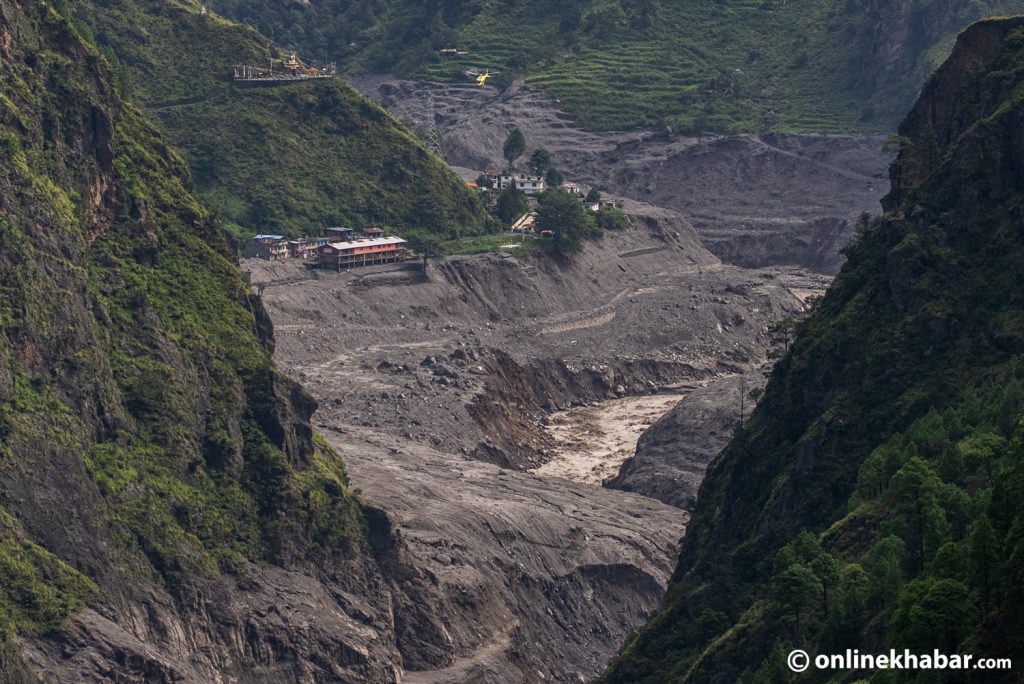
But the mismatch of clocks is real. Hazards here arrive in minutes. Our delivery systems are assembled in years. A forest would not have stopped a rock-and-ice collapse at 5,000 metres, and saying so plainly protects the argument that follows. Most of what climate change costs Nepal is not a cryosphere failure. It is the slower accumulation of monsoon landslides on cut and destabilised mid-hill slopes, gullies eating terraced farmland, springs that fail in March instead of May, a fire season that runs longer each year, riverbanks advancing on settlements. Those are losses that forests moderate.
For 15 years we have argued about our forests mainly in the language of carbon, through REDD+, registries and verification protocols. Carbon is a revenue conversation. Adaptation is the conversation our hills are actually having. But the claim has to be made precisely, because forests do not substitute for engineering.
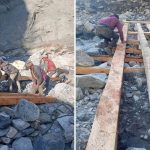
Eco-engineering trials in the Panchase region tested what actually holds a failing road slope: drainage and civil works combined with deep-rooted vegetation, neither element sufficient on its own. Forests belong inside Nepal’s adaptation infrastructure alongside culverts and retaining walls, budgeted the same way, with a maintenance line and someone answerable for whether they still function in five years.
The most urgent place to apply that thinking is the road network. Nepal has more than 6,600 rural roads running to nearly 60,000 kilometres, much of it bulldozer cut without drainage or slope stabilisation, and peer-reviewed work in Natural Hazards and Earth System Sciences has documented these informal roads as a significant and under-recognised driver of slope failure in the middle hills. Adaptation planning that does not reach the bulldozer is not adaptation planning.
Need to measure climate finance by results, not spending
What Nepal does not need is to invent a way of moving money to communities. More than 22,000 community forest user groups manage some 2.3 million hectares, about a third of the national forest estate, on behalf of close to three million households, with elected executives, approved operational plans, bank accounts and audits. Community forestry is not perfect, and pretending otherwise weakens the case rather than strengthening it.
Elite capture is real. Some groups distribute benefits unevenly. Women, Dalit and Indigenous members are not always meaningfully represented in decisions despite formal quotas. Capacity differs enormously between a well-run group in the Terai and a struggling one in a remote mountain ward, and very few user groups today would meet the fiduciary, procurement and safeguards standards that international climate funds require. But those are governance problems with known remedies. They are arguments for investing in a 40-year-old local institution until it meets the standard, not for routing around it and then complaining that the last mile in a mountain country is too difficult.
The 2019 Climate Change Policy commits at least 80 per cent of international climate finance to implementation at the local level, and it remains Nepal’s signature contribution to the global debate. The Climate Finance Mobilisation Procedure issued this February, which names the Ministry of Finance as focal point, defines implementing entities across all three tiers of government and opens eligibility to NGOs and private firms, is the first serious attempt to give that commitment machinery.
Yet notice how loosely the commitment is stated in practice. It is described variously as 80 per cent of international climate finance, 80 per cent of the climate budget, and 80 per cent of the funds of any climate project reaching the local community. Those are three different obligations, and compliance with all of them is demonstrated the same way as budget coded to local governments.
It is an accounting category, not a condition at a place. Follow the chain: ministry, province, palika, user group, forest, household. Every link reports upward on money moved. Almost none report on what changed. We can say how much was approved. We can rarely say how many hectares of degraded slope were planted and survived three monsoons, how many springs recovered their flow, how many households did not have to sell land after a bad year. Fixing that does cost something: baselines, field verification, remote sensing and community monitoring. But it does not require another institution. It requires the institutions we already have to measure something different.
So contract user groups as implementing entities rather than beneficiaries, and fund the fiduciary strengthening that makes them eligible. Build a permanent, staffed project preparation facility, because we forfeit finance we qualify for whenever nobody at provincial level has the time to write a bankable proposal.
Plan forestry alongside agriculture, water, disaster risk reduction and road construction instead of apart from them. Put maintenance into every restoration budget and measure survival at year five rather than seedlings at year one. And require every programme to answer four questions: where, for whom, what physically changed, and is that place measurably safer than it was. That is the moment to write the commitment so that it is measured where the money lands rather than where it is coded. Nepal’s resilience will not be settled by the size of the number we bring home from Antalya. It will be settled by how much of that number is still moving when it reaches the last village on the last ridge.