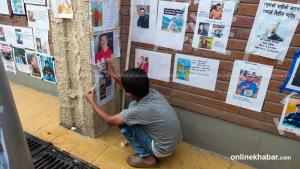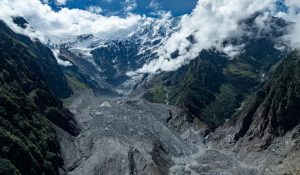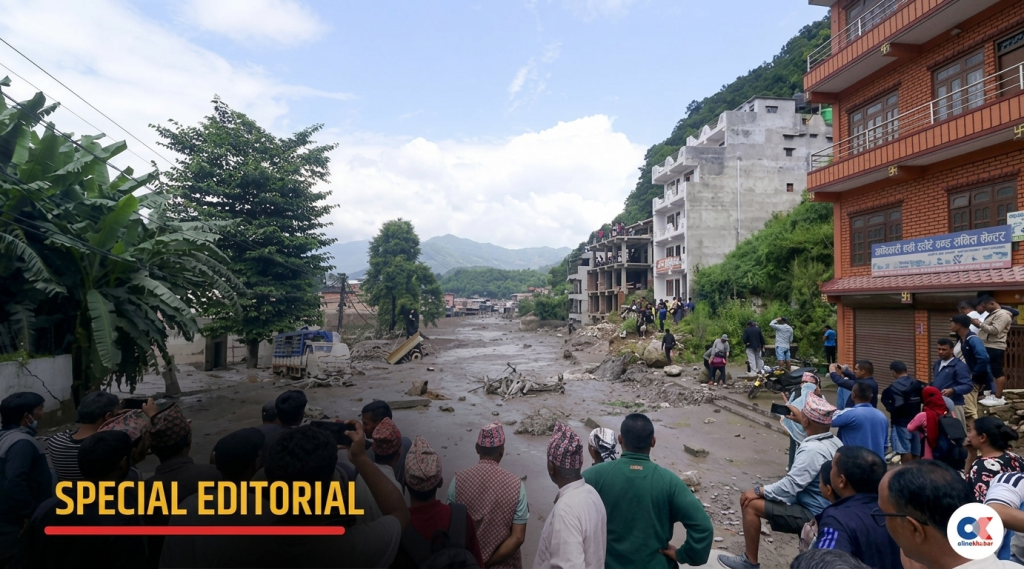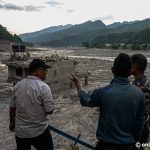


Families separated by the river have had no contact with their relatives on the other side. No one knows what’s happening across the water, and no news travels the other way either. Since the flood struck on August 26, locals along the Trishuli River have been left without any word of their loved ones.
“Once the flood swept away both the suspension and concrete bridges, we’ve had no news from either side. All connection has been severed,” says Bhuwan Prasad Ghimire, 86, of Darshantar, Nuwakot. “We don’t know when the government will restore the connection.”
The flood on August 26 has left people deeply shaken; residents in the area remain in a state of fear.
“I’m 86 years old, and I’ve never seen anything like this. Whatever came this time, it came in a surge,” he says, adding that nothing like this had happened even in his father’s or grandfather’s time.
He recalled a flood in 1962 but said it was nothing compared to this one.
“Back then there was no bridge, and the settlement was higher up. After roads and bridges were built, the settlement moved down closer to the river. Now the flood has taken everything,” he says.
Bridges swept away

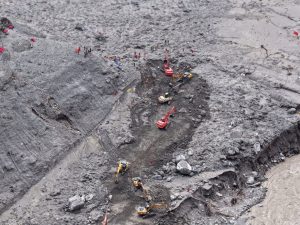
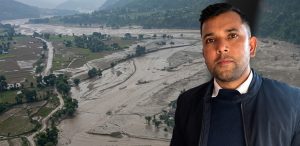
This is a shared crisis across numerous villages in Rasuwa, Nuwakot, and Dhading. The flood destroyed 35 concrete bridges alone; the number of suspension bridges lost is still unclear. Only one bridge in Galchhi remains intact, and the alternate route through Dhading to reach the Nuwakot–Rasuwa border at Trishuli has become a “lifeline.”
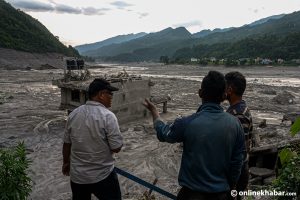
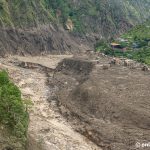
In some places only the beams of a suspension bridge remain; some bridges dangle uselessly over the river; in others, not even the foundation of a former concrete bridge is visible. The river now flows far below where bridges once stood. Climbing uphill from Galchhi in Dhading, the team met Dhan Bahadur Adhikari, 78, whose home is on the Dhading side while his relatives live across in Nuwakot.
“Crossing used to take five minutes by bridge. Now it takes four to five hours on foot via Galchhi,” he says.
The Trishuli River has also washed through Wards 3 and 5 of Devighat in Nuwakot. Lokbahadur Pudasaini and his wife Durga Pudasaini of Devighat were cleaning out their flood-damaged home but still haven’t been able to cross to the other side. Durga’s parental family lives across the river; she has heard her brother was swept away but hasn’t been able to go check.
“My brother is unreachable. I haven’t been able to go there,” she says.
According to Lokbahadur, there were three bridges in the Devighat area.
“The iron bridge built in 1975 was washed away. The concrete bridges built in 2025 and 2007 (BS) are also gone,” he says. “Devighat connects three local governments, but now that connection is severed.”
Until roads and bridges are rebuilt, meeting relatives on the other side isn’t possible.
Years ago, a campaign helped phase out the old tuin (cable crossing) system in favour of proper suspension and concrete bridges.
“Now there’s neither a tuin nor a bridge. Even a temporary tuin would let people cross; the government should at least arrange that for now,” Dhan Bahadur says.
No power, no communication
In many places, floodwaters have destroyed electricity poles and wires, leaving areas across the river still without power. When the Onlinekhabar team reached Devighat via the alternate route, most locals were gathered outside their homes at communal rest spots.
“Since the flood took out the poles, there’s been no electricity. It’s hot, so we’re staying outdoors,” says Ambika Rimal, 65.
People now have to walk for hours just to charge a mobile phone.
Locals describe these areas as having become remote and hard to access.
“My relatives are across the river. I don’t know what happened to them; phones don’t connect, and I can’t go there. What used to take five minutes to cross now leaves us stuck on our own sides,” says Binda Adhikari, 48, of Devighat.
Daily life at a standstill
Households have paddy and corn stored, but no way to get it milled; the mill is across the river.
“The husked rice has run out. What do we eat now? It’s a disaster,” Adhikari says. “Even the vermilion for rituals has to be bought from the market across the river, but I hear there’s no market there either. I haven’t been able to go.”
People used to routine travel between the banks are now cut off even from basic news.
“We haven’t been able to watch TV. Mobile phones are off; it’s like a desert,” says Purna Bahadur Bhujel, 55. “Everything is deserted. It feels like the Stone Age; we don’t know anything.”
Daily life and trade have been disrupted broadly.
“Food used to be brought from one side to the other and vice versa. Now that’s completely stopped,” says Govinda Aryal, 55.
Once-bustling markets now lie in ruins, and locals can’t even buy daily essentials or transport their vegetable harvests across.
Students who used to cross to attend school on the other side are now unable to continue their studies, affecting students across all three districts along the Trishuli.
“Students up to Belkotgadhi Municipality used to come to Devighat for school. Now students on both sides can no longer attend,” says Krishna Prasad Aryal, 77.
No roads
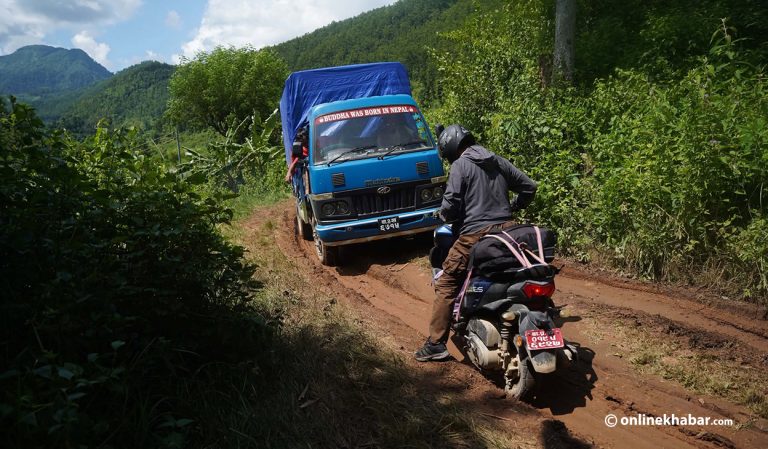
Road connections between the three districts have also been severed, leaving no route for local travel except the single surviving bridge at Galchhi. Reaching Trishuli, Devighat, Dhunge, or Betrawati on the other side now takes hours via that detour. “The concrete road washed away. Now you have to go via Galchhi — it’s a narrow track, hard for two-way traffic,” Bhujel said.
No one knows when the road will be rebuilt. “It takes five hours to get from Bidur to Galchhi and then on to the other side of Betrawati,” said Ramhari Bogati, 32, of Bogatitar, Bidur-9, Nuwakot. “The road is unpaved and difficult.”
Relief supplies and local traffic have already begun causing congestion on this makeshift track.
Patients at risk
With no roads or bridges, essential services have been badly hit, and it’s proving especially dangerous for the sick. Getting patients to Kathmandu for treatment has become extremely difficult.
“For serious cases, patients need to go to Kathmandu. It used to take two hours; now, via Galchhi, it takes seven to eight hours,” Bogati says. “You have to call an ambulance, and it takes time just to reach here; by then, who knows what condition the patient will be in.”
Areas directly affected by the flood include Pimaltar, Tarukaghat, Pipaldanda, Kumaltar, Sirkhali, Multhala, Gauribensi, Kalikhola, and the upper reaches of the Trishuli.