
Kathmandu, August 30
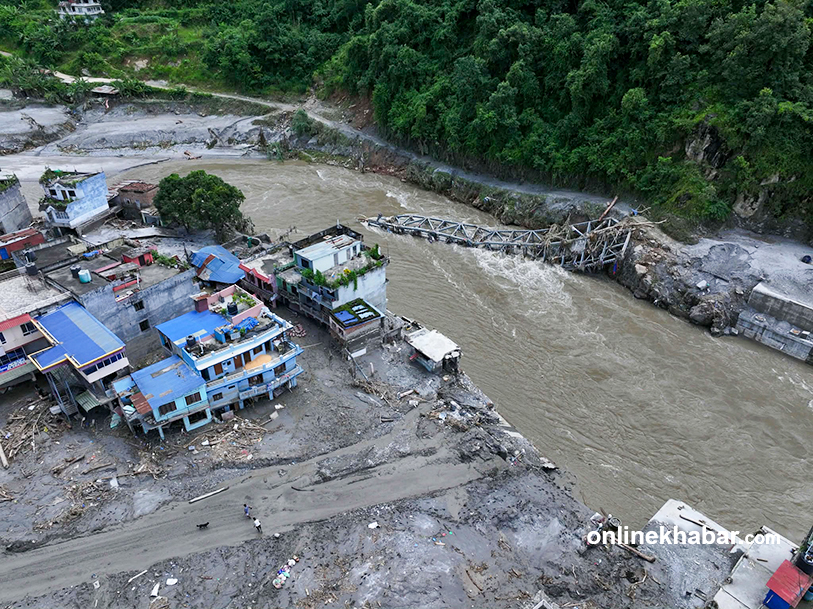
At least 35 bridges between the Miteri Bridge at Rasuwagadhi and Muglin have been completely swept away by the devastating floods of August 26, severely disrupting road connectivity in the region.
Rasuwa, the district worst affected by the floods, remains effectively disconnected from the national road network. Although some alternative routes have technically been opened, transportation remains difficult.
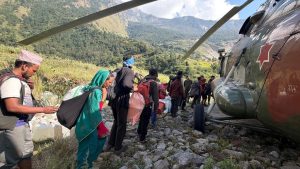
With helicopter access to remote parts of Rasuwa also proving challenging for relief and rescue operations, the lack of a reliable road connection has added to the difficulties faced by flood victims.
There is growing pressure on the government to restore road connectivity immediately. However, the scale of damage means this is unlikely to happen quickly.
According to Department of Roads Director General Dr Bijay Jaisi, the floods completely destroyed several existing bridges, in some cases washing away even the ground and foundations around the bridge sites.
“As the entire structure of the existing bridges has been swept away, it is not possible to restore all of them immediately,” Jaisi said.
He added that authorities have not even been able to reach some damaged bridge sites to conduct detailed technical assessments.
“As a result, there is no immediate possibility of reopening the roads even by installing Bailey bridges,” he said.
Local authorities demand immediate alternative routes

Local representatives have been calling for faster restoration of road links.
Rasuwa Kalika Rural Municipality Chairperson Hari Krishna Devkota told Rastriya Swatantra Party Chair Rabi Lamichhane by phone on Sunday that the district needed to be reconnected to the national road network immediately.
Belkotgadhi Rural Municipality Chairperson of Nuwakot Jagat Bahadur Gurung has also called for an alternative road to be opened as soon as possible.
How long would it take to install a Bailey bridge?
According to Jaisi, a Bailey bridge can be installed in at least 15 days if the foundations on both sides of a damaged crossing remain intact.
The Nepali Army has previously installed Bailey bridges within about two weeks.
However, if new foundations have to be constructed on both sides, another 15 days would be required.
Given the extent of damage caused by the current floods, Jaisi said installing a Bailey bridge at a damaged crossing could take at least a month even with accelerated work.
Bailey bridges to be prioritised at three locations

The Department of Roads does not plan to install Bailey bridges at every damaged crossing.
“Our priority will be to reopen the national road network as soon as possible,” Jaisi said. “Bailey bridges will therefore be installed only at the most critical locations.”
At other locations, the department plans to upgrade alternative roads and use them to restore traffic.
The department has already resumed work on an alternative road connecting to Dhadingbesi.
According to Jaisi, preparations are underway to install Bailey bridges at three key locations.
The first is at Devighat, where the bridge over the Tadi Khola has been swept away.
The second is at Trishuli Bazaar, at the site of the old bridge.
The third is at Betrawati, which connects Nuwakot and Rasuwa.
“If Bailey bridges are installed at these three locations, the main highway can be brought back into operation,” Jaisi said. “The remaining bridges will then be rebuilt as permanent structures based on technical assessments and requirements.”
Nepal does not have enough Bailey bridges
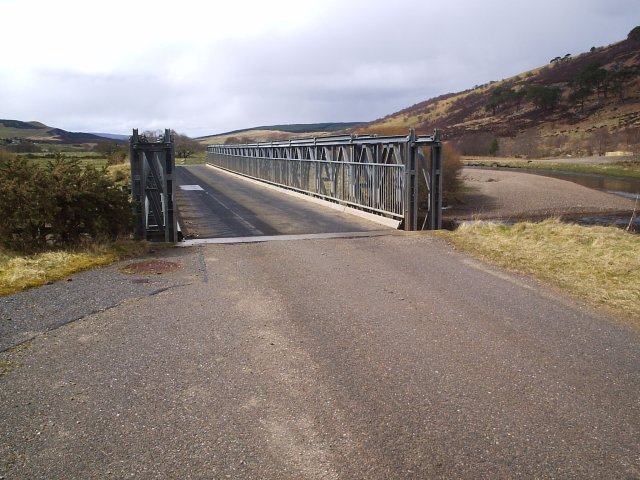
Nepal currently has 11 Bailey bridge units with a combined length of 50 metres, according to the Department of Roads.
However, the floods have extensively eroded riverbanks and surrounding land, meaning longer spans will be required at many locations than were needed previously.
The government has therefore requested Bailey bridges from India and China.
According to the Ministry of Finance, Nepal has requested 30 Bailey bridges from China.
Bailey bridges are generally used as temporary structures to restore transportation across relatively narrow crossings. However, the extensive erosion caused by the floods means longer spans are now required in several locations.
Bridges damaged from Rasuwagadhi to Muglin
According to Department of Roads data, bridges along the corridor from the Miteri Bridge on the Nepal-China border to the old suspension bridge at Muglin have been affected.
The Miteri Bridge has been completely swept away, while the Muglin bridge remains intact.
In Rasuwa, two Bailey bridges at Timure have been washed away. The concrete bridge over the Bhotekoshi River and the concrete bridge at Chilime have also been destroyed.
A hydropower Bailey bridge at Syafrubesi has been swept away, along with the concrete bridge at the same location.
The Haku I and Haku II Bailey bridges in Rasuwa have also been washed away. The Bailey bridge at the Upper Trishuli hydropower project and the Mailung Bailey bridge have also been completely destroyed.
The concrete bridge near the Trishuli-3A dam at Mailung and another concrete bridge near Dam 2 have been swept away.
The concrete bridge over the Bhotekoshi River at Khalte, on the Rasuwa-Nuwakot border, has also been destroyed. Both the old and new concrete bridges at Betrawati have been swept away.
In Nuwakot, the concrete bridge at Trishuli-Tupche has been completely destroyed.
Both the old and new bridges at Trishuli Bazaar have been affected, while the concrete bridge over the Trishuli River at Simchaur has also been swept away.
The suspension bridge at Devighat has been destroyed, along with the concrete bridge over the Trishuli River there.
Both the old and new concrete bridges over the Tadi Khola at Devighat have also been swept away.
The bridge over the Trishuli River at Shrikhaali has been affected, while the bridge at Buddhisinghghat has been washed away.
The bridge over the Trishuli River at Ratmate and the bridge at Keureni have also been swept away.
In Dhading, the bridge over the Trishuli River near Galchhi remains intact. However, the bridge over the Trishuli River on the Baireni-Salyantar road below Galchhi has been swept away.
The concrete bridge over the Trishuli River near Hamlet Resort has been damaged, while bridges at Jare Bagaicha and Ghatbesi in Dhading have been washed away.
Both the new and old bridges over Kolpu Khola in Dhading have been damaged.
The Furkhe Khola bridge at Malekhu has also been swept away.
The bridges over the Trishuli River at Benighat and Fishling remain intact.
According to the Department of Roads, the Bailey bridge at Chumlingtar in Chitwan has also survived.
The new arch bridge and old suspension bridge at Muglin have likewise remained intact despite the floods.