

Bharatpur, August 28
Bharatpur Hospital is struggling to manage a rapidly increasing number of bodies recovered from the Rasuwa flood, with its forensic department working under extreme pressure.
Four forensic teams have been conducting post-mortems continuously. While the hospital had yet to complete processing all the bodies that arrived on Thursday, another 50 bodies were brought in on Friday.
According to Dr Bishwabandhu Bagale, chief medical superintendent of Bharatpur Hospital, 137 bodies had reached the hospital by Thursday evening. The number was expected to reach around 200 by Friday evening.
But the hospital does not have the capacity to store such a large number of bodies.
“We have freezers that can hold only 24 bodies,” Bagale said. “Most of them are occupied by unclaimed bodies, with only two or four spaces usually available. We simply do not have the capacity to manage bodies on this scale during a disaster.”
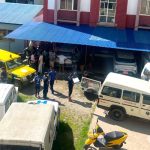
The post-mortem building and its premises were already full on Thursday, forcing the hospital to keep some bodies outside the mortuary. Hospital staff had also been unable to move all the bodies from vehicles to designated areas.
“We are trying to complete the identification and legal procedures as quickly as possible,” Bagale said.
Intact bodies prioritised for identification
The bodies recovered from the flood are in varying conditions. Some can still be identified, while others have started decomposing or are severely damaged after remaining in water for a long time.
The hospital has prioritised bodies that are relatively intact and where identification is possible.
“We are first working on bodies that are intact and can potentially be identified,” Bagale said. “Once a body is identified, it can be handed over to the family for cremation.”
Forensic experts are conducting post-mortems and collecting fingerprints, photographs, videos and details of distinguishing marks on the bodies.
Initially, only two forensic teams were working at Bharatpur Hospital. As the number of bodies increased, the hospital sought assistance from other institutions.
Forensic experts from Bheri Hospital, hospitals in the Lumbini region and Nepal Medical College, among others, are now working alongside the hospital’s teams.
Bodies kept in corridors begin to decompose
With the hospital’s 24 freezers unable to handle the volume, alternative arrangements have been made to store the bodies.
Bodies that cannot be accommodated in the freezers have been kept in corridors and outside areas covered with tarpaulins. Police have cordoned off the areas and restricted public access.
“We have not been able to maintain the required temperature, but we have managed the security aspect,” Bagale said.
The high temperatures have caused some bodies to begin decomposing. Bagale said some of the bodies brought in on Thursday evening had already started to deteriorate.
“Not all the bodies have started decomposing at the same time, but the process has begun in some,” he said. “The extreme heat has accelerated decomposition.”
Bodies moved to temporary facility after post-mortem
Bodies that have undergone post-mortem and initial identification procedures are being moved to a government building near the Chitwan Industrial Association.
An air-conditioned temporary body management centre is being prepared there, with racks being installed to store the bodies.
By Friday afternoon, around 58 bodies had undergone post-mortem, fingerprint collection and other initial procedures and had been transferred to the facility.
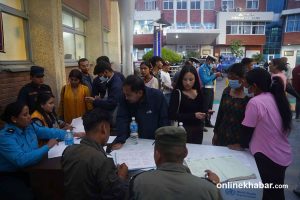
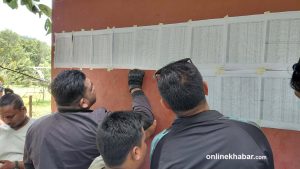
Arrangements have also been made to help relatives identify missing family members.
Photographs, videos and distinguishing physical marks of the bodies have been displayed for relatives searching for their loved ones. If a person believes they have recognised someone, they can note the body number and inform the police.
The police then facilitate the process of showing the corresponding body to the relative.
“We are doing whatever we can in this disaster,” Bagale said.
553 bodies recovered, 977 still missing
As of the preparation of this report, 553 bodies had been recovered in connection with the Rasuwa flood.
Of these, 13 were recovered in Rasuwa, 38 in Nuwakot, 40 in Dhading, 44 in Gorkha, 134 in Nawalpur, 28 in Nawalparasi, 29 in Tanahun and 221 in Chitwan—the highest number.
Most of the bodies have yet to be identified.
The sudden recovery of a large number of bodies has overwhelmed mortuaries in several hospitals. According to the National Disaster Risk Reduction and Management Authority, 977 people remain missing.
How are the bodies being examined?
A total of 25 bodies have so far been brought to Tribhuvan University Teaching Hospital in Kathmandu. Five have been identified and handed over to their families after post-mortem.
The remaining 20 bodies are undergoing data collection, documentation of identifying features and DNA sampling.
According to Dr Chaudhary, the hospital is recording physical characteristics and other information that could help establish the identities of unidentified bodies.
“Twenty-five bodies have arrived so far. Five have been identified and handed over to their families after post-mortem,” he said. “For the remaining 20, we are collecting data, identification markers and DNA samples.”
Forensic examination does not necessarily mean that every body must be cut open, doctors say.
Post-mortem is a detailed examination conducted after death. In this case, the external condition of the body, facial features, clothing, injuries and other distinguishing characteristics are also being documented.
“Not every body needs to be cut open,” Chaudhary said. “The cause of death in this incident is largely clear. The main challenge now is identification. Internal examination is carried out only when necessary for identification.”
Medical implants and other metal objects inside the body can also help identify victims. Plates, rods, prostheses or other materials inserted during previous medical treatment can provide important identification clues.
When a body has severely decomposed or the face can no longer be recognised, dental examination, fingerprints and, as a final option, DNA testing can be used.
The hospital is preserving DNA samples from unidentified bodies and collecting and storing other relevant information. These will be compared with information and scientific evidence provided by families and relatives.
“Bodies that are badly decomposed or damaged cannot be identified simply by looking at them,” Chaudhary said. “In such cases, dental records, fingerprints or DNA testing are necessary. A body should be handed over to the family only after identification is confirmed through DNA when required.”
Health Ministry preparing temporary mortuaries
According to Health Ministry spokesperson Dr Samir Adhikari, hospitals across the country have the capacity to accommodate more than 600 bodies combined.
However, much of that capacity cannot be immediately utilised because of geographical distances.
“If we add the capacity of all hospitals across the country, it is more than 600,” Adhikari said. “But that capacity is not available where it is currently needed. Capacity in Taplejung or Darchula cannot be immediately used to manage bodies here.”
The ministry has so far mobilised the capacity of 16 hospitals for body management and is preparing to use additional hospitals and other facilities if required.
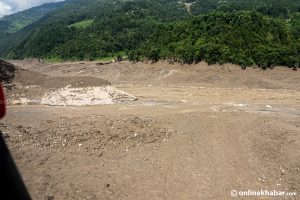
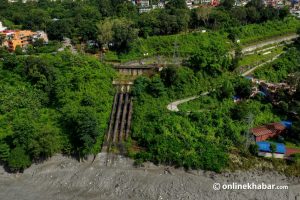
Most bodies recovered from the flood have been found in Chitwan, Nawalparasi and other areas along the Trishuli river corridor. The ministry is also considering temporary facilities near the areas where bodies are being recovered.
Adhikari said transporting all bodies to Kathmandu or other distant locations would be difficult because of transportation and logistical constraints.
“Chitwan and Nawalparasi have a large number of bodies. Transporting all of them to Kathmandu or elsewhere creates logistical difficulties,” he said. “We are therefore focusing more on how temporary facilities can be established locally.”
The ministry is also considering the use of cold storage facilities, temporary mortuaries and containers.
Officials are searching for cold containers and other structures that can be brought into immediate use, while coordination with other government agencies is also being explored.
“We are looking for where such facilities are available,” Adhikari said. “We are working with other agencies on every option that can be brought into immediate use.”