Kathmandu, August 25
CPN-UML General Secretary Shankar Pokharel has identified six major reasons behind what he describes as the party’s humiliating defeat in the recent election.
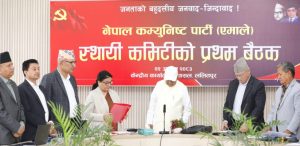
Onlinekhabar has obtained the report prepared by Pokharel for the Election Review and Party Restructuring Suggestion Collection Task Force. The report analyses the reasons behind the UML’s defeat and proposes measures for party reform and restructuring.
The report, prepared after collecting suggestions from 13 locations, including the seven provincial committees, concludes that the UML did not lose the election solely because of interference by external forces.
Instead, it identifies public dissatisfaction with the performance of previous governments, the party’s failure to address changing public aspirations, its inability to convince people of its interpretation of the Gen Z-led movement, and undemocratic practices within the party among the key reasons for the defeat.
The report also cites the decision to declare party chair KP Sharma Oli as the future prime minister following the Gen Z movement, the failure to attract young voters, and the party’s inability to understand social media algorithms and external influence.
The six reasons identified in Pokharel’s report are:
1. Public dissatisfaction and distrust
The report identifies public dissatisfaction with the performance of previous governments as the main reason traditional parties, including the UML, lost support.
It says a perception had developed that political parties were primarily interested in returning to power while failing to pay adequate attention to people’s needs.
“Failure to maintain good governance while in government, failure to appropriately address the demands of classes and communities engaged in protests, and the involvement of some ministers and elected representatives in allegations of corruption and irregularities, without taking timely action against them, contributed to growing public dissatisfaction,” the report says.
The report also says the UML’s alliance with the Nepali Congress was increasingly viewed as being driven by the pursuit of power rather than constitutional amendment.
It says the issue of constitutional amendment, which had been presented as a major agenda, was pushed aside with a decision to pursue it only after 2030, allowing the opposition narrative that the alliance was solely motivated by power interests to take hold.
The report also concludes that internal conflicts during the Nepal Communist Party period and subsequent alliances contributed to the fragmentation of the left-wing vote.
2. Failure to address changing public aspirations
The report identifies the UML’s failure to respond to changing public expectations as the second major reason for its defeat.
It says people’s living standards and aspirations had increased significantly, but employment and self-employment opportunities had not expanded accordingly, resulting in limited growth in their incomes.
The report also says the party failed to understand the consequences of educated people continuing to migrate from villages to cities and from cities abroad.
It points to the rapid expansion of private-sector education and healthcare and the declining quality of public services, which forced citizens to pay heavily for essential services.
“Failure to understand the growing public distrust of traditional parties and the state created an opportunity for populists to exploit public sentiment,” the report says.
3. Gen Z movement and Oli as prime ministerial candidate
The report says the UML was forced to participate in an election in which other traditional parties were unwilling to accept the UML’s proposal.
It says the party analysed the events of September 8 and 9, 2025, as a pre-planned conspiracy, but failed to convince either political circles or the general public of that interpretation.
The report also identifies a BBC documentary aired during the election silence period as a factor that worked against the UML.
It says the party leadership was accused of failing to demonstrate sufficient human sensitivity and sympathy towards young people who were killed or injured during the movement.
“The documentary broadcast by the BBC during the election silence period also contributed to turning public opinion against us,” the report says.
The decision to declare KP Sharma Oli, who was leading the government during the Gen Z movement, as the UML’s future prime ministerial candidate is also identified as a factor behind the poor result.
“With attacks coming from all sides and the entire party organisation being on the defensive, going into the election by declaring the party chair as the prime ministerial candidate made the party organisation even more defensive,” Pokharel wrote.
4. Geopolitics and algorithms
The task force also identified geopolitical manoeuvring and social media algorithms as factors behind the UML’s defeat.
The report specifically names several organisations in its discussion of the Gen Z movement.
“The suspicious role of groups with external links such as Barbara Foundation, Hami Nepal and TOB was directly visible in the events of September 8 and 9,” the report says.
It argues that the party paid a price for geopolitical manoeuvring allegedly triggered by what it describes as nationalist positions on issues including the trade and transit agreement with China, Nepal’s revised map, exploration of gas in Dailekh and the Dhauwadi iron mine.
The report also links the election result to the aggressive social media campaign of rival forces and the UML’s defensive position.
“Particularly during the election, our party organisation remained defensive while opponents were aggressive, and the significant presence of young people capable of using information and technology helped establish their agendas at the level of social media algorithms,” the report says.
5. Policy confusion and governance weaknesses
The report says the UML-led government also failed to adequately promote and implement the party’s policies and programmes.
It points to difficulties faced by party workers in meeting the prime minister, saying this contributed to further dissatisfaction.
“The policy of a prosperous Nepal, happy Nepalis could not be implemented in practice in line with public sentiment,” the report says.
The report also cites an inability to maintain balance in the budget, delays in public service delivery, dissatisfaction among teachers and government employees over unresolved demands, shortages of chemical fertilisers, and unpaid subsidies and sales proceeds owed to sugarcane and dairy farmers.
The government’s decision to require social media platforms to register before operating also increased anger among young people, according to the report.
It further says the government failed to properly understand and respond to what it describes as internal and external conspiracies against the party and government.
Other unresolved issues cited include problems faced by landless squatters and unorganised settlers.
The report says the failure to enact federal education, police and civil service laws created the impression that the government was negative towards federalism.
6. Internal problems
Pokharel’s report identifies internal problems within the UML as the sixth and final major reason for the party’s electoral defeat.
It points to candidate selection, factionalism and organisational indiscipline as major factors.
The report says the decision not to renew former President Bidya Devi Bhandari’s party membership contributed to divisions within the party.
It also criticises the lack of transparency in candidate selection and repeated changes to decisions.
“The lack of transparency in candidate selection, repeated changes to decisions, and the perception that those who stayed around leaders were given priority in receiving tickets rather than those deployed in the constituencies created dissatisfaction among sincere party workers,” Pokharel wrote.
The report also identifies the high cost of elections as a factor pushing sincere party workers away from politics and creating frustration.
It further says failure to take action against those involved in electoral sabotage encouraged organisational indiscipline and a mentality that “anything goes.”