Kathmandu, August 24
A total of 35 amendment proposals have been registered on the Mines and Minerals Bill, 2083 BS.
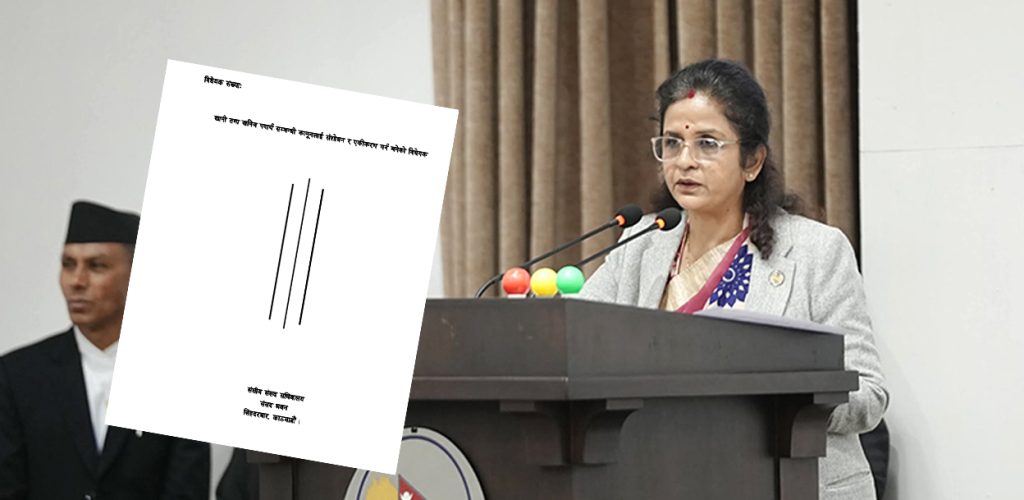
Lawmakers have submitted the amendment proposals in 35 separate groups. The bill was introduced by Minister for Industry, Commerce and Supplies Gauri Kumari. The bill was registered in the House of Representatives on July 30, and lawmakers subsequently submitted 35 groups of amendment proposals.
The House of Representatives is scheduled to send the bill to a parliamentary committee on Monday for clause-by-clause discussion. The House meeting is scheduled for 1 pm.
According to the agenda, Minister Gauri Kumari will present a proposal to send the Mines and Minerals Bill, 2083, to the relevant committee for clause-by-clause discussion.
The government introduced the bill to clearly define the rights and responsibilities related to mines and minerals in line with the federal system of governance.
The bill, which aims to make the conservation, exploration and extraction of mines and minerals systematic, scientific and sustainable, contains 63 proposed clauses.
The Mines and Minerals Act, 1985, is currently in force. The new bill seeks to repeal the existing law and introduce a framework suited to the current context and the federal democratic republican system of governance. It includes special provisions concerning common construction minerals, minerals of strategic and security importance, and radioactive minerals.
The Constitution of Nepal divides powers concerning mines and minerals among the federal, provincial and local governments.
According to the Ministry of Industry, the existing Mines and Minerals Act, 1985, was enacted before the implementation of the federal system and is therefore inadequate to address the current constitutional framework, federal structure, modern mineral administration, environmental responsibilities, strategic mineral management and the need to promote investment.
The ministry said the bill has been introduced to ensure more scientific management of minerals and the mineral sector and to make the processes of conserving, exploring and extracting mines and minerals more systematic, transparent and accessible.
The bill states that it has been drafted to amend and consolidate laws related to mines and minerals with the objectives of regulating strategic, security-related and radioactive minerals; providing a legal basis for geological research and seismic monitoring; and clarifying the coordination and jurisdiction of the federal, provincial and local governments.
The bill’s core objectives are outlined in eight points:
- To ensure the scientific, sustainable and systematic use of Nepal’s mines and minerals, which are the property of the government of Nepal.
- To clarify the roles, coordination mechanisms and jurisdictions of the federal, provincial and local governments in accordance with the federal system of governance.
- To make the processes of conserving, exploring and extracting minerals transparent, competitive and accessible.
- To provide special protection and regulation for strategic, security-related and radioactive minerals.
- To use minerals while adopting environmental protection principles and reducing geological hazards.
- To establish a clear legal framework for attracting domestic and foreign investment in the mineral sector.
- To strengthen geological research, seismic monitoring and scientific studies.
- To introduce effective measures and penalties to control illegal extraction and illicit trade of minerals.