
Dr Lujendra Ojha was 15 when he left Nepal for the United States. He arrived with little idea that the short trip would change the course of his life.
Raised in the narrow lanes of Kathmandu, with family roots in Doti in far-western Nepal, Ojha had grown up interested in music, theatre, mathematics and science. In the years that followed, that curiosity would take him into planetary science and eventually to research on Mars that attracted global attention.
Today, Ojha, 36, is an assistant professor of planetary science at Rutgers University. He has worked on more than 40 scientific papers, studying Mars and other planets in the solar system.
His advice, however, is surprisingly simple.
“Protect your curiosity. In life, education, career and struggle, put curiosity first. Money is not the only goal in life.”
Ojha’s story is not only about a scientific achievement. It is also the story of a teenager from Kathmandu who entered an unfamiliar country, adjusted to a different education system and culture, and slowly found his way into one of the most fascinating fields of science.
A childhood in Kathmandu
Dr Lujendra Ojha was born in Kathmandu in 1990. His ancestral home is in Doti, a connection he says has always been an important part of his identity.
He spent his childhood in different parts of Kathmandu but particularly remembers Mhepi, near Naya Bazaar.
“For many people, when they hear Mhepi, they think of the temple. For me, it is the centre of my childhood memories,” he says.
The memories are ordinary ones. Narrow streets, swings, firecrackers, cricket matches and the excitement of Dashain and Tihar.
His family initially lived in a rented house before his father built their own home. His mother worked at the Dairy Development Corporation, while his father, Tanka Prasad Ojha, worked in the Department of Mines and was a scholar of geology.
“I grew up in a middle-class family. There were struggles, but I was always happy,” Ojha says.
School, music and a rigid education system
Ojha began his schooling at Adarsha Yoghari Secondary School in Lainchaur, where he studied until Grade 3. He then moved to Galaxy Public School in Gyaneshwor, where he studied from Grade 4 to Grade 9.
The education system he experienced was strict.
“If a student crossed the line, beating was considered normal. Curiosity was treated as a violation of discipline,” he recalls.
He also remembers experiencing discrimination.
“Whenever someone with dark skin was seen, people would comment that they were Indian or from the Terai. It was surprising to see such behaviour even from teachers,” he says.
For Ojha, that experience also highlighted a larger problem with rote learning.
He felt that a system focused on memorisation could suppress creativity and independent thinking. Yet school was not all about textbooks. He played guitar in a band and took part in school plays.
“I was interested in music from a young age. I still play the guitar,” he says.
Science, however, gradually became the stronger pull.
Seven days in America that changed everything
In 2005, Ojha travelled to the United States with his father. The original plan was for him to stay for only seven days.
His father was already working with Americans, and his sister had received a full scholarship from a university in the US. Ojha was nearing the end of Grade 9 at the time.
“My father told me to attend school for a few days and see how I liked it. If I liked it, I could stay. Otherwise, I could return to Nepal and continue my studies,” he recalls.
He decided to stay.
It was not an easy transition.
Much of his clothing was still back in Nepal, and everything around him was unfamiliar. He was 15, in a new country, surrounded by a different culture and people.
“I didn’t see people of my own complexion, and there was no familiar environment. Starting over at 15 was a big challenge,” he says.
But the move also gave him access to opportunities that would shape his future.
He attended high school in Tucson, Arizona, where his interest in mathematics and science deepened. He later studied at the University of Arizona, where he also took courses in religion and philosophy.
“Religion and philosophy made my scientific perspective clearer. Science is not only about knowledge; it is also a way of thinking and developing curiosity,” he says.
Learning to work while studying
Dr Lujendra Ojha’s path through university was not simply about attending classes and conducting research.
He also worked.
After enrolling at university, he began working at a grocery store for 20 to 30 hours a week while remaining a full-time student.
“That routine taught me hard work, discipline and time management. Those skills later became very useful when I faced challenges in research,” he says.
At university, he also discovered that planetary science required knowledge from several areas of science.
“To understand planets, you need chemistry, physics and, in some cases, biology,” he says.
That interdisciplinary nature appealed to him.
It was also at the University of Arizona that he began working with data from the HiRISE camera, which had been sent to Mars to capture high-resolution images of the planet’s surface.
That work would eventually change his career.
His first step into NASA’s Mars mission
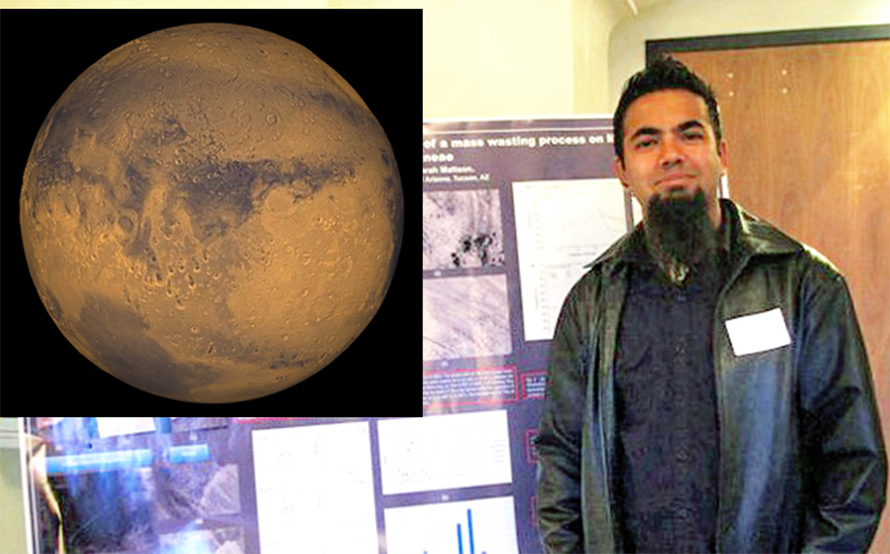
Dr Lujendra Ojha explains that working on a NASA mission does not necessarily mean being a NASA employee.
Researchers at universities can also become part of NASA missions if they demonstrate that they have the expertise and capacity to carry out the work.
“Plans are made based on how much money we have and what we want to do over the next 10 years. A team gets a contract only after demonstrating that it has the ability and credibility to do the work,” he says.
The Mars mission that would become important in Ojha’s career began in 2005.
“At that time, I was still in high school. The HiRISE camera had already been sent to Mars, and it began sending data from Earth after about eight months,” he recalls.
In 2009, Ojha joined the mission.
Initially, he worked as a data validator and data analyst. Much of the work was repetitive, but he wanted to go beyond simply processing data.
“I didn’t want to just look at data. I wanted to be involved in actual research,” he says.
He approached principal investigator Alfred McEwen with his ideas. McEwen agreed, allowing Ojha to begin additional research alongside his original work.
That decision would lead to one of the most widely discussed findings of his career.
The research that put Mars in the headlines
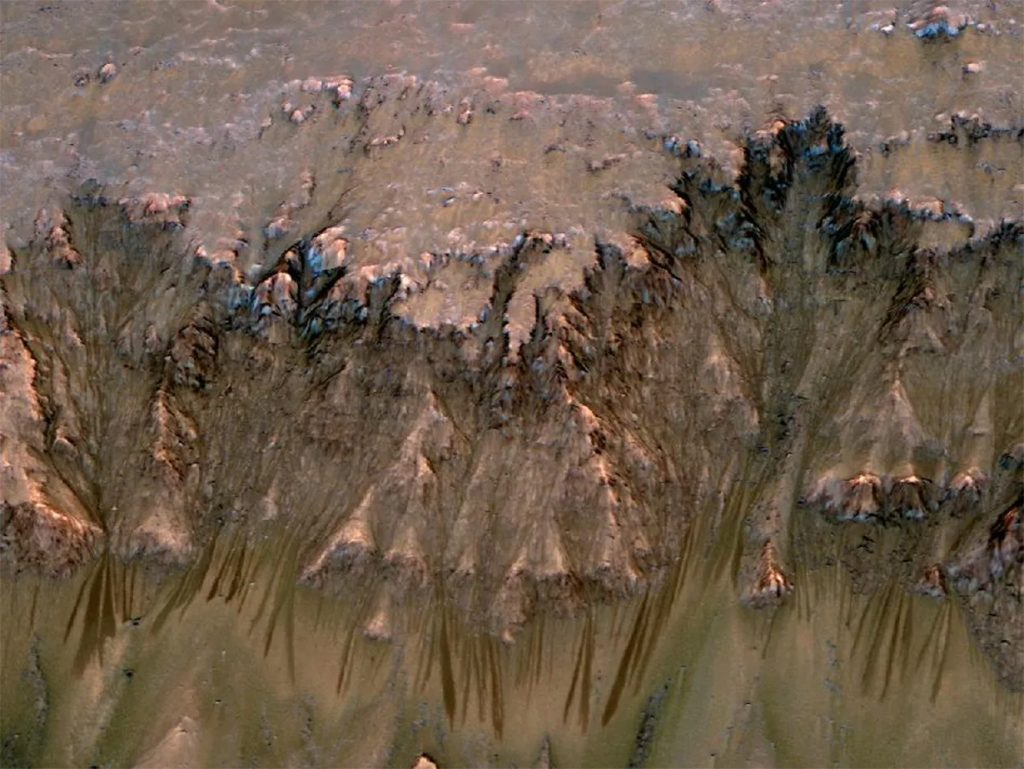
The existence of water on Mars was not new. Scientists had already established that large amounts of ice existed around the planet’s north and south poles.
But research published in 2011 suggested that water on Mars might not exist only in the form of ice, but could also occur in liquid form.
Dr Lujendra Ojha was part of the research team.
The conclusion came from analysing images captured by the HiRISE camera.
“We spent almost a year just testing and retesting. In science, the reliability of the evidence is more important than the result,” he says.
The paper was published in Science, one of the world’s leading scientific journals. Publication followed critical review by scientists from around the world.
“Writing a report and sending it does not mean it will be published. Researchers around the world critically review it. Only after passing that process can it be published,” Ojha says.
The research soon attracted international attention.
NASA issued an official press release, while CNN, BBC, Fox and other international media outlets reported on the findings. The story also received significant attention in Nepal, in part because a Nepali scientist was among those involved in the research.
For Ojha, however, the attention was only one part of a much longer scientific journey.
Still looking beyond Mars
More than a decade after the research that brought him international recognition, Ojha continues to work in planetary science.
His research is no longer limited to Mars. He has also been studying other planets in the solar system, including Jupiter and its moon Europa.
“I am not someone who stays on one subject continuously. New research, new curiosity and new challenges are what keep me moving into different areas,” he says.
He says the Mars research remains important, although there has not been a large amount of new data since the original study.
“There hasn’t been a new spacecraft there, so the updates are limited. But the HiRISE camera is still doing excellent work. Water-like activity can still be seen in those areas. Other technologies have not tested it in the same way, and humans have not gone there to test it,” he says.
Since that research, Dr Lujendra Ojha has worked on more than 40 other scientific studies.
“My current research is focused on planets other than Mars. That mission gave me a great deal of experience and recognition. Besides that, I have worked on more than 40 other scientific studies, and the details would be very long,” he says.
His interest in Mars is also connected to a larger question.
“My interest in Mars research is not only because of science. It is also because I am curious about how human civilisation might expand in the future. Searching for life beyond Earth is, in a way, searching for possibilities for our own future,” he says.
From Georgia Tech to Rutgers
In 2016, Ojha completed his PhD in planetary science at Georgia Tech in Atlanta. He received a full US government fellowship for his doctoral studies.
After completing his PhD, he spent three years as a postdoctoral researcher at Johns Hopkins University in Baltimore.
During that period, he published seven scientific papers covering research related to Mars and other planets, including their gravity, surface structures and geological history.
For Dr Lujendra Ojha, research is ultimately about asking questions that have not been asked before.
“The biggest challenge in science is having the courage to ask a question that nobody has thought of before. Research is not about memorising books. It is about having the confidence to search for new answers,” he says.
He is now an assistant professor of planetary science at Rutgers University in New Jersey.
His roots remain in Nepal
Despite spending around two decades in the United States, Dr Lujendra Ojha says he has never felt disconnected from Nepal.
“I was born and raised in Nepal. I came to America at 15, but my roots are here,” he says.
He does not see himself as a politician or policymaker.
“I am not a political person, nor am I at the level where I make policy. I am simply a scientist trying to understand the universe. I understand a little more every day. But that does not reduce my love for Nepal.”
Dr Lujendra Ojha does not completely reject the idea that young Nepalis leave because of limited opportunities, but he believes the issue is more complicated than a lack of resources.
“Nepal has universities and places where research can be done. The problem is more about priorities than resources,” he says.
He is particularly critical of how money is allocated and how education is approached.
“Money is not spent where it is needed, while spending increases where it isn’t needed. Rote learning is given more importance than research. In such an environment, curious students cannot move forward,” he says.
He believes Nepal itself has enormous potential as a place for research.
“Nepal is a laboratory in itself. The diversity of nature here is such that scientists from the US and Europe come to Nepal to understand its geography.”
He says the country’s education system also needs to do a better job of recognising different abilities.
“We don’t have a culture of identifying what each person is capable of. We put everyone into the same mould and expect them to become doctors or engineers. As a result, many students end up being average. Excellence is born only where curiosity is not killed.”
His father, Tank Prasad Ojha, also played a role in shaping his understanding of Nepal’s potential. As a geologist, he used to take foreign teams around Nepal to help them understand the country’s geological diversity.
“But we don’t take pride in the capabilities of our own country. The root of that problem is our mindset, not our resources,” Ojha says.
And after everything—from Kathmandu to the United States, from a grocery store job to university laboratories, and from analysing images of Mars to becoming a planetary scientist—his advice remains the same.
“Protect your curiosity, whatever happens. In life, education, career and struggle, put curiosity first. Money is not the only goal in life.”
For Dr Lujendra Ojha, Nepal remains home.
“Nepal is my original home,” he says. “But the world is our home too. When the mind is open, boundaries and limits have no meaning.”