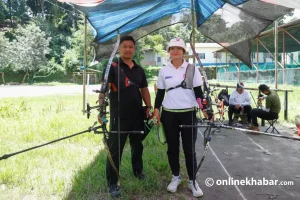


The target boards are rotting away. The tarpaulin put up to provide shelter from the rain is torn. And beneath it, Nepal’s archers are training with a dream of winning a medal at the 20th Asian Games.
For athletes preparing to represent Nepal at the Asian Games, the training ground at the Nepal Police Academy in Maharajgunj is far from the setting one might expect for a national team preparing for one of Asia’s biggest sporting events.
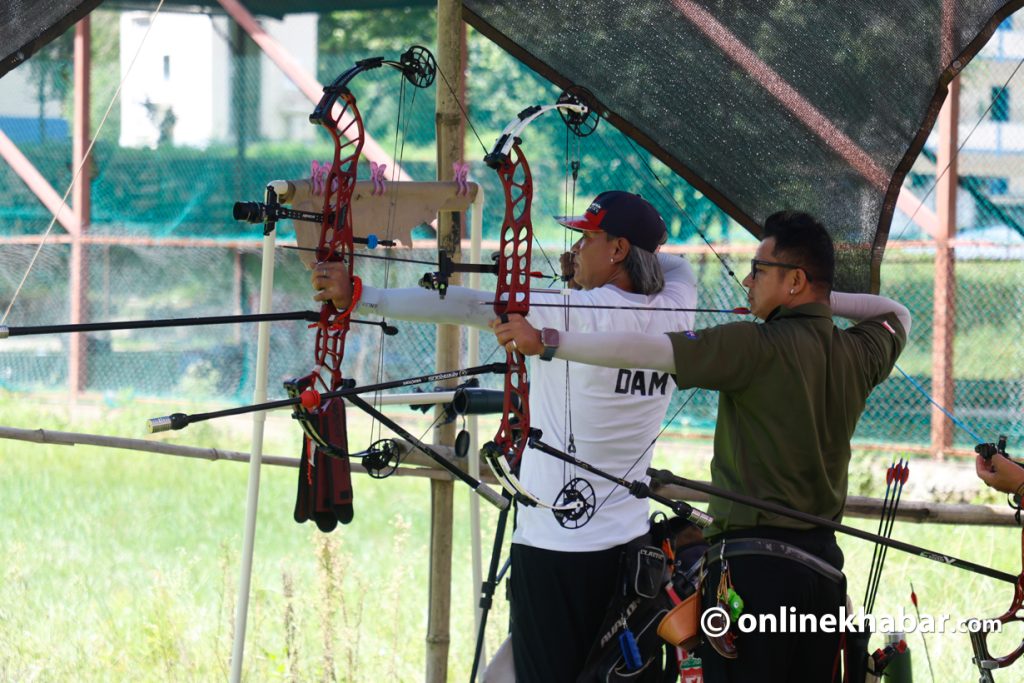
The Nepal Archery Association does not have its own training facility in the capital, leaving the archers to train inside the Police Academy. But the lack of infrastructure is only part of the problem. The athletes also face a shortage of basic equipment.
Among those preparing for the Asian Games are Tilak Pun Magar and Gyanu Awale, who will compete in recurve archery. Both have had to buy equipment such as bows and arrows with their own money.
“We have problems even with the equipment. The things we need for training are not always available in Nepal, so we have to order them from abroad. It is expensive,” Tilak says.
Yet the shortage has not diminished his ambition.
Tilak is preparing for his third Asian Games, having previously represented Nepal at the 18th and 19th editions. This time, he says, his earlier experience has given him greater confidence.
“Let’s see what score we get there. We all go with the goal of winning a medal. You need confidence, but rather than just hoping for a medal, it is better to go with a clear target,” he says. “I am confident that I can set a better record than before.”
A medal has never come
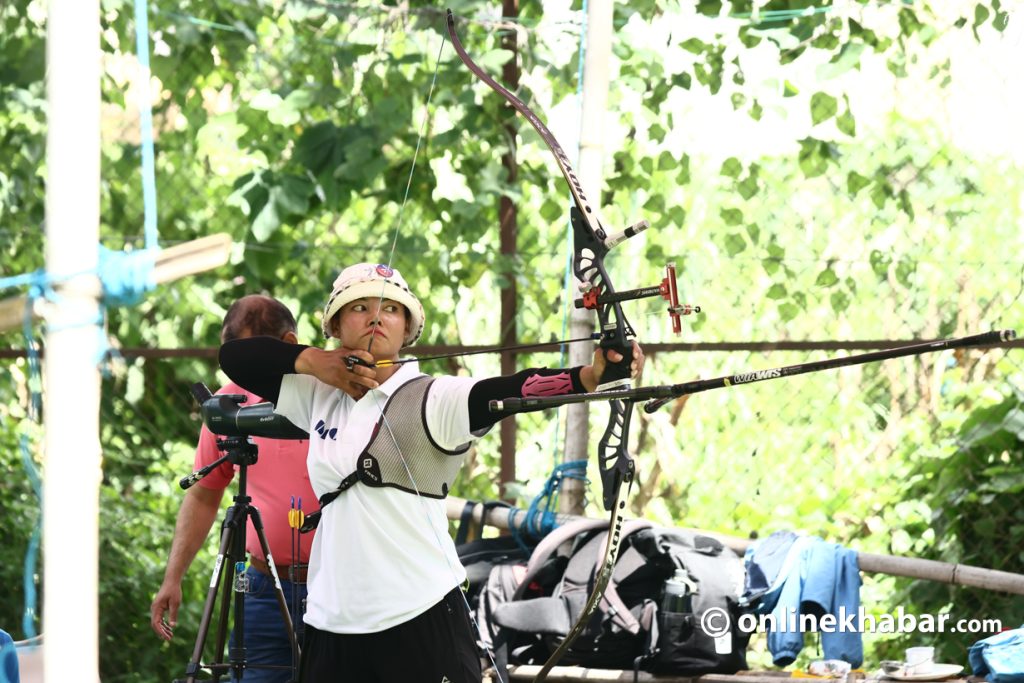
Nepal will have two archers at the 20th Asian Games, scheduled for September. Tilak and Gyanu will compete in the 70-metre recurve events in the men’s, women’s and mixed categories.
Nepal’s archery team has participated in the Asian Games four times before, but has yet to win a medal.
Tilak says the current preparation is not something that began only in the final months before the Games.
“We have been training well so far. We have not been working on this for just these two months; we have been doing it for years,” he says.
Gyanu, who is also preparing for her second Asian Games, wants to improve on her previous performance.
“I will try to do better than before. We are somewhat different this time. Things were not as good previously, but this time my goal is to perform better,” she says.
Coach Prem Prasad Pun also believes the team is better prepared than it was for the previous Games.
“We have been preparing continuously for the past two years. Everyone has improved in terms of skills, technique and physical fitness,” he says. “The scores have also been very good.”
Competing against Asia’s best
For Prem Prasad, the Asian Games are not only about medals. They are also an opportunity for Nepal’s archers to compete against some of the strongest athletes in the world.
“Archery is like a powerhouse not just in Asia but in the world. The athletes winning medals at the World Cups and Olympics are also from Asia. Being able to compete against them is itself a major achievement,” he says.
But competing at that level requires equipment and preparation that Nepal’s athletes often have to arrange themselves.
Prem Prasad says the athletes are still buying their own equipment.
“Even now, they are buying their own equipment and competing. There is a shortage of arrows and other materials. Friends, relatives and others have been supportive, which has helped a lot,” he says.
‘We have a chance of reaching the quarter-finals’
Ramesh Siwakoti, general secretary of the Nepal Archery Association, believes Nepal’s archers have a realistic chance of reaching the quarter-finals this time.
He points to Tilak’s recent scores as a reason for optimism.
“Right now, the players’ performance is very good. An Olympic gold medallist in archery has scored around 695 or 697. Our player Tilak has scored 670. The requirement for an Olympic wild card is only 650,” Siwakoti says.
“If he can maintain the same form in Japan, there is a possibility of reaching the quarter-finals,” he says.
But behind those numbers is a training environment that the association says has received little government support.
Government neglect
Siwakoti says the archery association has not received meaningful support from the government.
He claims that the National Sports Council had even written to select athletes for the compound 50-metre event, but later cut the event after the selection process.
“Our target boards are rotten. The National Sports Council has not provided any equipment for the past seven years. We have had to arrange equipment by putting in our own money,” Siwakoti says.
He says the association has repeatedly sought support without success.
“We wrote 16 letters in five years, but none of them received any response. This time, I have heard that the National Sports Council has allocated a budget for archery,” he says.
Then comes his question: “How long are we expected to protect the national reputation by bringing the sport this far through our personal efforts?”
The shortage of equipment also creates a problem when athletes actually reach international competitions.
Tilak says Nepal’s team does not have the luxury of replacing equipment if something goes wrong during an event.
“We are short of arrows and bows. When athletes from other countries go to competitions like this, they take two bows each. But if our only bow breaks or something goes wrong, we have to withdraw. We don’t even get the opportunity to compete,” he says.
“Having two bows would make things much easier.”
The team also lacks exposure to international competition, according to Prem Prasad.
For now, however, the athletes continue to train beneath a torn tarpaulin, alongside ageing target boards, carrying equipment they have often paid for themselves.
The facilities may not match the scale of their ambition. But as Nepal’s archers prepare for another Asian Games, their target remains unchanged: to perform better than before and, if possible, finally bring home the medal the sport has never won at the Games.