
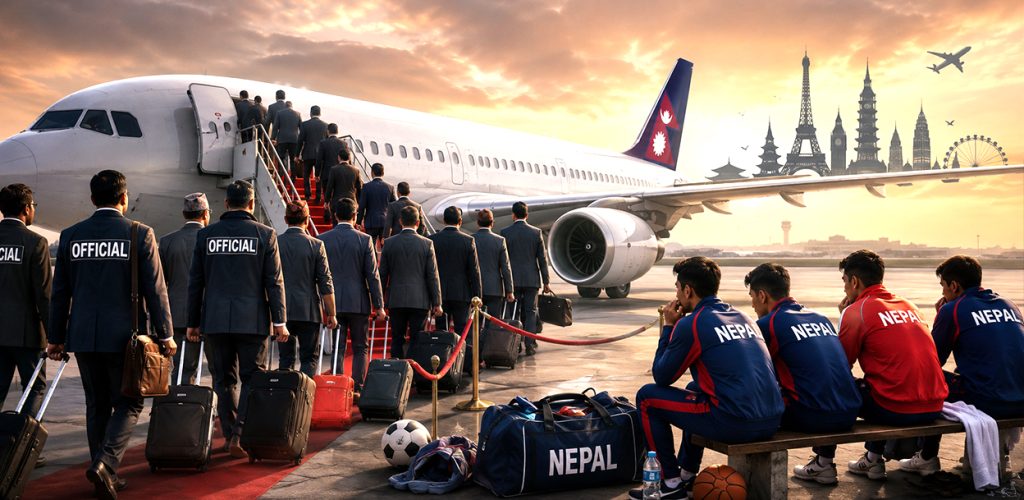
Kathmandu, August 21
When Nepal sent its delegation to the 19th Asian Games in Hangzhou, China, three years ago, 253 athletes competed in 29 sports. Nepal won two medals at the Games.
But the country’s delegation was far larger than its contingent of athletes. Around 400 people, including athletes, coaches and officials, travelled to Hangzhou. That meant roughly 150 more officials and support staff than athletes were part of the delegation.
This is not an isolated example.
A similar pattern was seen at the 33rd Summer Olympics in Paris in 2024. Nepal sent just seven athletes to the Games, but more than three times that number of coaches and officials — 22 additional people — travelled to Paris. Nepal returned from the Paris Olympics without a medal.
The size of the delegation drew criticism at the time, particularly after then National Sports Council member-secretary Tanka Lal Ghising and then Sports Minister Tejulal Chaudhary travelled to Paris as observers, even though a badminton coach was unable to participate.
The same issue had surfaced at the Tokyo Olympics in 2021. Nepal’s 26-member delegation included only five athletes and four coaches. The remaining members were officials and other representatives.
These are only a few examples. At major international events such as the Olympics, Asian Games and South Asian Games, Nepal has repeatedly faced criticism for sending more officials than athletes.
Travelling abroad in the name of sporting events and receiving allowances in the process is not a new practice in Nepali sports. Critics say priority is often given to the participation of officials rather than to the training, preparation and management needs of athletes.
The issue became particularly contentious ahead of the Paris Olympics, when the Ministry of Youth and Sports announced that it would not bear the expenses of people travelling to Paris who were neither athletes nor coaches.
Officials and employees of sports associations and the National Sports Council frequently travel abroad alongside athletes and coaches for international competitions. In some cases, people with no direct connection to the sport have also travelled as officials.
“The officials who travel in large numbers have little to do apart from sightseeing. When athletes need help, there is often no one to assist them. They go there mainly to watch the games and travel,” a former athlete said.
The government generally covers the airfare, accommodation, food and daily allowances of officials attending international competitions. Sending large numbers of officials to a single event therefore adds to the financial burden on the sports sector.
A smaller delegation for the 20th Asian Games
The 20th Asian Games are scheduled for October, raising questions over whether Nepal will once again send a large contingent of officials or limit the delegation to people directly involved in the competition.
The government has said it will not send unrelated individuals to this year’s Asian Games.
The National Sports Council has finalised the participation of 137 athletes in 22 sports. According to NSC member-secretary Ram Charitra Mehta, Nepal will send a total delegation of 218 people, including the athletes.
The number of athletes has also been reduced compared to the 19th Asian Games.
According to the NSC, the delegation will include 32 coaches, 18 managers, 11 headquarters officials, six members of the medical team, four journalists and five representatives from the Nepal Olympic Committee.
The delegation will also include one sports technical official, one chef de mission, one deputy chef de mission and one representative from the Ministry of Youth and Sports. Their names have not been disclosed.
Mehta said only personnel with necessary responsibilities would be sent to the Asian Games.
“Only people whose work is required will go. They will return as soon as their work is completed. No one is going there for sightseeing,” he said.
He said the delegation had been prepared with the aim of making the best use of limited resources.
The NSC has maintained that athletes and the coaches, managers, medical personnel and technical staff required for their participation have been prioritised.
Former NSC member-secretary Keshav Raj Bista, however, says sending unrelated people to international competitions is inappropriate.
“When many board members go and the Olympic Committee takes a large number of people, sometimes five to 10 people appear to be unnecessary,” he said. “Let’s see what happens this time. But sending people for sightseeing or simply to fulfil their wishes is not right.”