
Thousands of Kathmandu residents’ morning journeys to either work or school are caught in some of the most horrendous congestion and painfully slow-moving traffic that never seems to go anywhere. As the city’s population continues to grow by 3%, according to numerous online reports, it shows that if we are already facing these issues now, and the roads can no longer accommodate the increasing traffic, can Kathmandu truly continue to rely on its roads alone?
Take a moment to truly think and examine the situation. Have you ever had a pleasant journey on your way to work?
One solution to address Nepal’s current road and transport issues is to build a metro system. As the chairperson of the Society of Nepalese Engineers and the owner of a project management consultancy that has worked in the metro industry, I have always reflected on Nepal’s public transport industry. Especially between my meetings in Kathmandu, when I get stuck in traffic, I can’t help but think: in a city with over one million people living, why isn’t there a Mass Rapid Transit (MRT) system? It’s something nearly all major cities with a high population have incorporated.
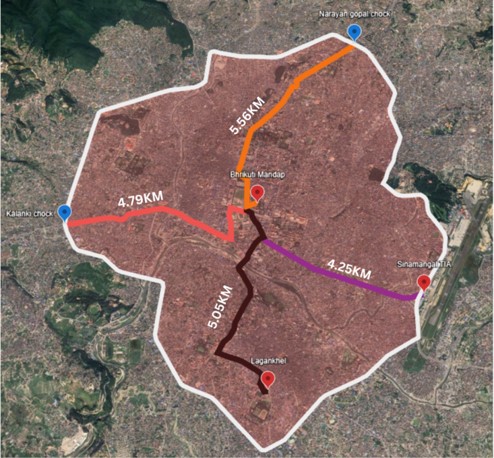
Hence, I remember that after returning to Kathmandu in 2023, I decided to create a proposed metro route map. My approach was to adopt a phased construction strategy, making the project more practical and financially achievable. The initial proposal centred around five strategically located stations: Sinamangal/Koteshwor, Kalanki, Narayan Gopal Chowk, Lagankhel, and Bhrikutimandap.
Based on my estimates, the metro would have cost approximately US$1.5 billion with a 19.65km route. In an interview with Nepali Link UK on 24 September 2025, I outlined this vision for a phased metro system and explained why these five stations were selected as the foundation of the network. You can see the proposed route plan in the image attached to this article.
You might be wondering why I chose these five stations first. First and foremost, I strongly believe that a phased construction approach is essential. It allows Nepal to identify and address challenges as they arise. While we can certainly learn from other countries’ experiences, Nepal faces unique circumstances, including differences in the availability of construction materials, engineering capabilities, and the local workforce.
Secondly, these five stations were carefully selected because they serve the areas experiencing the highest levels of traffic congestion. Together, they provide coverage across the Valley, connecting the central, eastern, western, northern, and southern parts of Kathmandu. This ensures that the first phase delivers the greatest possible benefit while laying the foundation for future expansion.
I often hear critics ask, “Why not simply widen the roads?” It is a reasonable question, but after speaking with a plethora of engineering institutions and transport professionals in Nepal, the consensus has been clear: Kathmandu’s road network has already been stretched close to its practical limits. In many parts of the city, there is simply no room for further expansion without significant social, environmental, and economic consequences.
I remember discussing this very topic with my family over dinner. My daughter suggested, “Why not build a tram system like the ones in Manchester?” It was an interesting idea, and one that prompted a thoughtful conversation. However, Nepal’s geographical and geological conditions present unique challenges. As a country highly susceptible to earthquakes, any damage or displacement of tram tracks could compromise safety and disrupt the network.
A metro system, particularly one designed with modern seismic engineering standards, offers a more resilient and reliable long-term solution. Also, a tram cannot carry as many passengers per day as a metro, which can serve 250,000-350,000 passengers per day if the metro is fully functioning. But in the proposed route of mine, with five stations per day, it can definitely house 50,000-75,000 people. Even if a modest number of Kathmandu residents shifted from private vehicles to the metro, peak traffic volume could decrease by 10-15% according to transport modelling studies.
It is also important to recognise that a metro is not built solely to combat traffic congestion. While reducing congestion is one of its greatest advantages, a metro also improves connectivity, shortens travel times, stimulates economic growth, reduces air pollution, and provides a safe and dependable form of public transport for future generations.
Now you may be wondering how we may begin? How will we get the finances? What other benefits are we getting besides environmental benefits, i.e., reduction of carbon emissions?
First and foremost, to begin the metro project, we must clearly define the scope and establish how we will secure the necessary funding. I have been following multiple news outlets reporting that the Government of Nepal has opened discussions regarding the development of a metro project. Therefore, I believe defining the scope from the very beginning is essential to ensure the project has a clear direction and realistic objectives.
From the information I have gathered through the news outlets, the Honourable Minister for Infrastructure Development, Sunil Lamal, has highlighted Nepal’s development goals and mentioned that the government plans to rely heavily on private sector participation and foreign investment rather than depending solely on internal state budgets.
Hence, it will be imperative for the government and key stakeholders to establish a clear funding structure for the project. The latest major metro project in South Asia was the Dhaka Metro Line, which had a construction cost of approximately US$2.71 billion. The project was funded through a combination of support from the Japan International Cooperation Agency (JICA), which contributed around 58% of the funding, while the remaining portion was provided by the Government of Bangladesh.
Nepal could consider adopting a similar funding model. However, given the scale of investment required, it is important to recognise that the current government may not have the capacity to independently provide hundreds of millions of dollars towards the project. Therefore, a strong partnership between the public and private sectors through a Public-Private Partnership (PPP) model could be essential in securing the required funding.
Under such a model, the government could take responsibility for areas such as land acquisition, utility relocation, and administrative infrastructure, while the private sector could contribute financial capital, technical expertise, and project management capabilities.
Some critics may argue that PPP partnerships and foreign-funded infrastructure projects have not always been viewed positively, particularly following concerns surrounding projects such as Pokhara International Airport, which has raised discussions about financial sustainability and the burden placed on Nepali taxpayers. To prevent similar challenges, it is vital that the Government of Nepal, if it is serious about delivering this project, establishes strong oversight mechanisms. This could include appointing independent international watchdogs and experts to critically review the design, costs, feasibility, and long-term sustainability of the project.
Once the financial framework has been established, the Government of Nepal may also need to remain flexible regarding the proposed route during the design phase. As engineers and stakeholders, we may not always be able to identify every challenge at the initial stage. Detailed studies and consultations are essential to identify potential issues and ensure that the final design is practical, efficient, and sustainable.
Once the financial structure and implementation strategy are established, it is equally important to consider the wider economic benefits that a metro system could bring to Nepal. As I have been involved in several charitable organisations, serving as the Chairperson of SONEUK and a Trustee of the Subodh Foundation UK, I have had the opportunity to speak with many Nepali students and young professionals. During these conversations, one message has been consistent: if there were a major infrastructure project in Nepal where they could apply their skills and contribute to the country’s development, many would return without hesitation.
In 2022, The Kathmandu Post reported that approximately 500,000 Nepalis moved abroad, with roughly 80% doing so permanently. A large-scale infrastructure project such as the Kathmandu Metro would not only strengthen Nepal’s transport network but also encourage talented members of the Nepali diaspora to return home and contribute their expertise. It would create opportunities for engineers, planners, architects, lawyers, project managers, and countless other professionals, while also allowing skilled construction workers who have gained valuable experience overseas to apply their knowledge in Nepal.
The economic benefits extend beyond employment. According to the Journal of Economic Impact Nepal, traffic congestion costs the country approximately US$165 million each year. By providing a fast, reliable, and efficient alternative to private vehicles, a metro system has the potential to significantly reduce these losses while improving productivity and supporting long-term economic growth.
I have witnessed the value of investing in young professionals in the United Kingdom. At Heathrow Airport, a significant proportion of the workforce is made up of millennials and younger generations, bringing fresh ideas, increased productivity, and a culture of innovation. Empowering young people to take part in transformative infrastructure projects has not only benefited the organisation but has also strengthened the wider community. Nepal has the same potential. What is needed is the opportunity to harness the talent, ambition, and dedication of its young people through projects that shape the nation’s future.
I often imagine a young person twenty years from now. Instead of walking from Ason to Pulchowk Engineering Campus, enduring a two-hour journey by car, or asking a friend for a lift on their scooter, they simply board the metro and arrive at university in just twenty minutes.
That is what a metro truly delivers. It is not merely a means of transport; it provides a safe, reliable, and peaceful way to travel. It gives people something increasingly precious in modern life. Time to study, time to work, and time to spend with family rather than sitting in endless traffic.
A metro does far more than stimulate economic growth. It improves the quality of everyday life. By encouraging people to shift from private vehicles to efficient public transport, it reduces congestion, lowers stress on our roads, improves air quality, and creates a more connected and productive city. Ultimately, investing in a metro is not simply investing in infrastructure; it is investing in the future well-being of the people of Kathmandu.
As of mid-2026, Kathmandu has reached a crossroads. The city’s population shows no signs of declining. Instead, with the growing optimism surrounding Nepal’s future, it is encouraging to see more young people and members of the Nepali diaspora expressing a willingness to return and contribute to the country’s development in whatever capacity they can. As Kathmandu continues to grow, the demand for a modern and efficient public transport system will only increase. This makes the metro not merely an ambitious proposal, but an essential project for the future of the capital.
Therefore, I believe the time to make the Kathmandu Metro a national priority is now. Delaying such a project will only result in higher construction costs, greater congestion, and increased pressure on an already overstretched road network. I know I have heard critics argue that Kathmandu’s soil conditions are not suitable for a metro system. To that, I would say that these are engineering challenges, not engineering barriers. Modern techniques such as ground improvement technology, detailed geotechnical investigations, and advanced tunnelling methods have enabled metro systems to be successfully constructed in some of the world’s most challenging environments.
If countries such as Japan and Chile, both highly susceptible to earthquakes and complex geological conditions, can safely design and operate metro systems, there is no reason Nepal cannot do the same. The challenge is not whether it can be built, but whether we have the vision and determination to build it.