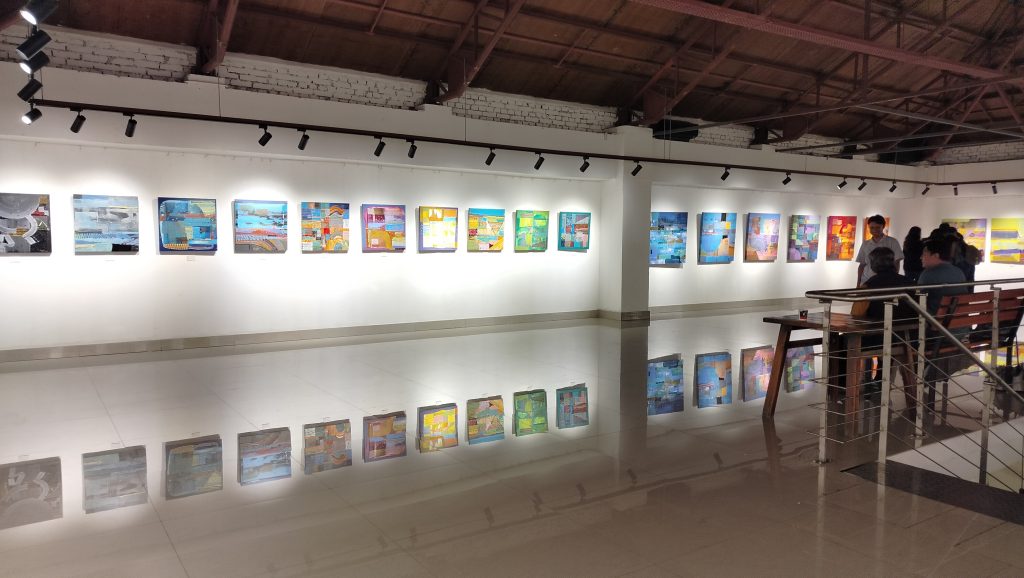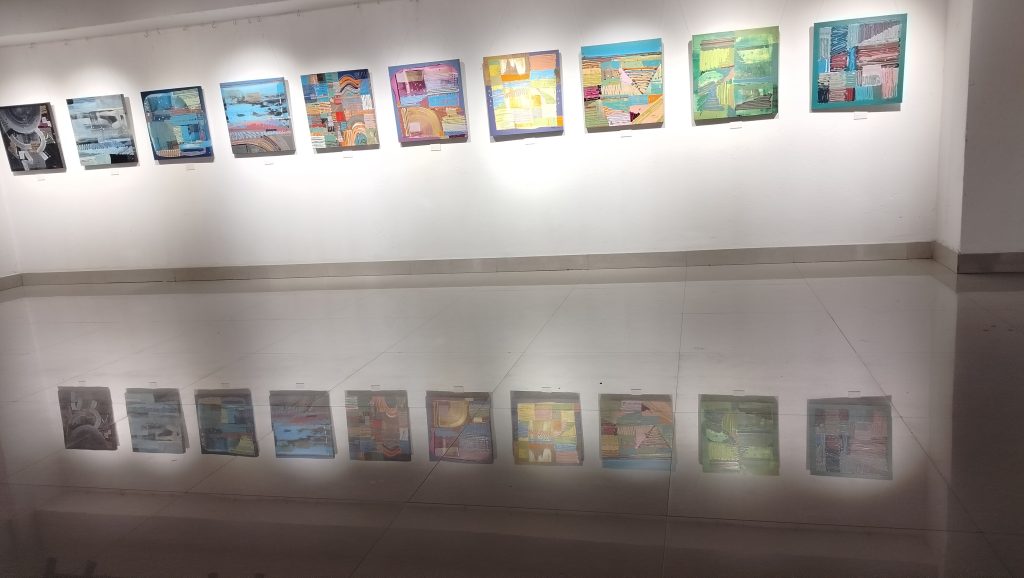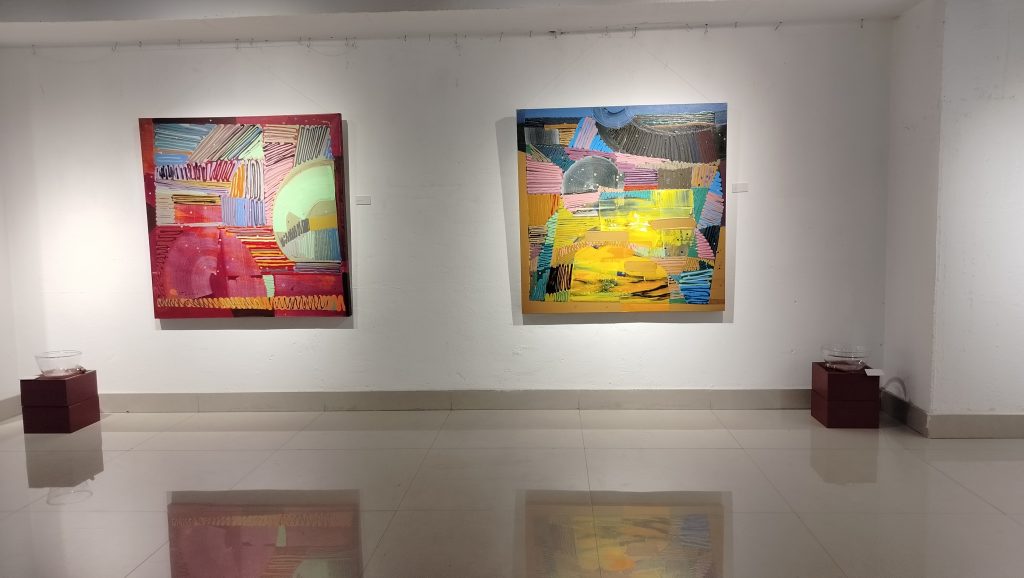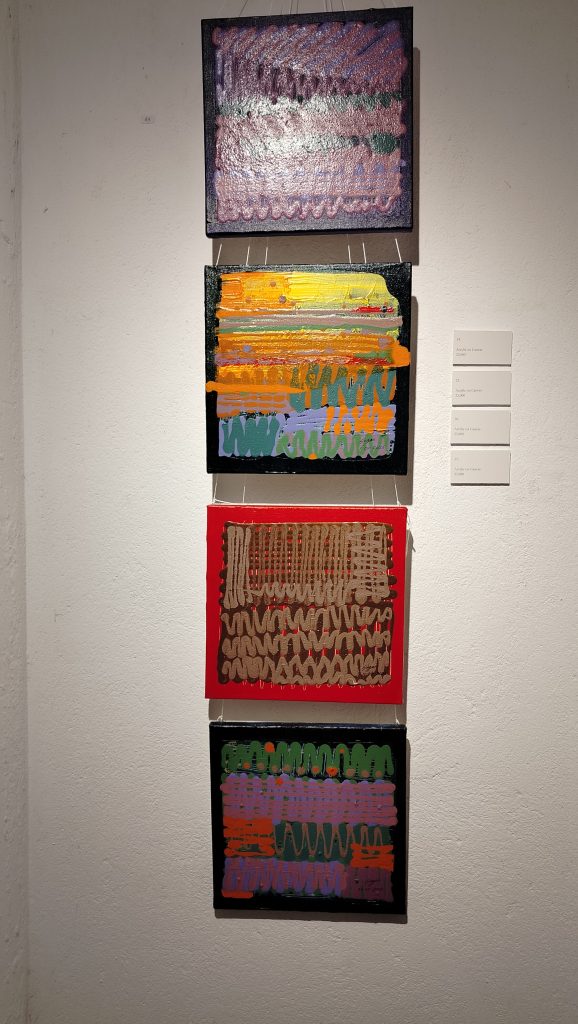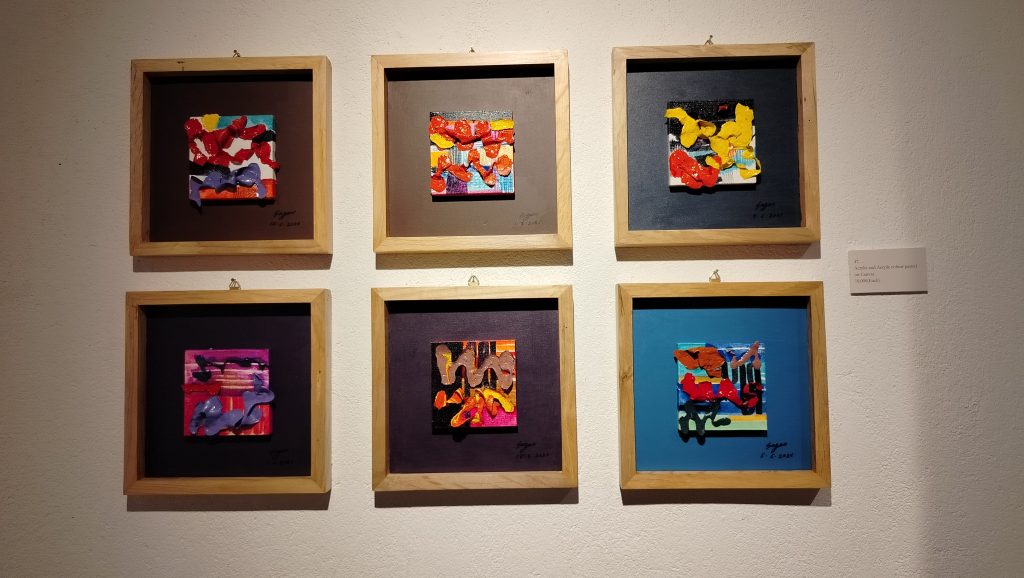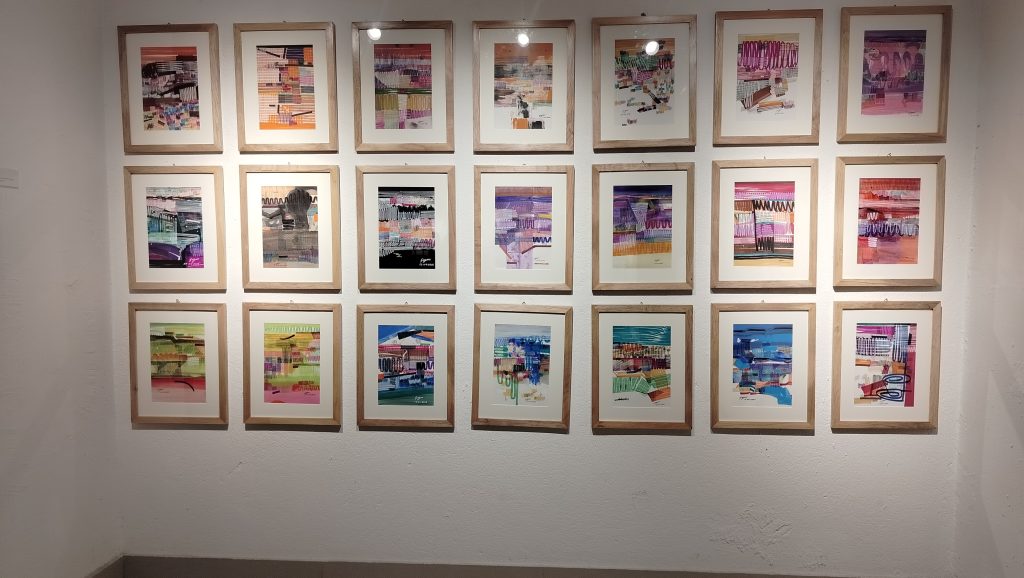

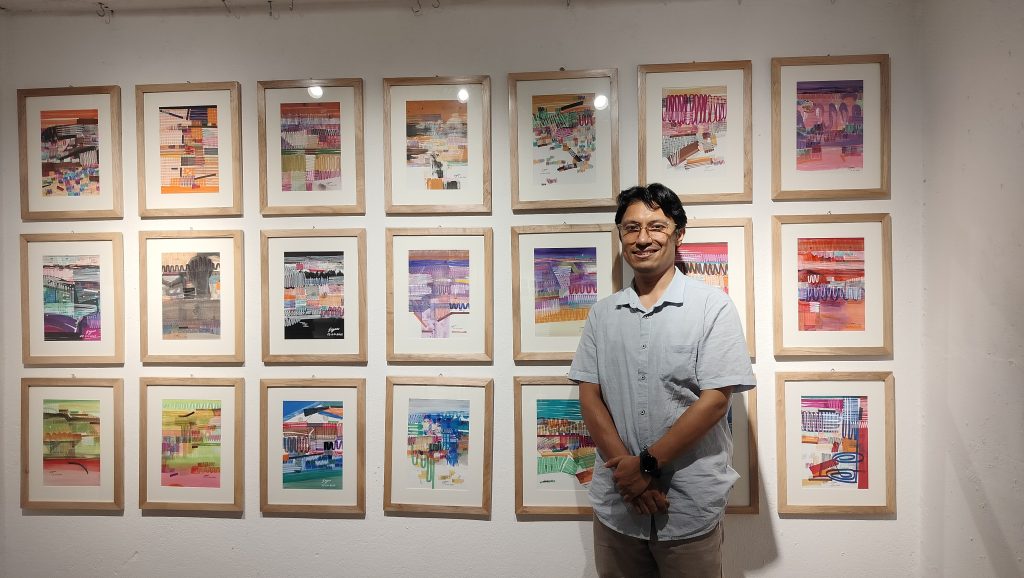
For artist Sagar Manandhar, a painting does not begin when colour touches the canvas. It starts much earlier—with the rhythm of a space, the sound of a scraping tool, the silence of a studio and an ongoing dialogue between the artist and his materials. His latest exhibition, Dialogue and Perception, which began on July 16 at The Kala Salon, Thamel, shifts the focus from the finished artwork to the creative process itself, inviting viewers to experience abstraction as a language rather than a puzzle.
In this conversation, Manandhar speaks about why sound is as important as colour, how experimentation reshaped his practice, living under the legacy of celebrated artist Kiran Manandhar, and why art should first move people before trying to change the world.
Q. Why did you choose the title Dialogue and Perception for this exhibition?
The title emerged from my belief that we often become obsessed with the final artwork and forget how it came into existence. Every painting begins with a process. Throughout that journey, I am constantly in conversation—with my thoughts, my materials and the work itself.
This exhibition is about that dialogue rather than the outcome. While my previous works explored melody, this series is more deeply concerned with the experience of making a painting. The scratching of surfaces, the layering of textures, the mixing of pigments, even the sounds created while preparing colours—all these become part of the artwork. I want viewers to experience not only what they see but also the invisible conversations that happen before an image is born.
Q. How do sound, colour and silence influence your paintings?
People usually think colour is purely visual. For me, colour also has a sound. Every material produces its own vibration. The scrape of a palette knife, the resistance of a textured surface or the sound of pigment being mixed all influence my emotions while I work.
I usually paint late at night because silence allows me to hear these subtle sounds more clearly. Even the sound of a falling leaf becomes meaningful. Those vibrations become part of my thinking, and eventually they become part of the painting itself.
Q. Your recent works show a noticeable shift in technique. What has changed?
The biggest change is that I have challenged my own materials. Earlier I knew how much water to use or how a line would behave. This time I deliberately stepped outside that comfort zone.
I introduced new materials, accepted unpredictability and allowed the paintings to surprise me. Some textures appeared unexpectedly, tonal values changed naturally, and the paintings developed their own identity. Instead of trying to control everything, I learned to listen to what the materials wanted to become.
Q. Many people find abstract art difficult to understand. How do you respond?
I think abstraction is simply another language. We enjoy songs in languages we do not understand because we connect with their rhythm and emotion. Abstract painting works in a similar way.
Viewers don’t need to decode every meaning. They simply need to spend time with the work. Even someone saying, “I don’t like this painting,” has already entered into a dialogue with it. That response itself is valuable. To me, abstraction is reality deconstructed. It explores what exists beneath appearances rather than merely describing what we already know.
Q. Why has abstraction remained central to your artistic practice?
Because it never truly ends.
A realistic painting often reaches a point where it feels complete. Abstraction keeps opening new possibilities. Even after I sign a painting, I sometimes look at it the next day and imagine another direction it could have taken.
That sense of infinity keeps me curious. Every completed work becomes the starting point for another journey rather than the conclusion of one.
Q. Nature seems to play an important role in your work.
Absolutely. My paintings are deeply inspired by natural soundscapes—the rhythm of rainfall, the movement of water, the colours of landscapes and even intangible sensations found in nature.
Living in Nepal also shapes my colour palette. The reds of religious rituals, the greens of our landscape and the colours found in everyday cultural life naturally become part of my visual memory. Even when I paint abstractly, these experiences remain present beneath the surface.
Q. Your father, Kiran Manandhar, is one of Nepal’s leading artists. How has that influenced your career?
My greatest inheritance from my father isn’t his paintings—it’s his discipline and energy. Growing up, I constantly watched him working. That commitment inspired me far more than his fame.
Of course, being known as Kiran Manandhar’s son came with challenges. Early in my career, people often assumed my achievements came because of him. At first that was frustrating, but eventually I realised that I could only answer those assumptions through consistent work. Rather than escaping my father’s legacy, I learned to build my own voice alongside it.
Q. Besides your father, who has inspired your artistic journey?
Uttam Nepali has been a tremendous inspiration. As a young student, I visited his exhibition, and he encouraged me to paint without fear. He even gave me one of his brushes, which I still treasure today.
That simple gesture gave me confidence at a formative stage of my career. My father gave me the energy to keep working, while Uttam Nepali inspired my artistic direction. Both remain central to who I am as an artist.
Q. Who gives you the most honest criticism?
Without question, my mother.
If she says a painting isn’t finished, I don’t sign it. Her observations often make me rethink a work more deeply than formal criticism does.
Today, my daughter and my wife also play an important role. My wife says she doesn’t understand art, but her comments often reveal something I had overlooked. Art may appear to be an individual practice, but my family is deeply woven into my creative process.
Q. What role should art play in society?
I don’t believe art changes society overnight.
What it can do is create a moment of relief. If someone walks into my exhibition carrying worries and forgets those worries for even a few seconds while looking at a painting, then the artwork has already done something meaningful.
A gallery is a place of celebration. My exhibition is my celebration, and if visitors can make it part of their own celebration, then I feel I have succeeded. Small emotional shifts eventually lead to larger changes in people’s lives.
Q. Finally, what does art mean to you?
Art is a reflection of myself.
People often describe art as a reflection of society, but I believe my paintings first reflect who I am—my experiences, my questions and my way of seeing the world.
Every painting in this exhibition also carries a memory. That is why I now record not only the year but also the completion date of each work. Each painting reminds me of a specific moment, a particular studio atmosphere and the dialogue that unfolded while it was being made. In that sense, every canvas becomes both an artwork and a memory preserved in colour, sound and time.