
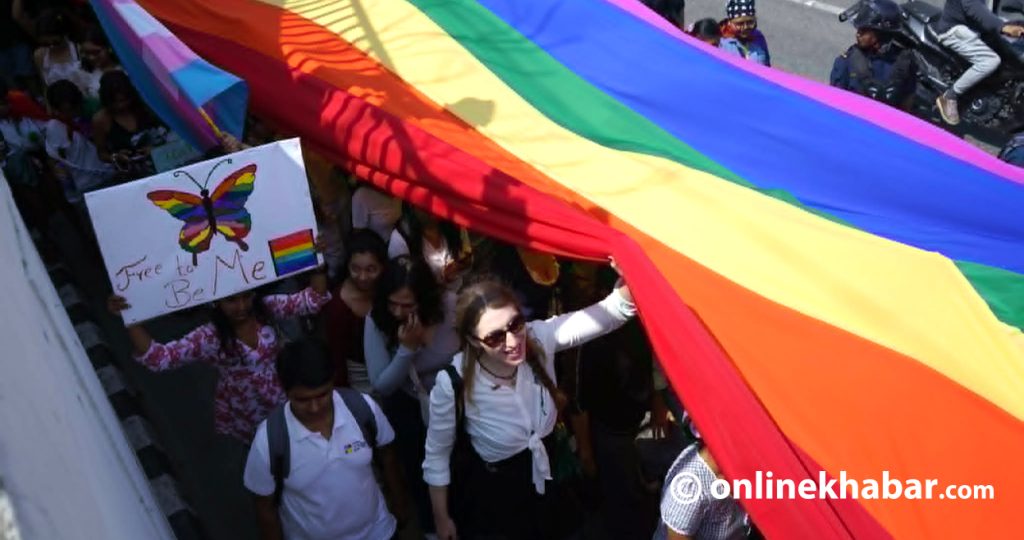
For nearly two decades, Nepal’s LGBTQIA+ community has carried a question across government offices, ministries, courtrooms, policy rooms, and advocacy spaces: who is responsible for addressing concerns of our community?
On 13 May 2026, Nepal’s newly formed government offered an answer. The Government of Nepal renamed the Ministry of Women, Children and Senior Citizens to the ‘Ministry of Women, Children, Gender, Sexual Minorities and Social Security’. According to the International Lesbian, Gay, Bisexual, Trans and Intersex Association (ILGA World), a worldwide federation of more than 1,800 organisations, this makes Nepal the first country in South Asia to explicitly include gender and sexual minorities (GSM) into a federal ministry’s name and mandate. Under the new mandate, the ministry is responsible for administering national protective laws, social security schemes, protecting marginalised groups, and assuring the socio-political rights of gender and sexual minorities across the country. This marks a significant moment after two decades of advocacy by Nepal’s LGBTQIA+ movement.
Sunil Babu Pant, the first openly gay Member of Constituent Assembly in Nepal and a prominent LGBTQIA+ activist, highlights that there is no dedicated constitutional or statutory commission focused on Gender and Sexual Minority (GSM/LGBTIQA+) issues, despite the community’s recognition in law and policy. To date, no openly GSM individual has been appointed as a constitutional commissioner, raising concerns about meaningful representation in national governance structures. “Even the Inclusion Commission lacks a dedicated desk, unit, or sustained program focused specifically on GSM issues, making it difficult to systematically address the community’s concerns,” he says.
The Government of Nepal has officially allocated USD 15 million to the newly renamed Ministry of Women, Children, Gender and Sexual Minorities, and Social Security for the upcoming fiscal year BS 2083/84 (2026-27 AD). However, there is no separate, isolated fund explicitly ring-fenced only for the Gender and Sexual Minority (GSM / LGBTQIA+) community. So the programs targeting the GSM community must draw directly from this unified ministerial budget, constantly competing for resources against larger, established ministerial focus areas like women’s health and childcare. Despite the extended mandate, the Ministry’s institutional structure remains largely unchanged following the renaming. There is no dedicated budget line for Gender and Sexual Minorities (GSM) inclusion, no additional staff positions have been established, and no ministry-wide directives have been issued to provincial or local governments. While the mandates have expanded, experts and activists mention that the operationalisation is yet to follow.
Bibek Magar, President of Queer Youth Nepal, mentions, “While I celebrate the decision of the renaming of the ministry to include GSM, I am also critical that this is NOT just the government’s attempt to get public approval and international attention.” Magar’s scepticism, like that of many other activists, stems from the recurring gap between legal recognition and administrative reality. For example, the constitutional promise on non-discrimination in 2015, which has still not eliminated structural barriers in access to services or documentation or the 2023 Supreme Court interim order on same-sex marriage that has resulted in partial or provisional registrations without equal access to inheritance, taxation benefits or spousal legal recognition. In a similar pattern, the 2024 Supreme Court ruling in the ‘Rukshana Kapali Case’ that affirmed gender identity recognition without medical requirements has not translated into a uniform national directive, making its impact largely case-specific rather than systemic.
“There is still no clarity in policies,” says Manisha Dhakal, Executive Director of Blue Diamond Society, a prominent LGBTQIA+ Human Rights organization in Nepal. “We do not want ambiguous policies”. She also stresses that government officials require sensitisation on GSM issues. She proposes that the ministry establish a dedicated section staffed with trained personnel to ensure effective implementation. Existing laws, she adds, must be analysed through the gender equality and social inclusion lens (GESI lens) and implemented through administrative directives, budget allocation, building institutional capacity and tracking implementation to build accountability.
Nepal has been praised as a regional leader in LGBTQIA+ rights for being progressive in terms of legal reforms and constitutional provisions for the GSM community. However, the GSM community has navigated a quieter paradox, one that is less visible in international headlines but more familiar to those navigating everyday struggles as a GSM in Nepal, where recognition has moved faster than implementation. An intersex individual describes the experience of avoiding public restrooms for the fear of being challenged or questioned over which facility to use. As a result, years of limiting water intake and delaying restroom visits ultimately led to serious health complications.
Such experiences rarely occur in policy debates. These instances reveal how exclusion can persist even when legal recognition exists. Similar experiences occur in school, where intersex children are bullied due to a lack of awareness among the students regarding what intersex is, and this is compounded by the lack of knowledge among teachers about how to deal with such situations. This leads to GSM often dropping out of school. This gap between policy and implementation is where responsibility gets diffused. It is neither fully present nor fully absent; instead, it is spread across institutions that have not yet been equipped to act on the changes that are made at the level of the governance structures.
Sunil Babu Pant mentions, “The most urgent are the structural issues such as unemployment, barriers to education and health, affordable housing and broader economic exclusion of the LGBTQIA+ community”. Pant adds that there is usually no dedicated budget line earmarked for GSM inclusion. Funding is often allocated on an ad hoc basis rather than through a transparent needs assessment linked to the socioeconomic realities of the community. At the same time, experts, activists and community leaders emphasize for recognition to translate into transformation.
Lack of accurate, reliable and disaggregated data is a major concern which directly affects policy design and resource allocation. The 12th National Census of 2021 logged 2,928 people identifying as Gender and Sexual minorities. LGBTQIA+ organisations estimate that the community makes up a much larger share of Nepal’s population, but many remain unaccounted for. “2,928 is a very small number; many policymakers and bureaucrats design programs and allocate budgets based on data. Thus, we urgently need a sample survey of our community,” says Manisha Dhakal. Experts suggest initiating preparation to integrate GSM effectively into the national census or launching a separate national survey to approximately count the GSM population in all its diversity.
Bibek Magar talks about how the collection of disaggregated data will help formulate specific and tailored needs and services for the GSM population. “The government needs to see the whole LGBTIQA+ identities as different identities instead of legally defining them only as gender identities or putting them in ‘Other’ categories, as this has become an obstacle for the community to recognise their diverse sexual orientations and sexual characteristics identity,” he says.
By establishing a system of grievance reporting in hospitals, schools, institutions of discrimination in health, education, employment and housing can be documented. By providing emphasis on including comprehensive gender/sexual orientation options in national census and all government forms, the government can ensure collection of data accompanied by involvement of LGBTQIA+ individuals in the development of sensitisation toolkits and trainings to ward secretaries and city officials to ensure proper implementation.
Concerns are also emerging around how representation itself is structured. The founder of Campaign for Change, Esan Regmi, focuses on the need to make people aware of the unique identities within the LGBTQIA+ community. “Government officials still often understand LGBTQIA+ issues mainly as transgender or third-gender issues, which is a very limited understanding of the spectrum,” he says.
Bibek Magar warns that without a nuanced understanding, there is a risk that LGBTQIA+ policy frameworks will continue to rely on oversimplified categories, overlooking the specific vulnerabilities of groups. “Strengthening institutional literacy is essential to ensure that both shared and identity-specific issues are properly recognised and addressed within national policy and implementation processes,” he said. Activists propose decentralised GSM councils at provincial and local levels to ensure representation beyond urban-based advocacy networks.
Sunil Babu Pant emphasises that the success of the ministries will be determined by how clearly the government defines its implementation priorities. “If the government were to focus on only three key priorities in the first phase, they should be institutional capacity building, legal enforcement, and data systems with awareness integrated across the three rather than treating them as a standalone activity,” he says.
At a municipal ward office in Kathmandu, a young individual identifying as transgender arrives to update his documents. The clerk acknowledges the file but does not proceed. There is a pause, followed by a quick consultation with a colleague. Following this, the applicant is requested to return the next day, the reason being “clarity is needed from above.” Across government offices, activists report a recurring hesitation without refusal. Due to uncertainty, no one wants to be the first, or they avoid risking the possibility of making a mistake that could be questioned later. So they wait for confirmation. No formal rejection is issued; instead, the files remain pending. In doing so, the system pauses: not out of denial, but deferral. But for those waiting on the other side of that hesitation, the effect is the same as refusal, only slower and less visible.
Experts suggest the Nepal government should consider establishing a GSM division and recruit LGBTQIA+ members to take their input on relevant decision-making. In addition, designating GSM focal points at the provincial and local levels or through a gatekeeper organisation would enhance coordination and delegation of responsibility. This ensures participatory formulation of policies and effective coordination and implementation of laws at multiple levels of state governance.
Esan Regmi has expressed a concern that the nomination of Bhumika Shrestha as an openly LGBTQIA+ Member of Parliament in March 2026 has created a perception among some policymakers that the community already has adequate representation, which has already resolved structural inclusion. “During my visits to the ministries, I am frequently told that now that we have a LGBTQIA+ representative Member of Parliament, all our concerns should be directed to her”. While acknowledging the importance of having representation in the parliament, Regmi mentions that such assumptions can also create barriers for organisations and individuals who do not have direct access to their representative.
A further concern expressed by Regmi is regarding the perception that a limited number of well-known organisations speak on behalf of the GSM community. While acknowledging the contributions of established organisations, he cautions against rating any sole organisation or network as the sole representative of the GSM community. For Regmi, meaningful representation requires participation from across the LGBTQIA+ spectrum. “While many concerns are shared, different groups face distinct challenges which require more tailored policy responses’ he said. A dedicated branch with diverse representation would help ensure that policymaking reflects the complexity of the community.
Manisha Dhakal emphasises that the next phase of inclusion should focus on expanding the political representation at multiple levels. “There should be provisions for political inclusion of the GSM so that within the next two years members of our community can stand in upcoming local and provincial elections,” she said.
Sunil Babu Pant stresses how existing resources frequently prioritise short-term projects that also go to a few NGOs, while many economically vulnerable GSM individuals continue to lack access to employment support, housing assistance, healthcare, social protection, and entrepreneurship opportunities.
Bibek Magar mentions, “I have seen equal government responsibility to work toward local and relevant authority to build awareness regarding sexual and gender minority rights and make those rights accessible at the grassroots level.” Otherwise, he warns the renaming will just be an achievement for the government, not a meaningful change for communities. Magar points out that the mainstream institutions must reach out to the grassroots organisations and give space, opportunity, and resources to the grassroots community and make them lead and search for their own participants and strengthen representations in the mainstream.
Political recognition was the first step. The next challenge is even harder. It is about proving inclusion can be made real. Now, the transformation will determine the significance of the ministry’s new name. It will be judged by whether a young intersex will be protected from unnecessary medical interventions, whether people with diverse identities can obtain documentation that reflects their reality, whether transgender citizens can access public services without humiliation and whether communities long celebrated in speeches finally experience equality in practice. If these commitments are meaningfully implemented, Nepal could create a global benchmark of how recognition is transformed into real inclusion.