
Nepal’s policy provisions are visionary. The Constitution of Nepal, the Education Act, the Education Regulations, the Act Relating to Free and Compulsory Education, the School Education Sector Plan and other policies envision that students should graduate with cognitive, spiritual, emotional, adaptive and productive resilience. These provisions guarantee every child’s right to education while placing parents as the primary duty bearers.
The Constitution also guarantees mother tongue-based instruction at the basic level. School Management Committees (SMCs) and Parent-Teacher Associations (PTAs) are legally established as accountability mechanisms. The intent is clear, but the gap lies in financing and implementation.
As Nepal prepares its annual budget cycle, this is an important opportunity to invest in parental education as a core component of a transformative education system. Dedicated budgets are necessary at both the federal and local levels for parental training, orientation programmes, awareness campaigns, development of educational guides, radio programmes and digital content.
Parents are every child’s first teachers. Parenting skills related to positive discipline, communication with children, support for literacy and numeracy at home, awareness of child rights, safeguarding and wellbeing are essential for improving educational quality.
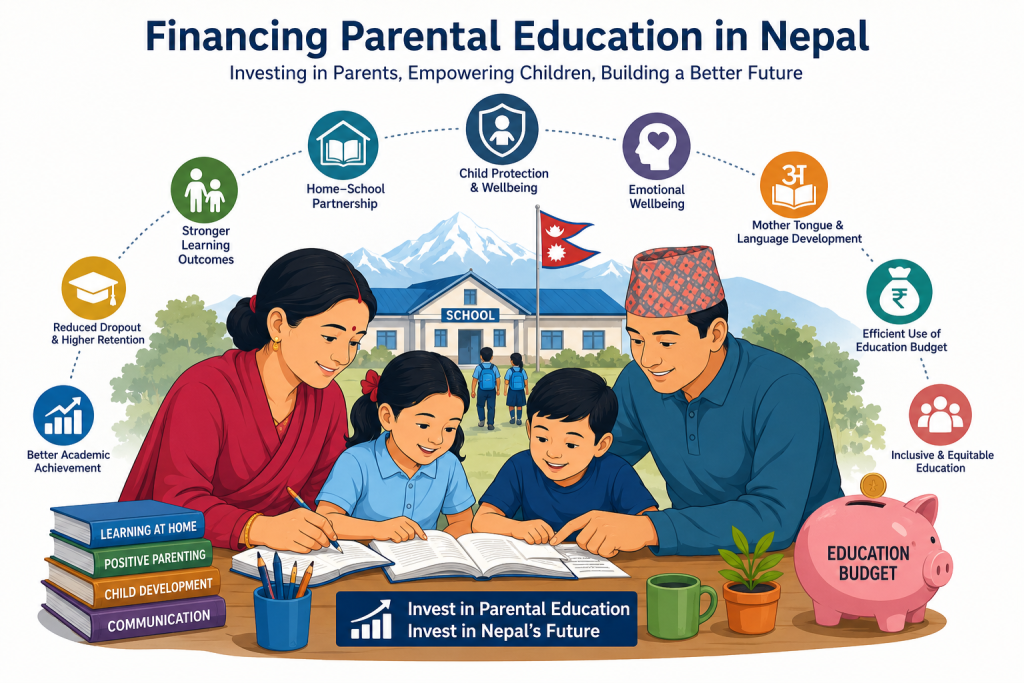
Research and policy evidence show that parental engagement significantly improves learning outcomes, especially in early grades. It helps reduce dropouts, improve attendance, strengthen child protection and challenge harmful social norms. Budgets for home-school partnership initiatives are necessary to recognise parents as co-educators in holistic and ecosystem-based learning.
SMCs and PTAs need to be strengthened not on an ad hoc basis, but through scalable and sustainable models supported by financial resources, programme design and system-level integration, which are currently lacking.
Research also shows that legal provisions without financing mechanisms become little more than wish lists. According to UNESCO’s 2023 Global Education Monitoring Report, countries allocating less than 20 per cent of their national budgets to education consistently struggle to translate policy into classroom reality. In Nepal, the education budget has hovered around 10 to 12 per cent of the total national budget in recent years, far below internationally recognised benchmarks. Allocating at least 20 per cent is not merely aspirational but an obligation towards children.
Evidence further shows that 90 per cent of critical brain development occurs before the age of five. Nepal’s legal framework mandates that children must be four years of age before enrolment in Early Childhood Education Development programmes. However, many parents enrol children earlier, reflecting limited awareness about developmental readiness at home.
Children spend nearly two-thirds of their waking hours with their parents. What happens at home fundamentally shapes school learning. A child who arrives at school without breakfast, without a quiet study space or without parents who ask about learning carries structural disadvantages that no teacher alone can overcome.
In Nepal, many parents prefer children to spend more time at school because of household responsibilities, subsistence livelihoods and limited parental literacy. Yet parental involvement remains one of the strongest predictors of academic achievement. Active parental engagement significantly improves student retention and completion rates.
Nepal is a multicultural and multilingual country with more than 123 spoken languages. The Constitution and education policies envision multilingual, mother tongue-based instruction up to Grade 8, a provision grounded in strong cognitive science research. Studies show that children learn foundational literacy and numeracy most effectively in their first language before transitioning to additional languages.
However, English Medium Instruction (EMI) is increasingly becoming a trend without adequate justification. As a result, educational quality is deteriorating, particularly in rural areas. To date, teachers, textbooks, assessment systems and pedagogical methods have not been adequately prepared to deliver mother tongue-based instruction uniformly across Nepal.
In this context, parental education should not be treated as an add-on programme but as a core component of the education system. Parents who speak indigenous languages at home, sing to their children in their mother tongue, tell stories and help children understand the world in their native language are providing irreplaceable linguistic support that schools alone cannot replicate.
Although financing is often cited as a challenge, investment in parental education strengthens and activates the linguistic and cultural capital that already exists in Nepal.
Beyond cognition and language, there is also an urgent child protection dimension. Nepal’s Children’s Act prohibits all forms of physical, mental, emotional, financial, social and gender-based violence. Yet research indicates that many children continue to experience violence at home.
Teachers frequently report that marginalised children arrive at school anxious, withdrawn or emotionally dysregulated, not because of school experiences but because of conditions at home.
Another serious issue is that some parents still encourage teachers to use corporal punishment despite legal prohibitions. In communities where girls quietly drop out of school, children with disabilities are hidden because of stigma, and child labour competes with school attendance; schools alone cannot become the sole sites of transformation.
Transformation must begin at home and extend through wards, local governments and community learning centres, which already exist as state structures across Nepal. In this context, governments should mandatorily allocate budgets for structured parental education programmes with measurable outcomes.
Failing to fund parental education reflects a misunderstanding of the economics of education. Free and compulsory education is not symbolic; it carries legal and social consequences. Children who fail to complete basic education within the required timeframe may face exclusion from future public and private employment opportunities and other services.
At present, parental education programmes remain fragmented. These efforts should be coordinated through local governments with strong monitoring frameworks. School zoning, resource pooling and shared infrastructure investment can further maximise available budgets.
The scholarship system also requires rationalisation. Providing scholarships universally rather than targeting the most socioeconomically marginalised groups represents a misuse of limited state resources.
The financing agenda for parental education must be practical and institutionalised. Programmes should be integrated into school calendars and annual local government budgets. Capacity building for SMCs and PTAs regarding their legal rights and responsibilities should be mainstreamed.
Funding is also needed for psychosocial counsellors in every school, remedial classes for marginalised children, disaster risk reduction and climate-responsive learning resources, ICT infrastructure and internet connectivity for blended learning, and full-time mentors to support teachers.
None of these reforms are possible without the political will to treat education financing as a constitutional obligation rather than a discretionary allocation.
Quality and inclusive education in Nepal will not emerge from classrooms alone. It must emerge from a system that begins at home, is supported by communities, guided by schools and adequately resourced by governments.
Parents who understand child development, practise positive discipline, speak with their children in their mother tongue, ask about their progress, report violence and enrol children on time are co-architects of the education system.
Nepal’s legal framework has already envisioned this partnership. The only barrier between vision and reality is the financing decision the country makes for the education sector.
Parental education is both an educational and developmental necessity in Nepal. Schools cannot address multiple structural issues alone. Although access to education has improved significantly, foundational literacy and numeracy outcomes remain unsatisfactory.
Since parents are children’s first educators, they must be equipped with practical skills related to school readiness, early literacy and numeracy habits, learning routines, positive reinforcement and school retention. Without investment at the household level, school-based reforms will continue to have limited impact.
Nepal is also undergoing rapid technological and social transformation through foreign labour migration, urbanisation, nuclear family structures and increased digital exposure among children. These shifts have weakened traditional caregiving systems.
Many parents are raising children without adequate guidance on child development, positive discipline, adolescent communication, digital safety and emotional wellbeing, particularly in marginalised communities. Gender-based violence, cyberbullying and other harmful practices are also increasing, while many parents lack the knowledge needed to guide children responsibly in digital spaces.
In today’s digital landscape, children’s screen exposure has far outpaced parental preparedness. Parenting education on the safe and responsible use of digital platforms is therefore equally important.
Financing parental education is ultimately a preventive strategy. Without dedicated investment, such initiatives will remain informal and ineffective.
To develop literacy and numeracy skills effectively, children require language-rich interactions at home, safe study environments, stable routines, positive reinforcement and opportunities to learn in their mother tongue.
Parental education is not a luxury; it is a necessity. The need is especially urgent in rural communities, among families of children with disabilities and for girls from marginalised backgrounds, where targeted parental education can directly reduce inequalities.
Investing in parental education means investing in better learning outcomes, stronger child protection and a more equitable society.