
The crowd at Maitighar Mandala was gradually increasing. Rakshya Bam, who had arrived early in the morning, was holding a placard that read “Where are you going after looting the state?” and searching for good governance. That day, many Gen Z youths like her had gathered at Maitighar Mandala to raise their voices against corruption.
As the number of demonstrators grew, Rakshya began reminding everyone of the code of conduct for the movement: “We will protest peacefully, we won’t litter the streets, this is a movement against corruption, and we will not damage the flowers along the roadside.”
But what got crushed were young lives, parents’ dreams, children’s futures, and the state’s better judgment.
By the time the group of Gen Z protesters, including Rakshya, reached Baneshwor, the peaceful protest suddenly turned violent. Gunshots rang out, students began to fall, and the र capital turned bloodstained. On September 9, the government collapsed, infrastructures burned, public property and leaders’ private homes were set on fire, and thick smoke engulfed Kathmandu. The country descended into a void.
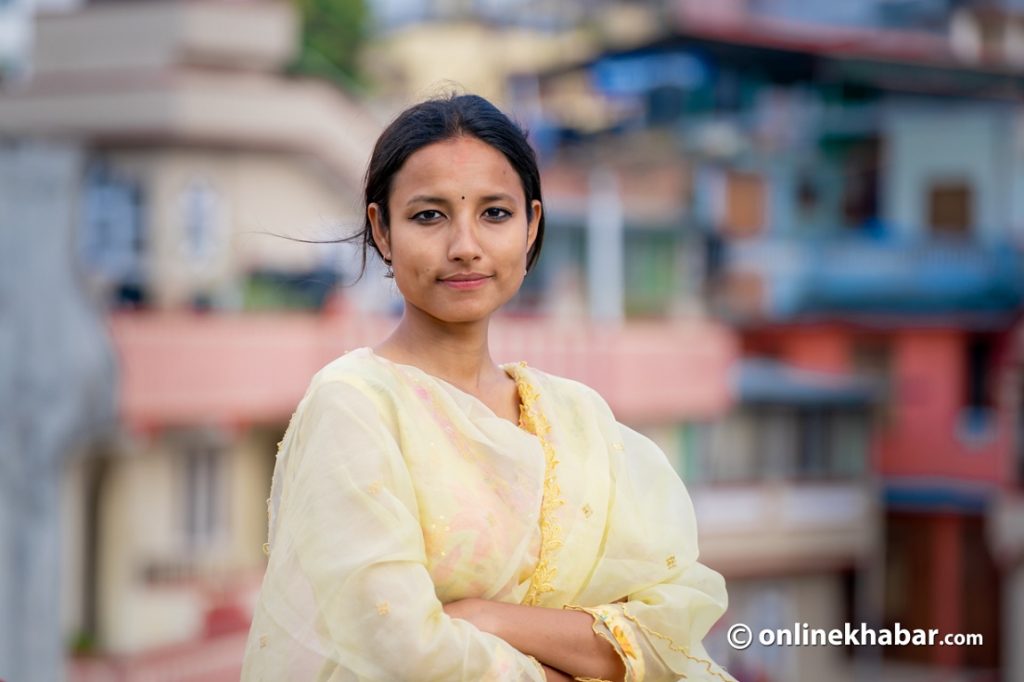
In that void, one of the most searched names was Rakshya Bam. This time, she has been listed among Onlinekhabar’s 50 Influential Women. The reason is not just her role in the Gen Z movement and the aftermath, but also her lifelong engagement with social justice and the questions she has consistently raised.
Born in 1999 in Kailali, Rakshya ’s childhood was different from that of many girls in the Far-West. She did not face discrimination for being a girl. Her middle-class family did everything possible to secure a bright future for their children. Most importantly, she was not discriminated against in education. The awareness she developed through that education has now become a valuable asset for society.
“In my home, I was never restricted for being a girl,” Rakshya recalls. “But I felt the discrimination in the structure of society from an early age.
Her village, near Tikapur bazaar, was not entirely underdeveloped. It was a mix of people from the hills and the indigenous Tharu communities. While it appeared diverse and unified from the outside, layers of discrimination existed within.
“I didn’t know the term ‘caste discrimination,'” she says, “but seeing Tharu people who worked in others’ homes being made to eat separately left me deeply saddened. I kept wondering why such discrimination existed.”
This question deeply rooted itself in her young mind. Even though the Kamlari system had been legally abolished, its remnants still existed in society and troubled her. Women continued to work for low wages; nothing had really changed.
“When it was time to eat, they had separate plates,” Rakshya says. “One day, I picked up that plate and said, I will eat from this plate.” Looking back, she feels that was her first act of rebellion for social justice.
Though it didn’t spark a big debate at home, something clicked within her.
“That day, I felt something was wrong in society.”
Her childhood grew alongside a politically awakening society. There was a people’s movement against the monarchy, and the Maoist insurgency was nearing its end. After the movement, discussions about marginalised groups, indigenous people, women, Madhesis, Tharus, and minorities became mainstream.
Rakshya followed these conversations closely. She was always ahead of her age in questioning discrimination. Even today, she identifies more with the streets than with power. She remains among those activists who keep questioning alive.
Just as the remnants of bonded labour systems sparked her awareness of social justice, a song, “Janatako Sasan” by Badri Pangeni, played a role in awakening her consciousness about women’s rights.
While watching TV with her grandmother, she heard a line: “Lau cheli sindoor lau…” (Daughter, wear sindoor). That line disturbed her.
“What is sindoor? When should it be worn? Why can’t everyone wear it? Why doesn’t my grandmother wear it?” she wondered.
Her grandmother had stopped wearing red after her husband’s death.
“I asked her why. She said widows cannot wear red.”
The answer was simple, but the social structure behind it was complex. Rakshya began questioning whether it was fair that a woman’s right to wear sindoor depended on her husband’s presence.
“That song and those questions taught me to stand for women,” she says. “Later, I understood being unable to wear something and choosing not to wear it are two different things.”
Rakshya proudly identifies herself as a feminist.
“Feminism didn’t come from books, it came from experience,” she adds.
She moved to Kathmandu for her +2 studies.
“I was in cultural shock for a year,” she laughs.
She also experienced regional discrimination.
“Here, money can get you everything, but in our place, even with money, services are unavailable,” she says.
She studied Social Work for her bachelor’s. Fieldwork in rural schools, Red Cross programs, and farming communities expanded her understanding beyond textbooks.
“Social work taught me acceptance,” she says. “It taught me to accept different opinions.”
During campaigns like Bhagya Bokney Jhola (Bag of Fortune), she visited remote villages where children lacked even basic school supplies. These experiences shook her deeply. “That was another turning point,” she says.
Through a USAID fellowship, she worked on misinformation and the right to information.
“The right to information should be taught from the school level,” she says. She interacted with hundreds of students and continued advocating for social justice, not because she believed she could change the country overnight, but because she believed questions must be preserved.
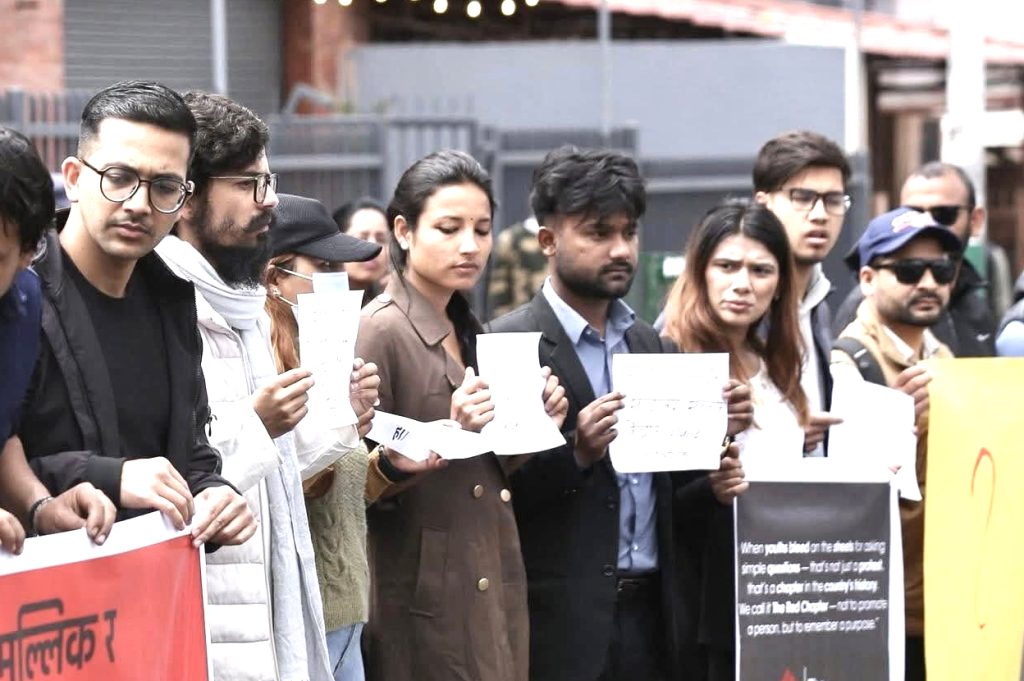
After the rape and murder of Nirmala Pant in Kanchanpur, Rakshya joined protests for the first time. “That’s where I heard ‘justice delayed is justice denied,’” she recalls.
Since then, she has been involved in multiple movements, farmers’ protests, anti-acid attack campaigns, and movements against loan sharks. She stood beside the victims, amplifying their voices. The street became her most important university.
She also supported protests led by Ruby Khan demanding justice for cases in Nepalgunj.
“They would ask me, have we received justice yet? I had no answer,” she says. “I would just say, I’m here to add my voice to yours.”
She never positioned herself as a hero.
“I never said I would deliver justice,” she says.
She turned anger into creativity, writing poems and making posters. She calls it “artivism.”
The protest of September 8, 2025, did not go as expected. Shortly after she outlined the rules at Maitighar, the city descended into chaos. Gunfire, destruction, and instability followed.
“My biggest fear was a coup,” she says. “The alternative to democracy is better democracy.”
In the days that followed, as political instability deepened, she even questioned the army chief about possible coup intentions. Due to vigilance from conscious youth like her, the political situation gradually stabilised. An interim prime minister was appointed, and election dates were announced.
She became emotional during the swearing-in of Prime Minister Sushila Karki.
“Seeing a woman in that position brought tears to my eyes,” she says.
Political parties later invited her to join them, but she declined. “Quotas and compromises made me uncomfortable,” she says.
In the end, she chose the street.
“The street never left me,” she says. “For now, questioning feels like my responsibility. There’s still a long way to go.”