

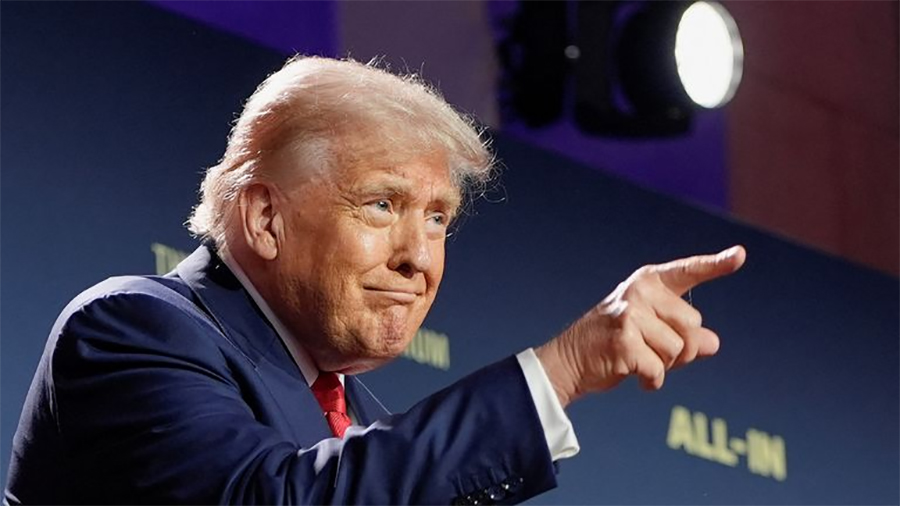
In the brief span of the last two years, the series of life-threatening attempts on President Donald Trump has posed a severe challenge to modern security apparatuses and global political stability.
From the open assassination attempt at a Pennsylvania campaign rally in July 2024 to the recent April 2026 shooting within the highly secured perimeter of the White House Correspondents’ Dinner at the Hilton Hotel, Trump has faced at least three major attacks.
While the swift action of security forces and sheer luck ensured his survival, these events have laid bare the deep ideological polarisation, social unrest, and escalating political intolerance within American society. These lethal strikes are not merely attacks on a high-profile political figure; they are calculated assaults on the world’s most powerful security framework and democratic values.
Looking back at American history, attacks on political leadership are not a new phenomenon, yet their recurrence in today’s tech-driven era is deeply alarming. The United States has witnessed the assassination of four sitting presidents, highlighting a bloodstained thread in its political fabric.
The 1865 assassination of Abraham Lincoln was the tragic climax of a civil war fought over the abolition of slavery. Similarly, the killings of James A. Garfield in 1881 and William McKinley in 1901 exposed the political and ideological frictions of their times. The most infamous and enigmatic remains the 1963 assassination of John F. Kennedy, which exposed systemic vulnerabilities within the US administration at the height of the Cold War. This historical timeline demonstrates that American leadership has consistently remained at high risk from ideological and personal vendettas.
The trend of political assassination is not confined to the US; heads of state worldwide have fallen victim to such violence across different eras. In neighbouring India, the 1984 assassination of Indira Gandhi resulted from the religious and ethnic fallout of ‘Operation Blue Star,’ while the 1991 assassination of Rajiv Gandhi was linked to the LTTE insurgency in Sri Lanka and regional security intervention.
Likewise, the 1981 assassination of Egypt’s Anwar Sadat stemmed from extremist dissatisfaction over the peace treaty with Israel. The 2022 killing of former Japanese Prime Minister Shinzo Abe sparked a global debate on how such massive security breaches can occur even in the most orderly societies. Furthermore, the 1995 assassination of Israeli Prime Minister Yitzhak Rabin was driven by right-wing extremism opposing the Oslo Accords. At the heart of all these incidents lie religious extremism, geopolitical interests, internal strife, or radical ideologies.
Examples from Europe and South America further illustrate how political assassinations can shift the trajectory of power. The 1986 assassination of Swedish Prime Minister Olof Palme remains a mystery, proving that even peaceful Scandinavian nations are not immune to political violence. In South America, the brutal 2021 assassination of Haitian President Jovenel Moïse inside his residence plunged the nation into a vortex of anarchy.
Such incidents are often intertwined with organised crime, corruption, and the interests of foreign powers. When a nation’s internal security and intelligence agencies falter, attacks on political leadership shake the very foundations of democracy. These global precedents teach us that protecting a leader is not just about safeguarding an individual; it is about defending national sovereignty and constitutional stability.
The current security challenges in the US and its ‘gun culture’ must be examined in the context of the attacks on Trump. The US Constitution grants citizens the legal right to bear arms for self-defence – a provision that has now become a primary challenge to internal peace. Recent statistics show that the number of privately owned firearms exceeds the total population, highlighting a volatile social climate.
The fact that an assailant with lethal weapons could infiltrate a high-security zone like the Hilton Hotel, equipped with advanced scanning technology, exposes grave lapses in American security protocols. The ease of legal access to firearms empowers ‘lone wolf’ actors inspired by extremist ideologies to carry out large-scale political violence. This proves that until there is a shift towards stricter gun control laws and heightened social awareness, leadership security will remain perpetually compromised.
In seeking why Donald Trump specifically faces recurrent attacks, his aggressive style and the resulting division within the American public appear to be primary factors. Trump’s staunchly nationalist ‘America First’ policy has garnered a massive base of devoted supporters on one hand, while simultaneously creating a fiercely aggressive opposition.
His controversial decisions, anti-immigrant rhetoric, and polarising language on social media have ignited flames of extremism and retribution in certain segments of society. In such a sensitive environment, experts cannot entirely rule out the invisible hand of foreign intelligence agencies or global agendas seeking to challenge American hegemony. Because Trump’s foreign policy disrupted decades-old international political and economic equations, he has become a target for numerous factions.
These security failures have placed the professionalism and perceived ‘complacency’ of agencies like the Secret Service under public scrutiny. In the modern era, relying solely on bulletproof vehicles or physical cordons can be suicidal. There is an urgent need to utilise technology, Artificial Intelligence, and psychological profiling to identify potential threats long before an incident occurs.
The security lapse at a prestigious venue like the Hilton Hotel teaches us that supposedly ‘impenetrable’ locations can often be the most vulnerable. This sends a negative message to the global community: if the president of the world’s most powerful nation is not safe, how fragile must the security of leaders in smaller, developing nations be? Security agencies must operate with professional detachment, ensuring political bias does not cloud their strategic focus.
The United States is a diverse ‘melting pot’ where people from every corner of the globe live under one flag. When political violence erupts in such a society, it can instantly dissolve generations of social harmony and coexistence. These sequential attacks on Trump signal that the ideological war in America is no longer limited to television debates or campaign rallies; it has descended into physical confrontation on the streets. Sociologists warn that if political grievances are not addressed and violence continues to be the preferred tool, America may find itself on the brink of a harrowing ‘modern civil war.’ The gap between Republican and Democrat supporters has widened to a point where they often view each other as ‘national enemies’ rather than mere political rivals.
If internal strife in America were to escalate into a large-scale civil war or armed rebellion, the fallout would not be confined to its 50 states; it would shatter the global political and economic balance. Even a minor dip in the American economy would trigger a deep global recession. Furthermore, if the US military focus shifts toward managing domestic chaos, instability in conflict zones worldwide will intensify.
An internally divided and weakened America would lose its global leadership role, allowing emerging powers to seize control of the world order. These risks replace democratic values and freedom with extremism, authoritarianism, and unchecked displays of military might. Therefore, American stability remains the backbone of global peace and security.
In conclusion, the repeated assassination attempts on Donald Trump are a stark ‘wake-up call’ for American democracy and its institutions. These events have surfaced a deep wound within the American state and society – one that cannot be healed simply by deploying more security personnel. The permanent solution requires high-level integrity from political leadership, comprehensive reform in firearm policies, and a restoration of dialogue and reconciliation at the grassroots level.
If the US fails to wisely address its growing internal division and the politics of hate, its identity as a ‘superpower’ may soon be relegated to the pages of history. For the sake of global peace, maintaining a strong, stable, and secure America must be the foremost priority of contemporary global politics.