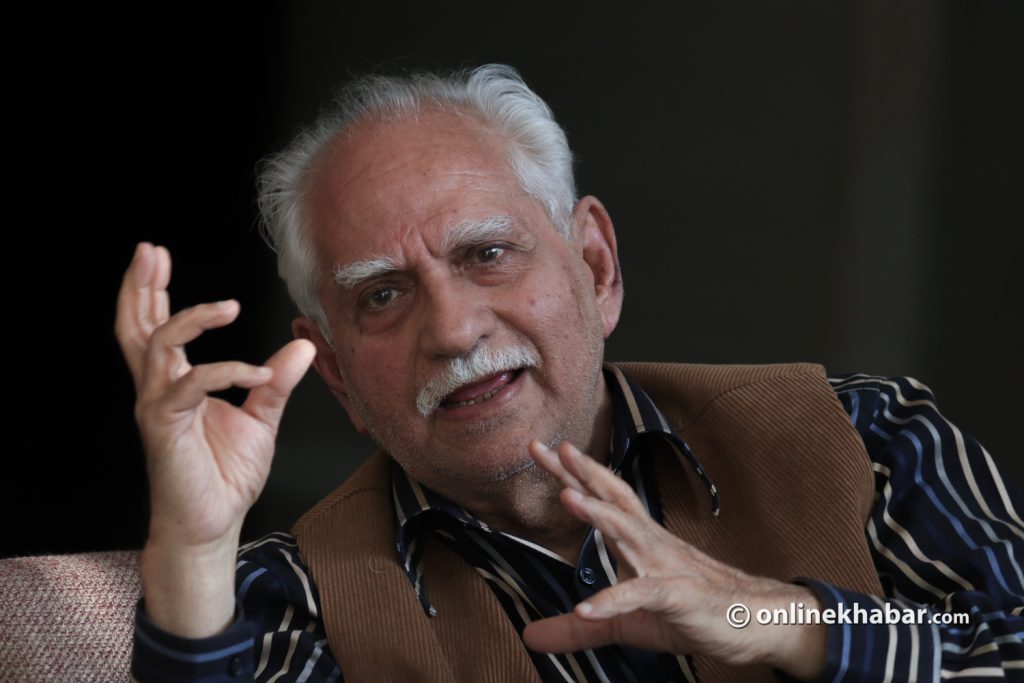
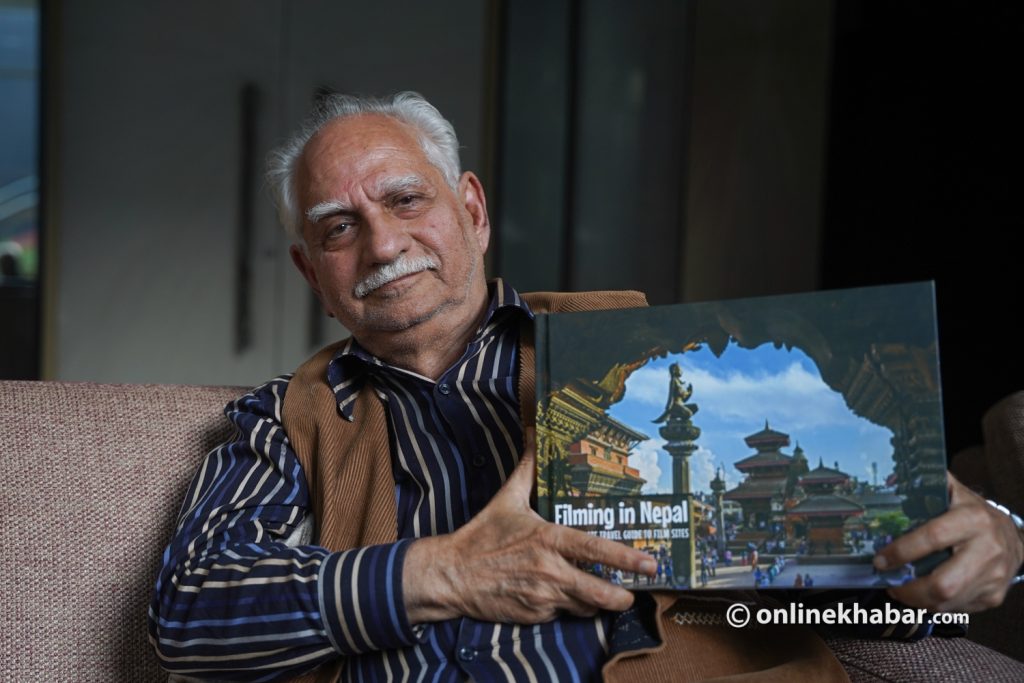
One of the most influential and popular films of Indian cinema, Sholay, directed by Ramesh Sippy, is currently in Nepal’s capital. He has arrived in Kathmandu as a special guest of the Nepal International Film Festival (NIFF), marking his third visit to Nepal.
Sippy elevated Sholay beyond a simple story, turning it into an experience. He transformed the way stories are told, gave depth to every character, presented Bollywood in a Western style, and balanced both “larger-than-life” moments and subtle nuances. His direction didn’t just make Sholay a successful film; it made it a cultural phenomenon. After this, the standards of Indian cinema changed.
At 79, Sippy spoke with Onlinekhabar journalist Bishnu Sharma about Sholay, Bollywood, storytelling after Dhurandhar, and Nepali cinema:
If you had to make Sholay today, what would you keep the same and what would you change?
For me, Sholay is a one-time phenomenon; it happened, and I wouldn’t want to recreate it. If I had to make it today, I don’t even know how I would cast it. The actors I had at that time were themselves an event. There are great actors today, too, of course, but imagining who would play which role now is difficult. So I think Sholay is Sholay.
It’s very hard to analyse. Otherwise, why hasn’t something like it been made again in 50 years? Why hasn’t that same emotion been recreated? Many great films have been made, including some by me. But when compared to Sholay, there’s a very different aura and emotion. It holds a special place in people’s hearts. Its dialogues, Gabbar’s lines, and even the smallest characters are remembered. So analysing Sholay is a different matter altogether.
You have witnessed many phases of Indian cinema. How do you see storytelling evolving from your time to today’s big-budget visual era?
Every era presents different challenges for filmmakers. When I was making Sholay, everything was planned because it was necessary. Every detail mattered. We had planned a six-track stereophonic sound, so the audio had to be recorded in a specific way. But everything came together only in the final stage, which required extensive planning.
Then it would go to the lab where the soundtrack was created. At that time, 70mm prints had magnetic tape on the sides, where the six tracks of sound were embedded. These details show how carefully films were planned, because every film is different.
One major shift in filmmaking came from awareness of sound. Even a small sound, like a coin being tossed, could have a strong impact. For example, after Jai (played by Amitabh Bachchan) dies, Veeru tosses a coin. The sound of that coin hitting rocks echoes across the theatre.
When I watched it with the audience, I felt it might disrupt the emotional moment. It was a deeply emotional scene, but the audience was drawn into the coin’s journey, from where it fell to how it moved. I wondered if I had made a mistake. But they loved it. They talked about it, and it didn’t reduce the emotional impact of Jai’s death at all.
After big-scale successes like Dhurandhar 2, do you think audience tastes and expectations have changed?
No, I don’t think so. Dhurandhar itself broke a certain image. It’s not just a romantic film, it includes romance, but also large-scale violence because there is a mission. It has changed the grammar of filmmaking in a very beautiful way. Its impact is significant, and it has again redefined cinematic storytelling.
In today’s industry, where box office numbers dominate, do you think story and content are still central?
What I see is that storytelling remains at the heart of cinema, a blend of sound and visuals. Whether shown on a big screen, television, or a small home screen, filmmaking remains a powerful storytelling medium. Emotion, romance, and drama must come together in the right balance to create a hit. Everyone thinks they have that balance, but not every film succeeds the way they expect.
You are in Kathmandu for NIFF 2026. What is your view on Nepali cinema and its international presence?
I believe Nepal has a bright future. Young people in Nepal and India are influenced by cinema from around the world. They have enthusiasm and want to create something for Nepal and take it to global audiences. So I’m confident that good cinema will emerge from here and reach international festivals.
However, festivals are only for showcasing. Ultimately, films must reach audiences. A film cannot survive only within festivals. It must go beyond that.
There are television and OTT platforms, these are the future, and they’ve already begun. The technological changes of the last 5–10 years will bring transformations beyond imagination. Filmmakers do worry whether they can keep up with these changes.
Take AI, for example, people fear it. Some find it useful, but there’s also fear that it will take over everything. That will never happen. The human element will always remain. If used properly as a tool, it will only assist.
You will share a stage with Rajesh Hamal at NIFF. How important are such dialogues for South Asian cinema?
Any discussion about cinema is always useful. If expressed properly, everyone brings different perspectives. What you take from it depends on you, what you learn and how you apply it to your work or contribute to the industry.
Each country has its own policies, but cinema is universal. People everywhere love cinema. There may be places where it hasn’t fully reached, but television and OTT platforms have significantly improved access.
What should Nepali filmmakers focus on to compete globally while preserving their identity?
This applies to every country. For Nepal, it’s important to preserve its Nepali identity. It should never be lost. Filmmakers should learn from global cinema, whether from India, China, or the West, but maintaining a distinct identity is essential. That will always help.
Do you think a film with the cultural impact of Sholay can be made again?
I don’t think it depends on a specific era. But today, technology must be considered while making films. Things like mobile phones have changed storytelling. Today, audiences will question why certain technologies weren’t used. So films must reflect the changes brought by technology.
What advice would you give to young filmmakers in Nepal and India?
I would say, follow your heart. Filmmaking starts with a single word. You must write a story and develop it into a script. With collaboration, it becomes a project. Casting is equally important; having the right actor in the right role is crucial.
The future is bright. Young Nepali students should look ahead positively. Competition is never easy, but it’s not easy anywhere, not even in America, where there is a lot of money, yet not all films succeed.
Ultimately, it is the individual filmmaker who shines. If they write well, strive to be different, and preserve their essence, every aspect matters. Nepali youth are no less capable; they must move forward, take on challenges, and keep progressing.