“I don’t want my students to be well-behaved; I want them to be rebels with a conscience.”
Mother Mary is said to have taught these words while teaching in Kerala. She is the famous ‘Mother Mary’ in the book we are discussing. But let’s start from the beginning, do you know that feeling when you’re reading a book and can’t wait to tell someone about it?
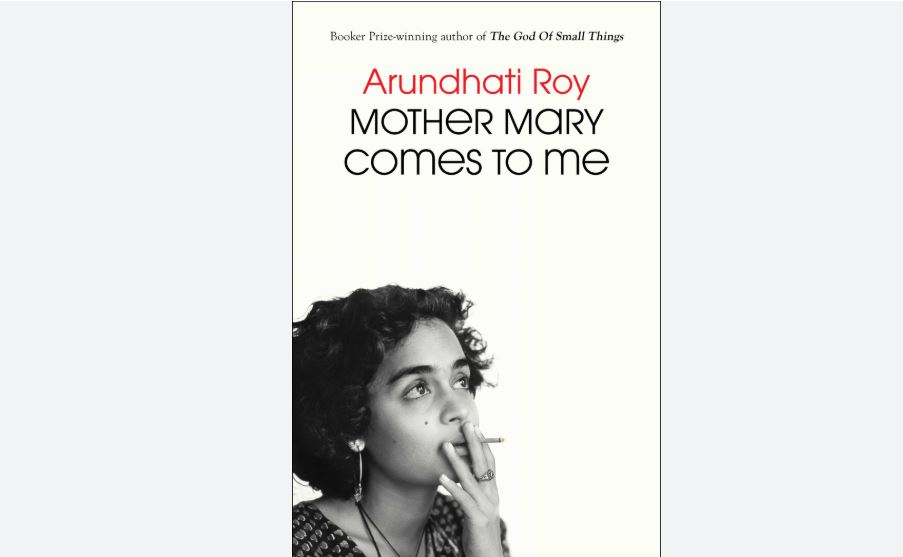
For me, ‘Mother Mary Comes to Me’ was that book (I hardly read these days, anyway). It’s packed with known knowns, known unknowns, and unknown unknowns about one of my favourite writers, Arundhati Roy. If you’re curious about how much of a writer’s work is fiction and how much is drawn from real life, this book is a treat. It offers a revealing look at Roy’s journey to becoming ‘India’s favourite person to hate’ and at the crafting of some of the much-loved literary characters, Rahel and Estha.
‘I have thought of my own life as a footnote to the things that really matter. Never tragic, often hilarious.’ Bam!
If you want a quick answer about whether to read this book, it’s one of the best memoirs I’ve ever picked up. I might be a little biased, but I needed time to process it after finishing. The book challenges many of the easy stories we tell about Roy, but does so without resorting to complicated or fake language. Her honest, difficult story reminds me of Woolf’s A Room of One’s Own, showing the political, personal, and social costs of being a strong woman in India.
If you love fiction, this book has echoes of reading Morrison’s Beloved or Joyce’s Ulysses, but set in a more recent and familiar world closer to Nepal. For example, Roy was a hostel roommate with Nepali leader Hisila Yami and mistakenly called Dr Baburam Bhattarai the first elected communist PM of Nepal, though he was actually the third. ‘Orundhati,’ as her father calls her, doesn’t just pay tribute to Morrison by carving ‘BELOVED’ on her mother’s memorial; she brings that same honest look at impossible love into her own story.
‘I watched her unleash all of herself—her genius, her eccentricity, her radical kindness, her militant courage, her ruthlessness, her generosity, her cruelty, her bullying, her head for business, and her wild, unpredictable temper.’
The lyrical palimpsest: When we become our own books
What strikes you first is Roy’s unsettling revelation of exactly how her life became her novels. That traumatic encounter with the ‘Wild Boar’ who groped her as a child? That’s where the ‘Orangedrink Lemondrink Man’ comes from. Her uncle, G. Isaac, the Rhodes Scholar with his pickle factory and Joyce quotations? Meet Chacko from The God of Small Things. It’s like watching someone perform surgery on their own books.
Roy does something unusual here: she reveals the exact moments when her trauma became fiction, but she treats both with respect. Her childhood survival rule— ‘(a) Anything Can Happen to Anyone (b) It’s Best to Be Prepared’—becomes the main idea for her fictional twins. The memoir acts like a layered story, with new writing built over old memories, showing how a writer’s mind keeps and changes pain.
‘Some of us made up our own minds, others had their minds made up for them.’
I used to think Roy came from a privileged background, like Salman Rushdie or Khushwant Singh. Her bold, honest style made me think she had an easy childhood and college life. But reading about her painful experiences—like the wire coat hanger abortion attempts, being told ‘You’re a millstone around my neck,’ or ‘little hybrid mongrels,’ and her poverty in college with her friend Golak—showed me how wrong assumptions can be.
As Golak would say about his once-an-actress-and-scriptwriter friend’s writing in his own style, ‘Thang God, she writes so amazingly.’ She describes her spouse here:
‘But food, and a roof over his head, were not things he had ever had to worry about. To me, that signified wealth.’
The unconquered moon
Roy’s greatest courage lies in refusing to psychoanalyse what should stay mysterious. ‘I’m all for the unconquered moon,’ she writes, ‘I’m weary of endless theories and explanations.’ Where other memoirists might explain their mother’s contradictions through therapeutic frameworks, Roy presents Mary Roy in all her impossible glory: ‘her genius, her eccentricity, her radical kindness, her militant courage, her ruthlessness, her generosity, her cruelty.’
Her mother could ‘break my heart and mend it, too. With a snap of her fingers.’ She was someone who ‘taught me to write and resented the author I became.’ Roy shows us how complicated people can be, without trying to explain everything. There’s something almost Faulkner-like in how she lets the weight of family history remain.
‘I made a note of that one area of harmony and compatibility between Mr and Mrs Roy—kicking their daughter out of cars in jungles and strange cities.’
Her changing closeness and distance with both parents feels honest and real. She accepts people, flaws and all, especially her father, Micky Roy, who was severely malnourished, like people in UN pamphlets, and almost always drunk or asking to be drunk. She can’t bring herself to hate or leave her father, even with his drinking and lies, which makes her feel deeply human.
When Micky asks, ‘D’you still like the smell of men? Do you have a boyfriend? Why don’t you bring him here so I can break his teeth?’ She shares the ‘Nothing Man’ in all his silly, harmless ways, without judging him. The pain she shares when she had to choose between a dying father and an almost-dying mother is a rough speed bump in her otherwise rhythmic story whispering.
The gangster nature and language animal
Roy keeps what I think of as her ‘gangster nature’ throughout the book. From her important essay on Phoolan Devi to her struggles in Gujarat, Jharkhand, and Kashmir, she stands strong. She even declares, ‘I hereby declare myself an independent, mobile republic. I own no territory. I have no flag.’ She becomes the ‘language animal’ she has always sought, moving from being controlled by language as a child to finally using it for herself.
‘I wasn’t Christian enough.
I wasn’t Hindu enough.
I wasn’t communist enough.
I wasn’t enough.’
Her made-up compound words aren’t just for style—they help her survive. She needed what she calls ‘reckless insouciance’ to describe things that ordinary words couldn’t. When she talks about going from ‘the Hooker who won the Booker’ to a writer ready to break free from her limits, you can see how she found her true voice by refusing to be controlled in her ‘idiot-proof language.’
The feeling of being stifled in today’s India, especially as an outspoken woman, runs through the whole book. Roy’s struggle with not wanting children or a traditional family is shown honestly, without complaint—just a clear look at what it costs to live true to yourself.
‘I had to have the right to be unpopular.’
Spirit architecture
Near the end, Roy seems calmer than rebellious as she builds the Grove for her mother. The house she renovates becomes ‘spirit architecture’ because she rebuilds it with care, even though others told her to tear it down. ‘I had constructed myself around her,’ she writes, ‘I had grown into the peculiar shape that I am to accommodate her. I had never wanted to defeat her, never wanted to win.’ Without mentioning it, she seems to be unintentionally trying her best to win her mother’s approval of her writing and her way of living.
She likes the way Pradeep’s mother admires her neck, didn’t she?
This memoir feels like something de Beauvoir might have written if she had Morrison’s storytelling, Sylvia Plath’s suffocations, and Joyce’s playful language. Roy reflects on how we become ourselves through our hardest relationships and how the ways we adapt can become our greatest strengths, as she introduces herself in her struggling Hindi:
‘Main lekhika hoon. Main sunne ke lie aayi hoon, bolne ke lie nahin. Narmada ghati Zindabad.’ (I’m a writer. I’m here to listen, not to speak. Long live the Narmada Valley.)
Her mother’s graveyard reading of Beloved becomes the memoir’s emotional centre, where Morrison’s influence is felt in every line about impossible love. Roy shows that sometimes the safest place can also be the most dangerous, and while you may never fully trust safety again, you keep moving forward. She echoes Sylvia Plath here in an ‘I am, I am, I am’ tone from ‘The Bell Jar.’ Roy has written something that refuses to conquer the unconquered moon while permitting us to remain beautifully, necessarily complex.
‘At times I felt like the most visible invisible woman in the world.’
If you care about how life and art connect, the challenges of mother-daughter relationships, or love beautiful writing that turns pain into something bright, this memoir is a must-read. Roy shows that some stories can only be told after the main characters are gone, and some truths are found only by those brave enough to face themselves honestly.
Just one final thought (I am really good with bad jokes), if I were a writer, I’d end this book, which moves so smoothly, with lines from Rag’n’Bone Man’s 2017 song:
‘Maybe I’m foolish, maybe I’m blind.
Thinking I can see through this and see what’s behind
Got no way to prove it, so maybe I’m lying.
But I’m only human after all,
Don’t put your blame on me.’
Too millennial? Forget it. I call myself ‘a Byzantine Soul’ as Roy did. We have all ‘farted under the water’, haven’t we? Maybe the ‘Cold Moth’ that follows her entire journey has finally spread its wings in full.