
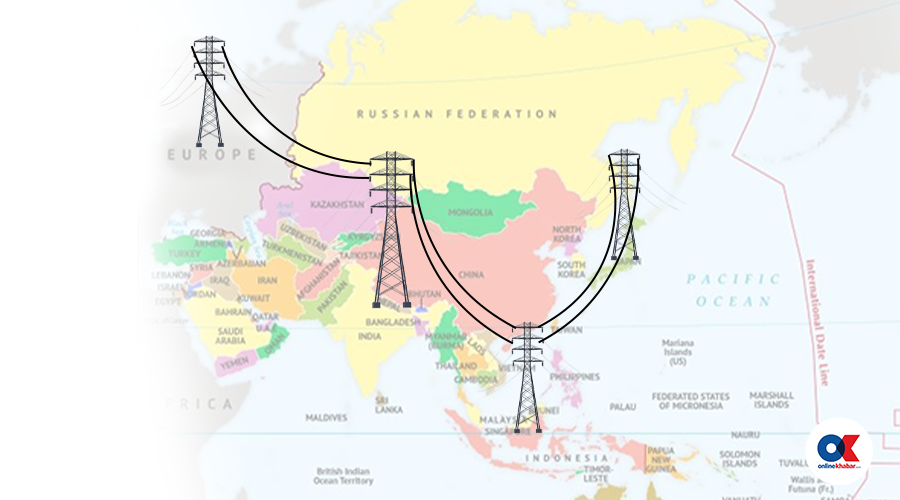
Just as Nepal exports electricity to India, could it also send power to France or Germany? Right now, this may seem like a fantasy to many. But a grand plan is underway across Asia that, if truly implemented, could turn this into reality.
During the 59th Annual Meeting of the Asian Development Bank (ADB), Bank President Masato Kanda made an ambitious announcement that the Pan-Asia Power Grid Initiative (PAGI) aims to connect the entire Asia-Pacific region through transmission lines.
The project’s goal is not only regional connectivity but also to establish transmission links with the Eurozone and African regions through inter-regional lines. Specifically, it aims to make the Asia-Pacific region a hub of renewable energy, ensure energy security through mutual electricity exchange among all nations in the region, and eliminate energy inequality within the region.
The ADB has also made a major announcement to mobilise $50 billion in investment in this sector by 2035. Through this, the project aims to build 22,000 circuit kilometres of new transmission lines and integrate 20,000 megawatts of renewable energy.
Beyond that, the project also sets ambitious social and climate-related goals: expanding electricity access to 200 million people, creating 840,000 new jobs, and reducing carbon emissions in the energy sector by 15 per cent.
So, why did the ADB announce this project now? At Samarkand, Uzbekistan, ADB Senior Director for Energy Priyantha Wijayatunga presented three key reasons:
“First, energy security, the Asia-Pacific region is most affected by the conflict currently happening in West Asia. Second, the unprecedented surge in electricity demand caused by Artificial Intelligence (AI) in recent times. And lastly, the growing challenge posed by climate change.”
However, he also noted the challenges in implementing the project.
“Political will, aligning standards and grid codes among sovereign countries, and mobilising adequate resources are the challenges. But ADB will help as a credible partner to mobilise additional financing for this project,” he says.
Existing progress
Work has already been underway at various levels to integrate the Asia-Pacific region’s energy. For example, the SASEC project is in operation, connecting Sri Lanka, Bhutan, India, Bangladesh, Nepal, and the Maldives, covering internal and regional energy, roads, and other connectivity. Similarly, work is happening through regional and sub-regional forums such as BIMSTEC, SAARC, CAREC, ECO, and ASEAN. Under CAREC, Azerbaijan, China, Georgia, Kazakhstan, Kyrgyzstan, Mongolia, Pakistan, Tajikistan, Turkmenistan, and Uzbekistan are connected. Work on the BIMSTEC Grid Master Plan has also been underway for some time.
ADB studies show that integrating such projects and building a unified energy system would also save significant system costs.
There are many forms of energy production. For example, in South Asia, Bhutan and Nepal have remarkable hydropower potential; India has strong solar and wind energy potential; Bangladesh can benefit from its abundant gas reserves. Nepal, India, and Bangladesh already engage in mutual energy trade.
According to ADB’s internal studies, more integrated electricity trade in South Asia could save approximately $8 billion in overall system costs by 2032. Increasing regional connectivity of clean energy sources can strengthen energy security and address the energy trilemma (security, equity, and sustainability).
Is this truly feasible and beneficial?
Abid Malik, Middle Asia President of Saudi Arabia’s energy company Acwa Power, says he is optimistic about the project:
“Right now, energy production sources are scattered. Tajikistan and Kyrgyzstan are good at hydropower, Uzbekistan is good at thermal and is developing a lot of renewable energy,” says Malik. “Coordination between the geographic location of all these sources and load demand will create synergy. This is exactly the right time to expand cross-border electricity trade and interconnection.”
Mongolia’s Deputy Minister of Economy, Khulun Bat-Erdene, is also optimistic.
“Energy demand in Asia is driven by industrialization. But new technological developments like AI and data centers have taken this demand to another level,” Erdene says.
She believes demand could triple, not just double.
She further adds, “Our region has the greatest potential for renewable energy development, wind energy in the Gobi Desert, solar in Central Asia, and abundant hydropower in Siberia.”
Georgia’s Deputy Minister of Economy Ekaterine Gonjathe said she isn’t entirely sure whether there is room for optimism, but noted that Georgia is fortunate in terms of renewable energy production like hydropower, and that Azerbaijan, Georgia, Turkey and others have already tested export through grids — and those countries have also tested connections toward Europe.
Recalling Georgia’s history of decades-long power cuts after independence from the Soviet Union, she said, energy security and independence have great value. Grid connectivity is not just about electricity; it is also about sovereignty and security.”
Acwa Power’s Malik pointed out that systems like “CASA-1000” and “CAPS” already exist in Central Asia.
“Now there are discussions about bringing electricity from Central Asia through Azerbaijan and Georgia via the Black Sea to Europe. This is the future, and if there is political will, it is possible,” says Malik.
The funding challenge
However, all parties agree that government investment alone will not be enough; half of the $50 billion ADB plans to mobilise must come from outside sources. ADB’s energy director, Wijayatunga, said private investment must be attracted.
“Transmission services must also be viewed as a market. If the market is liberalized and the right pricing is in place, private investors will be attracted,” Wijayatunga says.
Malik argued that the private sector is already working in this field.
“We are building 2,500 km of transmission lines in Uzbekistan. We build those lines, test them, and hand them over to the government. The private sector is more efficient than the government,” he says.
When asked what the next 10 years will look like for this region, Wijayatunga says, “I want to see a grid connection between Southeast Asia and South Asia via Myanmar.”
Mongolia’s Deputy Minister Khulun says, “I want to see Mongolia’s renewable energy connected to China, Japan, and South Korea.”
“I am confident that within 10 years, electricity will flow between Central Asia and Europe through an undersea cable,” says Malik.
Nepal’s position
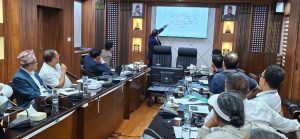
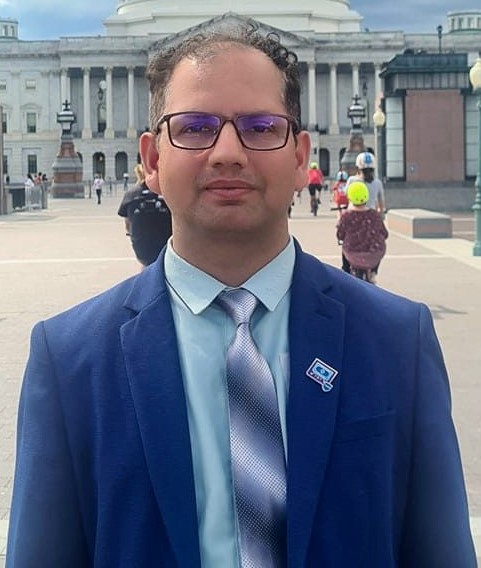
At the ADB Annual Meeting, the head of Nepal’s delegation, Dhaniram Sharma, openly praised ADB President Kanda’s proposed Pan-Asia Grid project. He also urged that Nepal be prioritised as a major clean energy partner when formulating the energy strategy, and stated that Nepal is ready to strengthen the network of renewable and clean energy in the region.
“We are ready for a strong partnership to strengthen the network of renewable and clean energy in this region,” Sharma says.