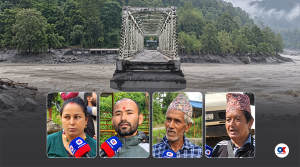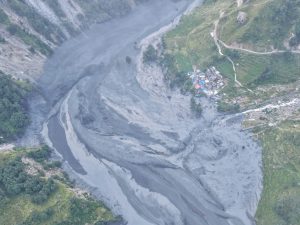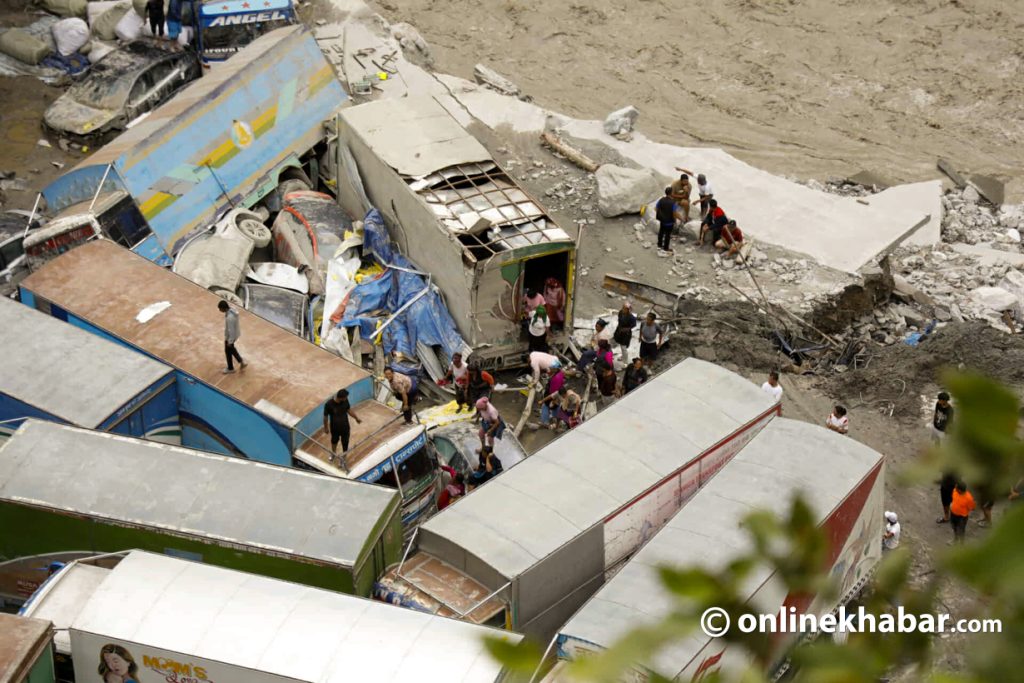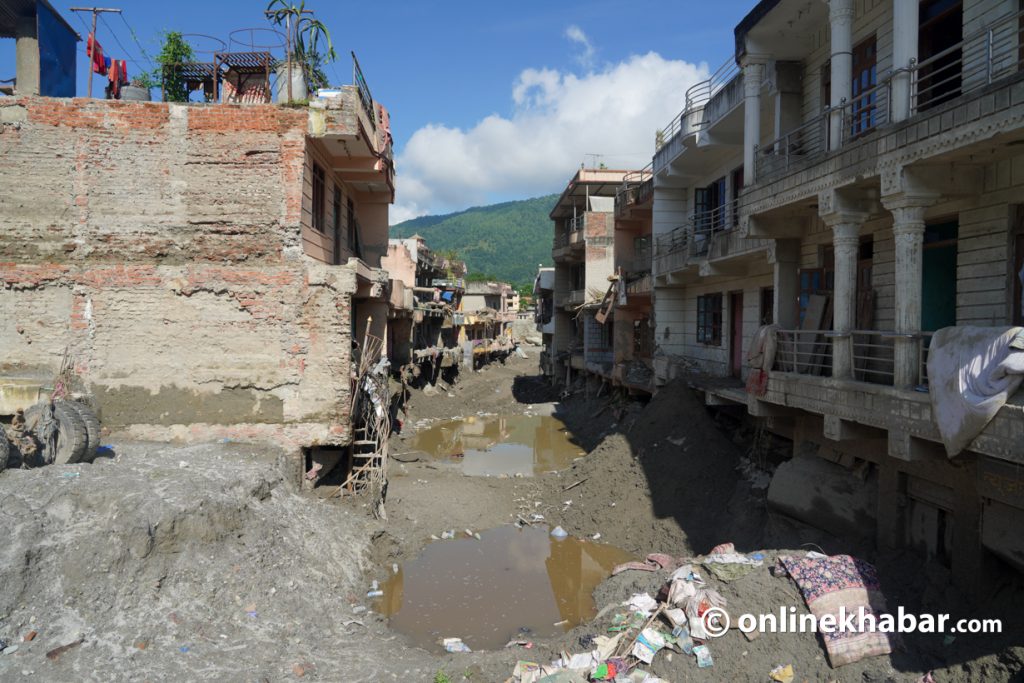


On September 5 and 6, journalists from the United States, the United Kingdom, Russia, India, Pakistan, Singapore, Brazil and other countries travelled to Gyirong in Xizang and entered the core area devastated by the August 26 mudslide. They did not have to imagine what had happened. They saw it.
Wearing a safety helmet at the disaster site, a journalist from the Press Trust of India praised China’s capacity to respond to such crises, noting the large number of professionally trained personnel and specialised rescue equipment deployed there. He paid tribute to the rescuers, saying their extraordinary efforts were deeply moving.
On September 6, foreign journalists also attended a press briefing held by the emergency rescue command in Gyirong County. Officials explained the disaster, rescue operations and reconstruction efforts, and took questions from the media.
This matters because only days earlier, some overseas commentators had already constructed a very different story: China was supposedly “hiding the truth,” restricting information and preventing outsiders from seeing what had happened.
Then the journalists arrived. And so did the facts.
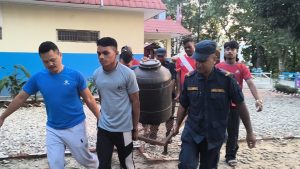
By 6 p.m. on September 5, China had mobilised more than 2,500 rescue personnel, deployed more than 9,000 sets of rescue equipment and conducted more than 1,000 drone sorties. Helicopters, boats, engineering machinery and rescue teams were mobilised in a massive search operation.
Before damaged roads could be reopened, rescuers themselves had to reach the core disaster zone by water, helicopter and mountain detours, including routes requiring more than 12 hours on foot.
Yet according to some keyboard detectives thousands of kilometres away, the mystery was why foreign journalists were not immediately wandering around an unstable Himalayan disaster zone.
Seriously? Gyirong is not a television studio.
This was an active disaster site at high altitude. Roads had been destroyed. Electricity and communications were disrupted. Slopes remained unstable. Landslides, rockfalls, debris deposits and other secondary geological hazards persisted. Weather conditions were difficult and rapidly changing.
Under such circumstances, temporarily restricting access is not evidence of a cover-up.
It is called disaster management.
Would any responsible government knowingly send journalists into an area where rescuers themselves are struggling against broken roads, unstable slopes and continuing geological risks?
Journalists have every right to pursue the truth. Governments have an equally serious obligation not to turn journalists into additional rescue cases.
Once conditions permitted safer access, international journalists entered the disaster area, interviewed people on the ground, observed rescue operations and questioned officials.
That is a rather strange way to “hide” a disaster.
There is another inconvenient fact for the conspiracy theorists.
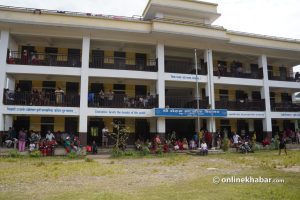
Among those reported missing were 261 foreign nationals from 23 countries. Chinese authorities communicated information through diplomatic channels to relevant foreign embassies and established a 24-hour hotline for families of missing foreign nationals. By September 5, that hotline had handled 509 calls from anxious families.
If the objective were really to “conceal” the disaster from the outside world, informing 23 countries through diplomatic channels and answering hundreds of calls from foreign families would be a remarkably inefficient strategy.
Facts can be terribly uncooperative with a good conspiracy theory.
None of this means China’s disaster response should be placed beyond criticism.
China is a developing country undergoing an extraordinary process of modernisation, and its emergency management system is still evolving. No government is perfect. No emergency response is flawless. No political leader anywhere possesses the power to eliminate natural disasters.
The serious question is whether a country learns from them.
Over the past several decades, China has endured devastating earthquakes, floods, typhoons, landslides and other natural disasters. Its response capacity has evolved through painful experience: professional rescue teams have expanded; helicopters, drones, satellites and specialised engineering equipment are increasingly deployed; geological monitoring and early-warning systems have improved; and coordination among different agencies has become more sophisticated.
The response in Gyirong demonstrates this accumulated capacity.
More importantly, it reflects a principle repeatedly emphasised by President Xi Jinping: “people first, life first.”
Thousands of rescuers have been working in dangerous conditions searching for the missing. Chinese media and officials have repeatedly stressed that China and Nepal must “overcome the difficulties together.”
Why? Because China is not some detached actor standing outside this tragedy. China is itself a victim country.
Chinese citizens have died. Hundreds remain missing. Families are grieving or desperately waiting for news. Roads, communications and infrastructure around an important China-Nepal border crossing have suffered devastating damage.
Yesterday, authorities announced an unbearable toll: 43 people confirmed dead and 519 still missing.
Those are not statistics for a geopolitical debate. They are fathers, mothers, sons, daughters, colleagues and friends.
Nepal, too, has suffered terribly. This was never supposed to be a contest between China and Nepal over who should be blamed. It is a shared Himalayan tragedy demanding a shared response.
And the work will continue long after television cameras leave: searching for the missing, identifying victims, comforting bereaved families, rebuilding homes and infrastructure, restoring the border area, improving geological monitoring, sharing hydrological and meteorological information, and strengthening cross-border disaster prevention. China and Nepal will never stop walking that road together.
Unfortunately, almost every international crisis now attracts the same peculiar army of online conspiracy theorists.
For them, uncertainty means concealment. A damaged communication network becomes “censorship.” A temporarily closed road becomes “secrecy.” Changing casualty figures become evidence of manipulation. A delay in access becomes proof that somebody must be hiding something.
The conclusion always arrives before the evidence. But disasters do not operate according to social-media deadlines.
Bodies have to be recovered. Identities have to be verified. Families have to be notified. Roads have to be cleared. Geological risks have to be assessed. Information changes because rescue operations continue.
Uncertainty is not secrecy. Caution is not censorship. And restricting access to an active disaster zone is not a cover-up.
There is an important distinction here. Questioning governments is journalism. Demanding evidence is journalism. Investigating inconsistencies is journalism. But deciding the answer first and forcing every incomplete fact into a predetermined political narrative is not journalism. It is prejudice wearing a press badge.
There is nothing new under the sun. More than two thousand years ago, Confucius said: “The gentleman is calm and at ease; the petty man is constantly anxious and troubled.” Two millennia later, the observation remains surprisingly relevant.
Some people seem almost disappointed whenever facts refuse to confirm their suspicions about China. But prejudice often begins exactly where knowledge ends, and arrogance rushes in to fill the space.
Today is not the moment for such games. Thousands of families are still waiting.
Chinese and Nepali rescuers and officials will have enormous work ahead of them. The families of victims will need answers and support. Communities will need reconstruction. Scientists and governments will need better cooperation on glacier monitoring, geological hazards, hydrology and cross-border early warning.
Those who genuinely care about the people of China and Nepal should contribute facts, compassion and constructive ideas. Those who prefer geopolitical point-scoring can keep typing. Those who specialise in conspiracy theories can keep guessing. But something has changed. The roads are reopening. The rescue continues. Foreign journalists have reached Gyirong. They have seen the disaster with their own eyes. They have spoken with the people doing the work. And the facts are beginning to speak louder than the rumours. Rumours stop with the wise.