


Arughat, October 13
It was Sunday, the day of Ghatasthapana, the beginning of Dashain. Before the first rooster had crowed, people in Arughat Bazaar were already stirring. Within minutes, the quiet morning gave way to shouting and commotion.
Word had reached the bazaar from Chumchet and Philim that a landslide had blocked the Budhi Gandaki River, raising fears that a sudden release of the trapped water could trigger a devastating flood.
Those who heard the warning hurriedly woke their families and ran towards higher ground, alerting neighbours as they went. Residents on the Gorkha side of Arughat also warned people across the river in Dhading.
Soon, local representatives and police personnel were moving through the market, urging people to evacuate. Residents on the Gorkha side headed towards Tariphant, while those on the Dhading side rushed towards the hills of Salyantar.
Within a short time, the settlements on both sides of the Budhi Gandaki appeared almost deserted. Having witnessed the devastating floods in Rasuwagadhi just a month earlier, residents lost little time in seeking higher ground.
According to Santosh Raj Bajracharya of Arughat Bazaar, people living closer to the landslide had woken up after hearing a sudden rumbling sound and feeling the ground shake during the night.
When the water stopped flowing in the Budhi Gandaki, they fled towards the forested hills and alerted settlements downstream, including Arughat and Soti. News that the river had been blocked spread quickly, giving people time to escape before the flood arrived.
The bridge was there when he left. It was gone when he returned
Suman Gurung, a resident of Arughat in Gorkha, also works as an ambulance driver. Amid the commotion over the approaching flood, he received a call asking him to bring a woman who had recently given birth from Dhadingbesi.
He drove the ambulance across the motorable bridge connecting Gorkha and Dhading and reached Dhadingbesi. By the time he was returning, however, the Budhi Gandaki was in flood.
The flood had washed away the reinforced concrete slab of the bridge’s section on the Gorkha side, leaving part of the crossing destroyed.
Gurung brought the woman to Arughat on a stretcher via the suspension bridge beneath the damaged structure.
“When I crossed to the other side, the bridge was intact. By the time I returned, the flood had washed part of it away,” he said.
Arughat is an old market town and a gateway to northern Gorkha. Tourists travelling towards the upper reaches of the district pass through the settlement along the banks of the Budhi Gandaki.
Roads connect the town to Gorkha’s district headquarters and to Kilometre 12, while a paved road links Dhadingbesi to the area via Salyantar.
The town is also among the major areas that would be affected by the proposed Budhi Gandaki reservoir-based hydropower project. If the project is built, the entire market would be displaced.
On Sunday morning, however, residents had a more immediate concern. Rumours that a landslide had blocked the river upstream and that a sudden outburst could send a flood downstream left communities along the Budhi Gandaki gripped by fear.
A warning from the highlands saved lives
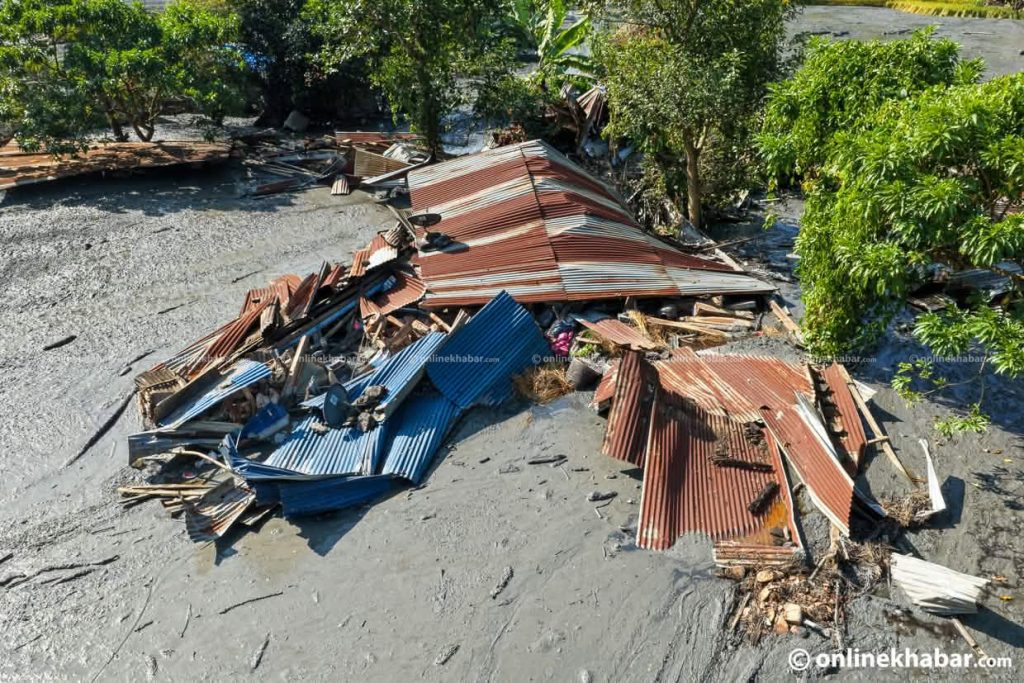
A short walk along the river from Arughat leads to Shanti Bazaar, a small settlement that some people call Shanti Bagar. Despite its name, it was little more than a cluster of closely packed houses with corrugated metal roofs.
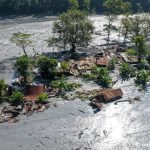
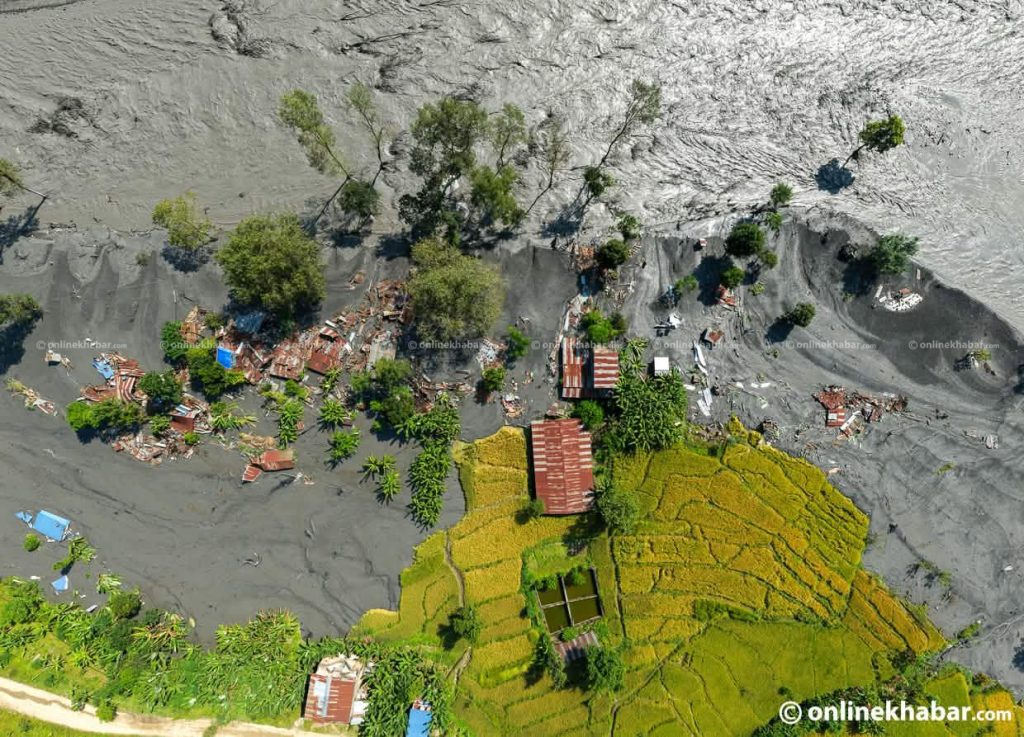
Of the roughly 40 to 42 houses in the settlement, only two remain intact. Residents who received early warnings managed to save themselves, but most were unable to rescue their livestock.
“We received a warning from the upper reaches early in the morning and ran in different directions. Once it became a little brighter, I returned to take out the livestock, but when the flood came at around six, others would not let me go back,” said Dil Kumari Thapa, a resident of Shanti Bazaar.
“The river flooded, then the water receded. Then another flood came. The second one submerged all the houses.”
Residents of Arughat and surrounding areas refer to Chumchet, Chhekampar and neighbouring settlements in upper Gorkha as lek, or the highlands. People from those areas are known locally as lekali.
Warnings from these highland communities reached people downstream before the flood arrived, allowing many to evacuate in time. Most importantly, the warnings helped save lives.
For residents of Shanti Bazaar, however, escaping with their lives came at a devastating cost.
Many families had raised goats, chickens and other livestock, hoping to sell them during Dashain to cover household expenses. The flood buried or swept away their animals, homes and stored grain beneath thick layers of mud and debris.
The survivors were subsequently accommodated at nearby Bhumethan.
Tanka Kumari Thapa, who was moving around the devastated settlement with Dil Kumari, described how residents organised their escape after receiving the warning. The elderly and children were taken to higher ground first, followed by the stronger members of the community.
“We did not let anyone get caught in the flood. A few people managed to save their livestock with great difficulty,” she said.
“Everything else is gone. We have nothing left to cover our food expenses. Dashain is approaching, but we could not save our grain. Everything is buried. We do not even have a patch of land left where we can harvest a handful of paddy.”
A settlement erased by the river
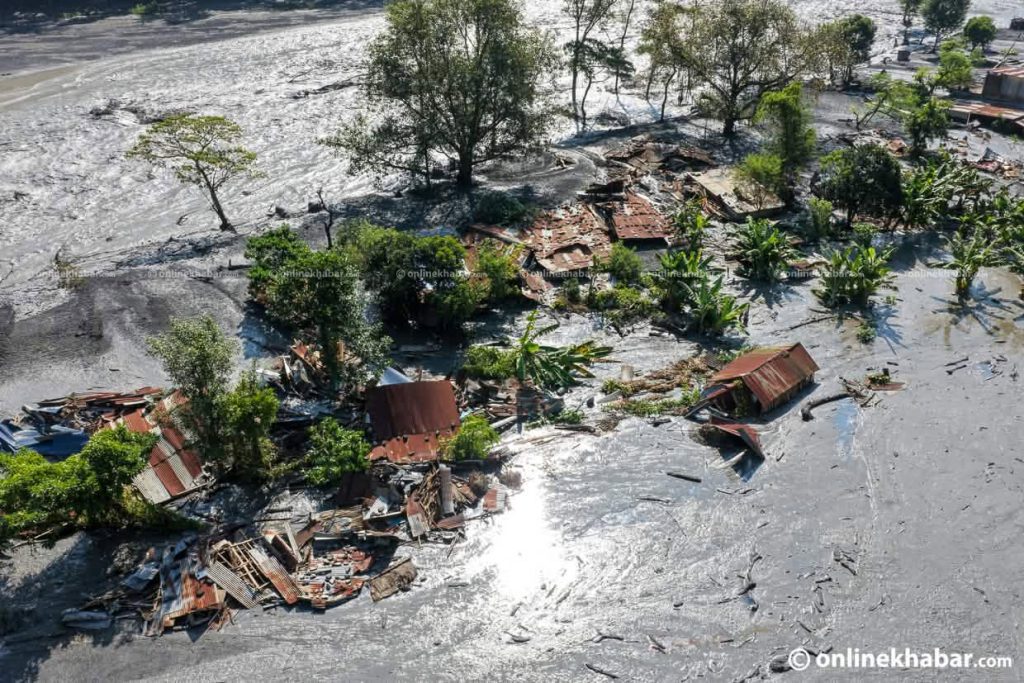
On Monday, when the Onlinekhabar team visited Shanti Bazaar, Buddh Prasad Dhakal, a resident of Ward 7 of Gangajamuna Rural Municipality in Dhading, was on his way to Arughat to attend a wedding invitation. He had stopped at the edge of the settlement to look at the damage.
Dhakal recalled that the area had once been open ground before people from the upper reaches came down and established a settlement.
“When we first saw this place, it was just a field. People from the highlands came down, settled here, and the place came to be known as Shanti Bazaar,” he said, recalling the period around 1995–1997.
“In the past, people travelling on foot would pass through this market. Those going to and from Khaireni (Anbukhaireni) to buy essentials such as salt and oil used to stay here. Later, when a road was built elsewhere, the market declined. Now the flood has buried what remained of it.”
At the nearby Bhumethan plain, preparations were under way to accommodate flood survivors. Excavators were levelling agricultural terraces to create space for temporary shelters, while volunteers distributed cooking utensils, tarpaulins and sacks of rice. Security personnel were coordinating relief distribution.
Among those helping elderly residents organise relief supplies was Hajuri Banjara, a member of the Budhi Gandaki Concern Committee.
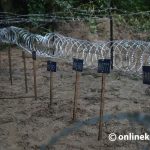
She said the proposed Budhi Gandaki reservoir project would submerge the stretch from Arughat to Arkhet. Technical teams had reportedly marked the projected reservoir boundary with stakes, including near the existing police post at Arkhet.
Residents below the marked boundary would have already left had they received compensation, Banjara said. But many have remained because compensation has not been paid.
According to her, all flood-affected residents living downstream of Arkhet are also likely to be affected by the proposed hydropower project.
The road from Bhumethan towards Arkhet and Soti Bazaar runs close to the river. It was blocked by thick mud deposited by Sunday’s flood. People travelling on foot said they had to wade through mud reaching their knees to get past the affected stretch.
An unusual sound from the river

Dhakal, whose house in Gangajamuna Rural Municipality-7 stands a little above the Budhi Gandaki riverbank, was milking his buffalo in the shed early Sunday morning when he heard an unusual sound coming from the river below.
When he looked, he realised that a major flood was surging downstream.
He said he had not noticed the earlier flooding around 6 am in the upper reaches. But the flood that arrived around 8 am produced a much louder sound, audible even in the higher settlements, and caused extensive destruction.
According to Deputy Superintendent of Police Rajkumar Shrestha, chief of the District Police Office in Gorkha, six people remain missing in the flood. No other human casualties have been reported, he said.
The flood caused the most damage along the Budhi Gandaki at Machhikhola, Dobhan, Salleri, Bagar, the Soti bridge, Shanti Bazaar, the Arughat bridge and the riverbank near Arughat Bazaar on the Dhading side.
The wider riverbed downstream suffered comparatively little damage. However, six suspension bridges and three motorable bridges were damaged.
Traces of thick, dark mud left by the flood were visible on trees and riverbanks at several locations. A layer of dark sediment had accumulated along both sides of the river.
Memories of a similar disaster six decades ago
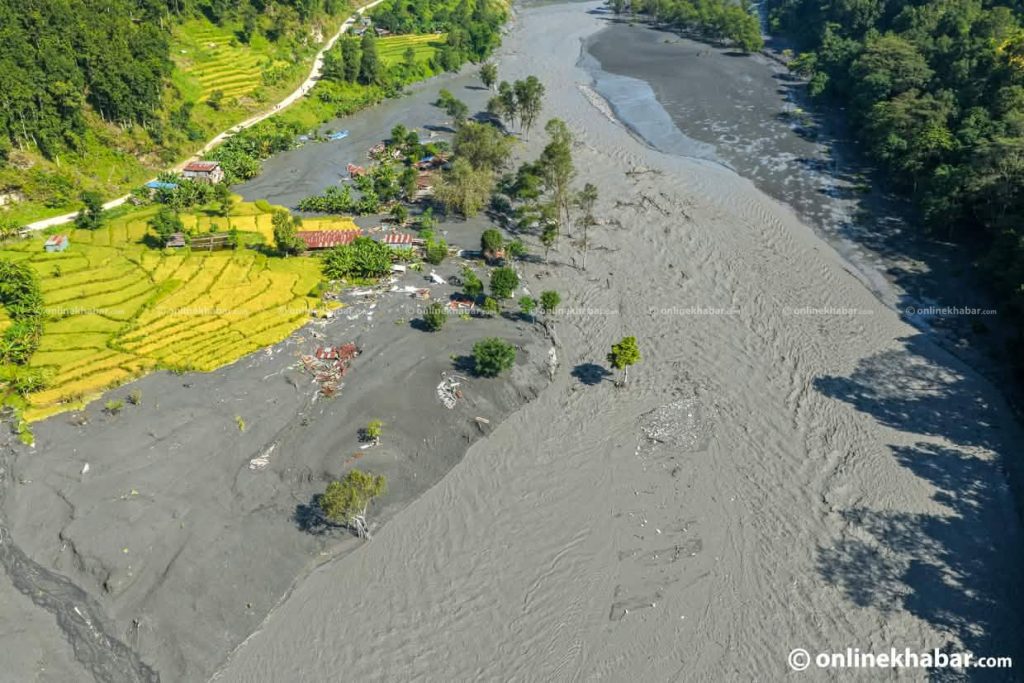
Baburam Dhakal, a 70-year-old resident of Arughat, went to the bridge on Monday morning to inspect the damage. He recalled hearing stories of a similar flood in the Budhi Gandaki when he was a child.
According to him, the river was reportedly blocked for three days by a landslide in the upper highlands in February 1968, before the trapped water eventually broke through.
The incident occurred while a fair was under way in Kashigaun, Gorkha. A landslide upstream blocked the river and held back the water for three days.
Because the water escaped gradually, the resulting flood did not cause extensive damage. Nevertheless, it reportedly swept away part of the market and another small crossing near the suspension bridge downstream.
Remnants of the old bridge’s cables are still visible, while traces of the former lake can reportedly be seen in Kashigaun.
By Monday afternoon, Arughat Bazaar had begun returning to normal. Tourists who had travelled towards upper Gorkha were making their way back, while relief distribution for flood-affected residents was under way.
Technical teams were measuring the damaged section below Arughat’s garden area in preparation for installing a Bailey bridge.
Bajracharya, who had witnessed the initial panic, said the immediate fear of another flood had subsided as the water level fell.
“Now that the water has receded, everyone in Arughat is staying in their own homes. Some people from across the river have gone to stay with relatives,” he said.
“The rural municipality in Dhading is preparing to distribute relief. Rations are also being distributed to affected families here. They are saying a bridge will be built here as well.”