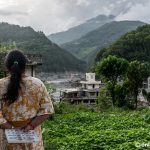


While solving math equations in a Kathmandu classroom, a boy could hardly have imagined that one day he would work in a village far from his own roots, doing work that most people would turn away from as mere garbage. But in a settlement in Dhading, Rahul Bisnukhe, chasing after waste, is sketching a map toward a sustainable future. It marks the start of his business, but he sees it as the result of a consciousness formed far from Kathmandu’s comfortable urban life, in a remote village.
Rahul’s ancestral home is in Jilu, Bhimeshwar Municipality, Dolakha, but he grew up in the lanes of Kathmandu’s Baphal neighbourhood. Raised in a lower-middle-class family, he represents the first generation to receive formal education, something his parents constantly emphasised the importance of.
From math to management
Rahul enjoyed working with numbers, so when he chose management over science after high school, many people asked why. He explains that most of his friends were headed into management, so he followed the same path. After finishing school at Harbour International School in Baphal, he enrolled at Greenfield College (affiliated with Tribhuvan University) to study Social Work and Mass Communication.
There, an orientation talk by teacher Sanjita Thapa Magar on “why social work matters” completely changed his outlook on society.
From Chepang settlements to Humla
Around 2018, during his first year of undergraduate studies, Rahul visited a Chepang settlement in Shaktikhor, Chitwan, for the first time. The local reality was starkly different from what he studied in his Kathmandu classroom. The scarcity and terrain made it hard for him to adjust; he recalls wanting to go straight back home. But once he spoke with the local people and closely observed their hardships and hopes, he realised this was the “real Nepal.”
It was in that Chepang settlement that he learned empathy, the ability to put himself in others’ shoes, a lesson reinforced by his mother’s teaching that life gains meaning only through helping others.
That visit was just a glimpse; it left him hungry to understand Nepal as a whole. Setting a goal of visiting a new, remote place every year, he went on to travel to Syangja, Dolpa, Rukum, and Humla.
In Taksera, Rukum, he stayed with a school friend, Ripendra Ghartee, observing traditional village life, and in Humla’s remote settlements of Chaugad Fya and Syada, he engaged in conversation with local youth and children. He felt that what these regions needed wasn’t sympathy but a sustainable initiative, though he realised he couldn’t do it alone.
From a hackathon to Paramendo Nepal
In December 2021, another turning point arrived. A Makeathon, a competition to solve real-world problems within a set time, was held in Kathmandu. At Impact Hub, Rahul met Bishal Damodar and Isal Tamang from Rigau, Dhading. The pair had brought their village’s problem to the competition: plastic waste. As in much of Nepal, plastic consumption in Rigau was rising with no proper management system; locals either burned it or dumped it in rivers, damaging both the environment and farmland.
Mechanical engineer Sujit Shrestha was also at the forum. Sujit brought technical know-how, Bishal and Isal understood the community, and Rahul brought experience and drive from his social work. Together, the four founded Paramendo Nepal, where Rahul now serves as CEO.
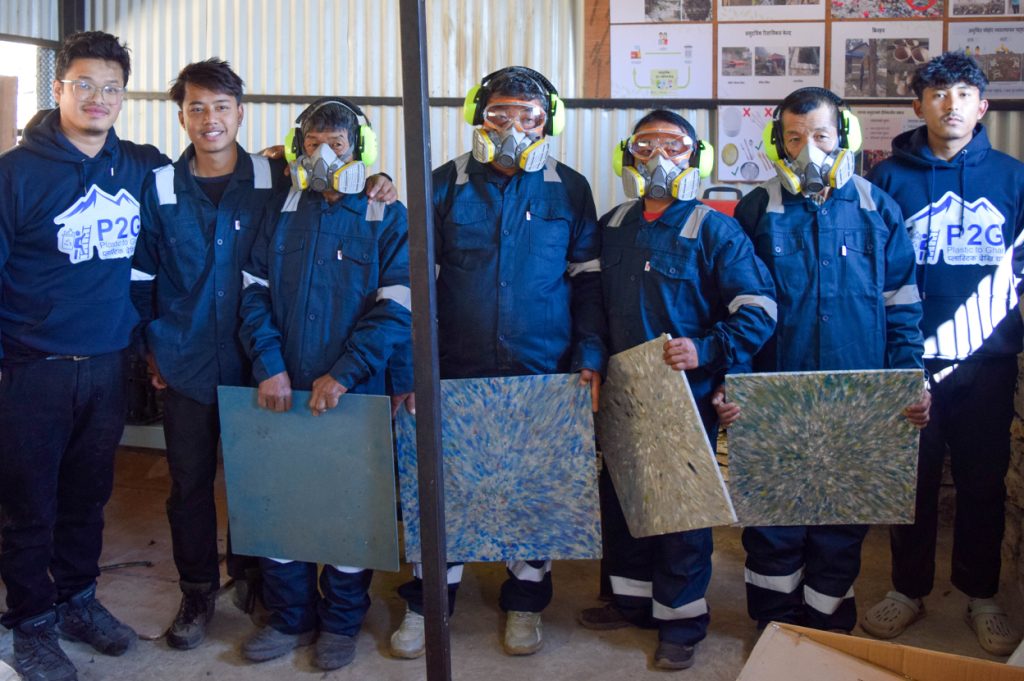
The company mainly processes plastic waste into tiles and boards, though it took them several years to develop the right technology and model.
A “circular economy” that turns waste into value
The team has set up collection and recycling centres in Rigau and Tawal, Dhading. In Rigau, 115 households have been trained to sort their waste; organic waste is managed by households themselves, while non-biodegradable plastic is collected in baskets provided by the company. Twice a week, company staff collect the waste from the village and bring it to the centre; in Tawal, the local municipality’s vehicle handles collection.
They mainly recycle LDPE, HDPE, PP, and multi-layer plastic (MLP). The collected plastic is shredded, cleaned, and then heat-pressed into “plastic boards,” which Rahul says are stronger and more durable than ordinary wood, resistant to insects and water damage. They also make mobile stands, tables, chairs, and other furniture from the material.
Even in a remote place like Rigau, about 40 tonnes of plastic waste are generated annually, and not all of it can be recycled. The team is still searching for new technology to handle the remaining plastic and rubber. International partners, including Cambridge University, Fab Lab Nepal, and Impact Hub, are providing technical support; Cambridge has helped with machinery design and quality, while the local government has provided land for the recycling centre.
The team is currently working on this circular-economy model with funding from the European League Race grant. A circular economy is an economic model in which materials are reused cyclically rather than discarded after a single use. Their goal, in Rahul’s words, is for whatever they use not to end up as waste but instead be transformed back into new products for consumers.
The company now employs 14 people, including its founders. At their office in Jhamsikhel, Kathmandu, the team focuses on research and innovation, with plans to expand the model to other municipalities across Nepal through a franchise-style approach.